Celebrating 25 Years
For 25 years, Living Edge has shaped the Australian design landscape with its curated collection of globally recognised furniture and lighting, leading the way in quality, innovation and sustainability.
Marking a quarter century in business is no mean feat. Living Edge is known for championing original design and setting the standard for thoughtful, sustainable interiors, and continues to inspire some of the country’s most respected architects and interior designers.
“I think what drew me to Living Edge initially is what still draws me to Living Edge,” says Damien Mulvihill of DesignOffice, “and that is the curation of brands and their products: joyful pieces, the functional pieces, the lighting.” Mulvihill, whose studio was founded on the idea of producing timeless, human-focused spaces, finds strong alignment with Living Edge’s values. “We have a really shared approach to the timelessness and the consideration of design that Living Edge has also always had.”
It’s this same dedication to longevity and meaning that resonates with Jonathan Richards of Richards Stanisich. “It comes down to quality build,” he says. “To me that’s the most sustainable way of addressing furniture … that gives clients the ability to see the furniture as almost like an heirloom rather than a transitory piece.” For co-director Kirsten Stanisich, Living Edge helped shift access to world-class design in Australia. “It made those pieces accessible … Living Edge is really about telling the whole story of the culture of all of the pieces.”
Angela Ferguson of Futurespace, a studio known for its neurodiversity-led design approach, appreciates Living Edge’s holistic approach to interior environments. She says, “Living Edge is one of our favourite partners because … there is such a huge amount of choice where we can really specify the products that are going to meet those human needs.” For Ferguson, the brand has been a “real enduring presence throughout my career”.
From the perspective of architects Ingrid Richards and Adrian Spence, of Richards & Spence, the connection between space and furniture is inseparable. “I think Living Edge has an awareness of the symbiosis of architecture and furniture,” says Spence. Richards agrees: “Quality, I think, defines the spirit and essence of Living Edge … If the humans are the final piece of a fit-out, the furniture is part of that. These are the things that you’re sitting on and touching and experiencing, and so things that have a quality and an enduring quality are critically important.”
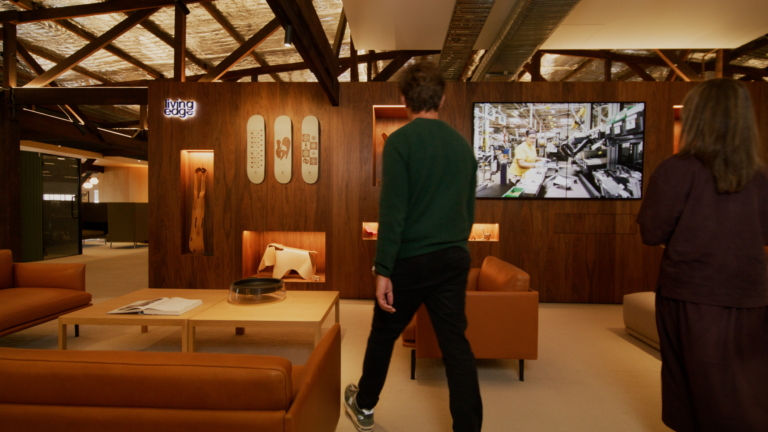
Across showrooms in Sydney, Melbourne, Brisbane and Perth, Living Edge’s dynamic collection is constantly evolving but never loses its clarity. As Todd Hammond of Hammond Studio says, “there was always a strong support for local designers and quality manufacturing … Each time I come in here, it’s something fresh, something new, and that’s exciting.”
Industrial designer David Caon credits the brand’s success to its people and culture. “Living Edge’s spirit is probably defined by the sense of community that it has created over the years. They’ve really created this network of creatives and industry leaders.”
This dynamism and clarity of purpose is central to Living Edge. “It really does start to represent a lifestyle and ambition, a sense of quality,” says Richards. “There are new pieces coming in all the time, but it never is diluted. It doesn’t ever feel like it’s got to a point where there’s confusion about what it stands for, and I actually think that’s a really hard thing to do.”
And as for the next 25 years? “Just keep going,” says Ferguson. “We need collaborators and partners and businesses like Living Edge to keep doing what they’re doing and keep continuing that discussion around the value of design.”