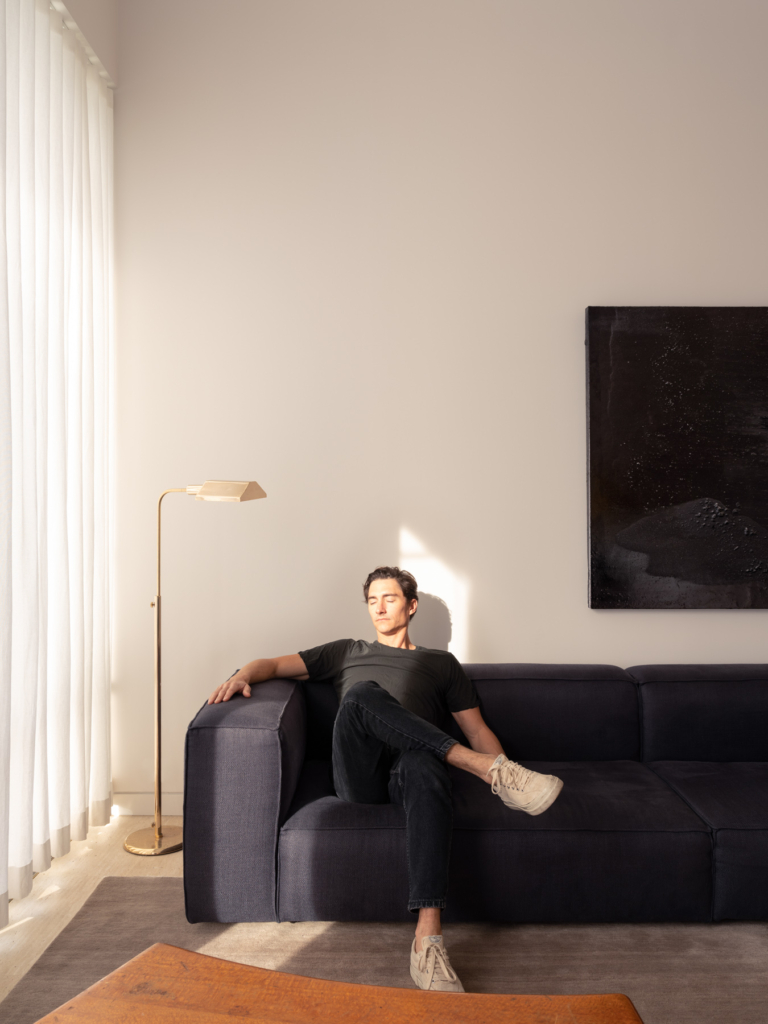
Henry Wilson
Tucked into the backstreets of Sydney’s Darlinghurst, Laneway Glass House isn’t just a clever architectural response to a tight site; it’s an expression of the ethos of owner and industrial designer Henry Wilson.
Designed in a collaboration between owner Henry Wilson and Brad Swartz Architects, the designer’s home quietly subverts the terrace house typology, reconfiguring a modest footprint into something that feels far larger than its 56-square-metre base. There is no wasted gesture; everything is beautifully resolved in the way that only such a personal project can be. Initially conceived as a garage and studio extension at the rear of a narrow Victorian terrace, the project evolved into a complete reworking of the existing home. With Wilson’s desire to create a personal sanctuary, it became something that could act as a buffer between the arterial intensity of Oxford Street and a life lived more slowly.



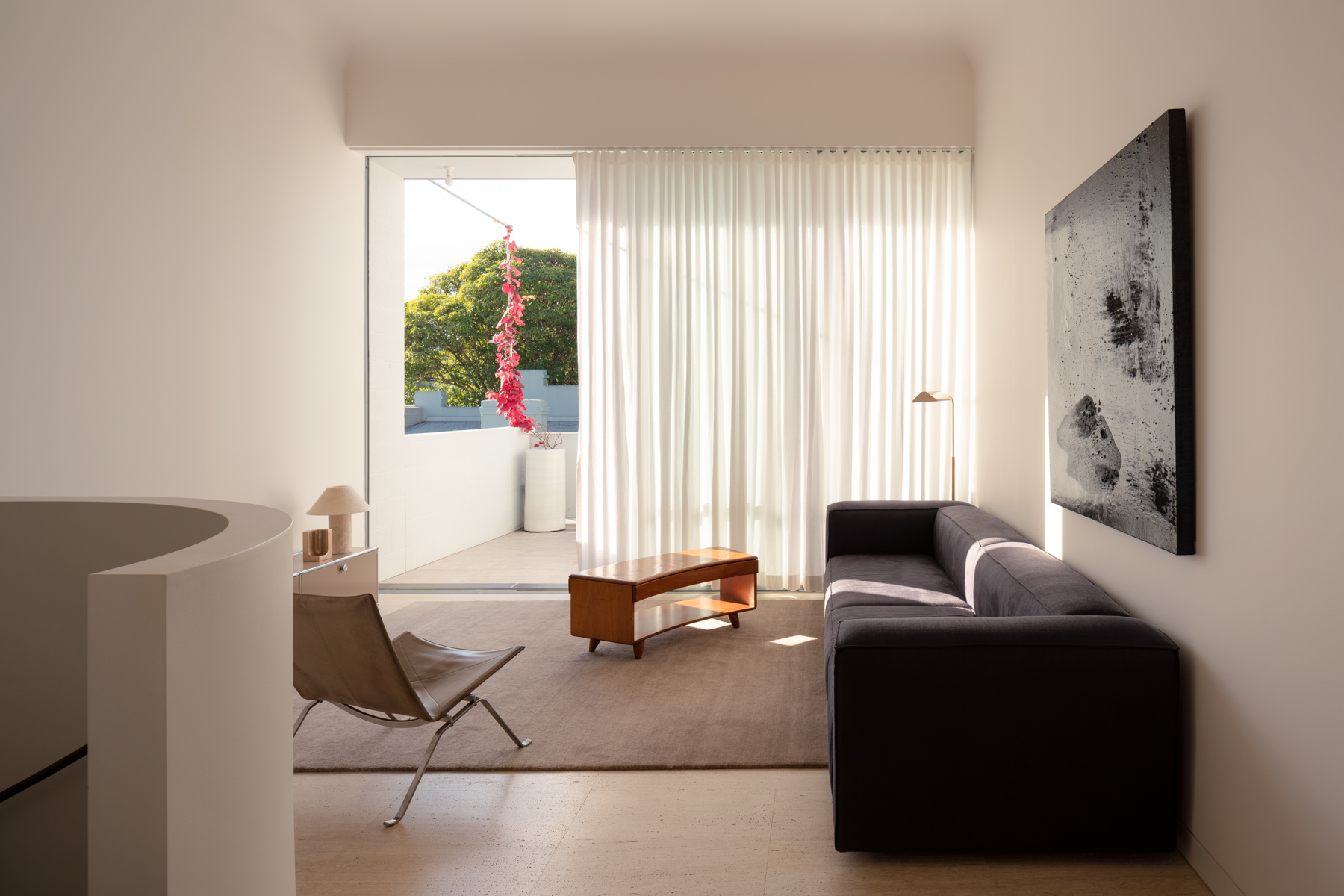
“It’s a pretty full-on area, that part of Darlinghurst,” says Wilson. “There was really nothing from the outside I particularly wanted to embrace apart from the light and location. In many ways, the design is a retreat from its context, one that creates separation from the bustle while fully embracing flexibility, light and material refinement.” The site is typical of the tight urban grain of the area, but with its compact footprint came the opportunity to prototype a new approach to laneway living. The building is 4.7 metres wide and three storeys tall, with a plan that flips the typical terrace arrangement: public living and dining zones are elevated, while private rooms are tucked behind operable partitions and layered circulation spaces.
The name Laneway Glass House gestures at the most conspicuous feature of the home, two facades made entirely from glass blocks. These bookends offer a diffused glow to both the interior and the street, turning the building into a kind of urban lantern after dark. Despite the building’s strong architectural identity, the local council initially resisted the bold use of glass blocks, with a preference for a more conventional facade. But Wilson and Swartz persisted. Though the reference to Pierre Chareau’s Maison de Verre is often made, Wilson and Swartz’s version is less homage and more of a pragmatic type of poetry, finding that the material could address privacy, permeability and structure in one move.
From the outside, Laneway Glass House offers little indication of the spatial clarity that lies within. For a project that feels so distinctly connected to its owner, it is also deeply considerate of whoever might occupy it next. The spatial planning was underscored by Wilson’s belief in flexibility and longevity, which he considers essential when designing for oneself. “I wanted it to be characterful without being too customised for me,” he explains. “I have a strong belief that you have a responsibility when building a new space that it should be something that can be inhabited after the occupant is gone.” This means keeping fixed elements minimal, resisting over-stylisation and designing clean floor plates and spaces that can easily shift to new uses. “Someone else in the future might want to put an office or an art gallery in the garage. There’s a lot of embedded flexibility in the space.” This quality has already been tested in the few years Wilson has called Laneway Glass House home. The ground floor, technically a garage, was originally used as Wilson’s design studio. With its polished concrete slab floor, track lighting and kitchenette, it could operate as a showroom and studio as much as a garage. Since relocating his design practice, Wilson has reconfigured the garage space into a home gym, complete with a sauna.
In a home this compact, planning is everything. One of the major constraints was access, which informed both the floor plan and the construction method. “The site was pretty prescriptive. A narrow rectangular terrace format really dictated the footprint of the house,” says Wilson. Working within these limitations, Brad Swartz Architects developed a spatial strategy that felt open yet efficient, with the circulation especially considered. “Usually, narrow houses become a lot of corridors. We’ve really only got one very small corridor,” says Wilson, “and even the bathroom is part of a room rather than having a corridor run through it.” Swartz and Wilson worked closely to limit wasted movement. On the middle level, what reads initially as one open living zone gradually reveals moments of privacy. Sliding panels open and close to shape the space depending on the mood or time of day. Visitors often experience an ‘a-ha’ moment as they realise how much hidden utility has been packed into the small footprint.

This versatility is paired with an equally focused material palette that defines the home’s atmosphere. Travertine, devoid of juxtaposing grout lines, provides a soft counterpoint across floors, bathroom walls and even the kitchen splashback, creating a continuous, monolithic quality. “The idea was to keep it all one tight material,” says Wilson. “It feels like a single surface that wraps just about the entirety of the space.” Additionally, stainless steel anchors the kitchen, a finish more commonly found in commercial environments, but here it reads as bold and built for use.
The spiral stair is the backbone of the plan, threading the three levels together with only two square metres of floor area dedicated to cross-level movement. It is one of the more indulgent moments in the home, intended as a steel piece but eventually realised in cast concrete. “That was probably one of the larger extravagances,” says Wilson, “but it was worth it. It turned out to be such a defining part of the house both functionally and aesthetically.” Another surprising feature has become one of his favourite parts of the home. “It’s a pretty small comfort, but I’m glad I put in heated floors when I had the chance,” Wilson says, with a laugh. “It wasn’t very expensive, but it’s a really nice thing to have in winter.”
Laneway Glass House was never imagined as a forever home. It reflects a particular moment in Wilson’s life: an inner-city address close to work, compact in scale and adaptable to shifting uses. As an industrial designer, Wilson is known for paring things back to their essential forms, and that ethos permeates every decision here. Yet in its restraint, it gestures toward something more enduring. In a suburb where space is scarce and heritage is often erased, Laneway Glass House offers a surprising alternative – one that points, gently but clearly, to a better way of city living.
Architecture and interior design by Brad Swartz Architects. Build by Mobius Build.
Joinery by Ethan James & Co. Door hardware and lighting by Studio Henry Wilson.


