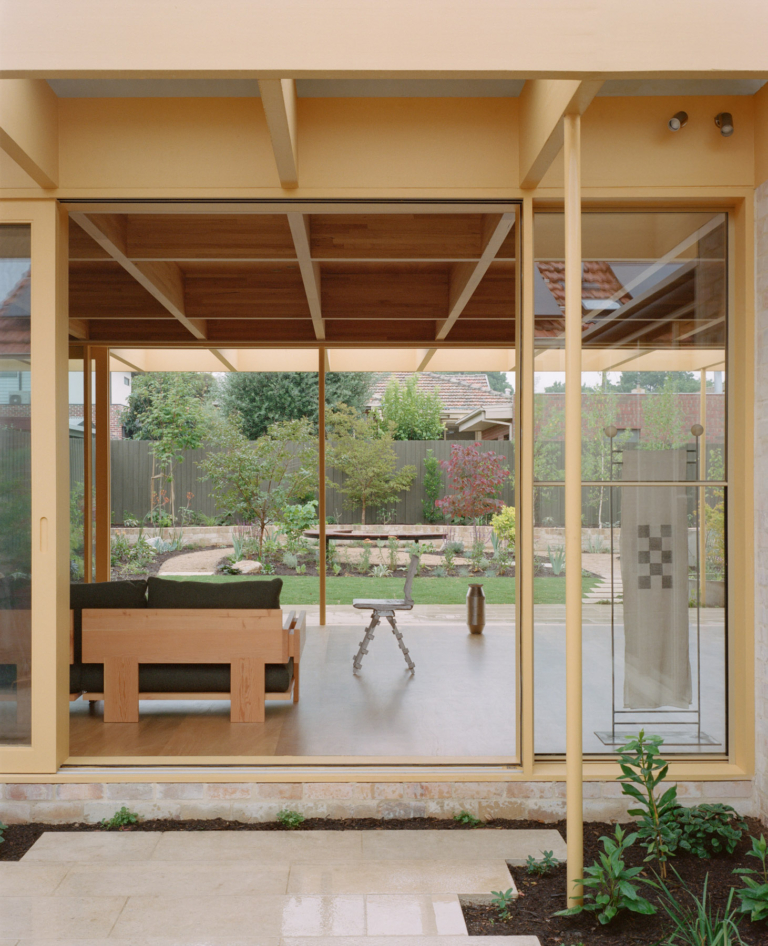
Olive Cooke and Henry Tervenski
The family home of designer Olive Cooke and builder Henry Tervenski drew inspiration from the craftsmanship and quietude of Scandinavian and Japanese design to become a detail-rich residence befitting its rural Australian context.
Ewingsdale, situated where the Byron Bay Road diverges from the Pacific Highway in New South Wales’ Northern Rivers, is characterised by fig trees, rolling farmland and an enduring sense of community. Amid this undulating landscape, animated by the shadowy passage of clouds moving across iridescent swathes of green, Field House assumes an abiding architectural rigour. Its barn typology is freighted by a design language that is softly primal and connected to its site through orientation, fenestration and dissolutions between inside and out.

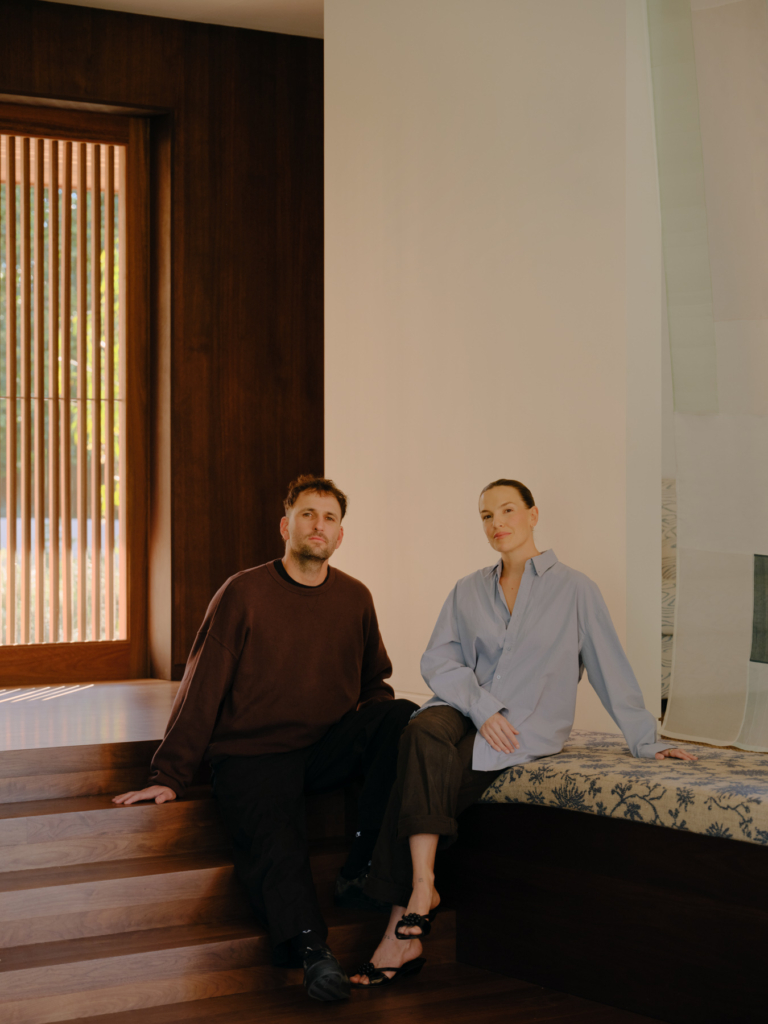


Designed by Fraser Mudge Architects, the home is anchored by the interiors of Olive Cooke and construction principles of Henry Tervenski, owner of Morada Build. This is the fourth project that Cooke and Tervenski have completed together and marks the home where they started a family. Their experience working together on residential projects “started as us building our first home, and it naturally became more personal as we focused on the interiors, turning it from a simple space into a reflection of who we are,” says Tervenski. This sentiment is reflected in Field House, where a split-level, T-shaped floor plan includes an anthology of intentionally crafted moments. Located on a 4,000- square-metre site, the home leverages design to foster the lifestyle of Cooke, Tervenski and their baby, Paloma.
Around the perimeter, connections have been carved out between the home and its landscape, creating a seamless dialogue that permeates how they live. Every room features a fixed-glass panel with an external slider, and every inhabitable inch offers sightlines into the garden, creating a botanical layer that is as much an element of the interior as it is on the exterior.
“The design is simple yet refined, inspired by rural Australian barn typologies and homesteads.”
After the home’s completion, the couple relished waking up to see the sun scorching a margin where sky and land meet. As the sun rose over the surrounding landscape, pool and gardens – its rays sliding across integrated walnut joinery, walnut floors and sisal floorcoverings – the warmth seemed to connect the inhabitants and the environment they have helped to shape. “In winter, the morning sun comes streaming through, and it’s beautiful to be in a place where you see the distinction of the seasons,” shares Cooke.
Intended to appear as entrenched in the landscape as possible, Field House is uniformly clad in spotted gum battens. This cladding lends a stillness “often associated with Japanese and Scandinavian aesthetics – design languages that share a respect for nature, a sensitivity to light and a dedication to craft. These pillars similarly distinguish Field House’s construction, making it a place of effortless sanctuary. “The design is simple yet refined, inspired by rural Australian barn typologies and homesteads,” says architect Fraser Mudge. “There’s a focus on economical construction that Morada has efficiently executed to yield a dwelling that strikes a balance between practicality and subtle aesthetic references.”


A long covered walkway extends across the front of the house, artfully simple in its appearance despite the complexity of its construction, which conceals box gutters and also balances the shifting visual qualities of the natural materials with edited precision. The walkway gradually reveals access to the interior through a large sliding panel that mediates openness and seclusion. Crossing the threshold, guests emerge into the horizontal axis of the T-shaped plan, with children’s and guest bedrooms extending from a hallway to the left, the main bedroom wing to the right and the expansive heart of the home – its living, kitchen and dining zone – unfolding outwards down three wide steps.
The ceiling line has been maintained despite the changing floor levels, creating a void to three metres in the recessed open-plan areas. The east-facing bedrooms capitalise on the morning sunlight and distant views of Cape Byron. These rooms assume a more immersive ambience, illustrating a balance between architectural clarity and a poetic interaction with nature.
The pavilion-style living spaces, set along the T-shape’s vertical axis, are orientated to optimise comfort, with northern exposure in winter and southern protection in summer. Precise lines and uncluttered spaces develop an agile yet logical functionality, delineated by a monolithic stainless-steel kitchen island and a central feature fireplace that is wrapped in a grass wallpaper. The design language is meticulous yet it never compromises the overarching relaxed feel of Field House. The kitchen sink is formed from folds in the steel sheet of the benchtop, as is the stainless-steel joinery extending across the kitchen’s back wall. The material’s lustre imparts a softness alongside its practicality, as it shapes places for using and storing the paraphernalia of a well-used family kitchen. Pocket bi-fold doors can be drawn closed, integrating into joinery on either side and laminated in a shade reminiscent of clay.
Details throughout the home reveal themselves slowly, with an edited curation of architectural hardware, stone and lighting emerging as touchpoints that lean into craft. Cooke’s eye for design and her understanding of the impact of relatively small pieces is evident in her tendency towards subtlety, singularity and impermanence. “There’s so much you can do to a space’s visual language without making massive design decisions,” she explains. Acrylic and nickel kitchen hardware, mid-century pendants, ceramic mosaic tiles, walnut bath surrounds and origami-esque bathroom sinks designed by Cooke, along with the visual drama of Artedomus stone – evocative of nature’s theatricality – are matched by detail-driven construction work.




This approach results in outcomes such as the timber-framed louvres and ventilation panels in the main ensuite, which nod to both a Swedish sauna and a Japanese bathhouse. It is also seen in the timber ledge recessed into the kitchen sink’s cavity to ensure the bench remains seamless, in the slight elevation of the main bed that gives it the illusion of floating, and in myriad other ways that are felt rather than seen.
The couple have tangibly channelled their personal and professional lives into Field House. Through this extension of their own experiences, they have realised a home that engages on a sensory level, a place that carries story and time. “Looking out into the greenery, waking up with the sun and being surrounded by nature makes you feel incredibly happy and grateful, almost like it doesn’t even seem real that this is actually your home,” says Tervenski. “The natural materials create a warm, inviting atmosphere that immediately conjures the feeling of home. Being in such a beautiful and peaceful place constantly reminds us of how fortunate we are to have this space to call our own.”
Driven by design done so well that it becomes invisible and rooted in organic rhythms – the rising sun marking new beginnings, the distant ocean offering guidance, as well as the enduring landscape providing stability – Field House embodies a delicate balance between humanity and nature. The design incites curiosity and touch while celebrating the passage of time and the home’s context, shaping a place that is deliberately unfettered. The result is an abiding testament to the imperfect realities of cloudy days, clutter, the cocoonlike sanctuary where a newborn sleeps and those tiny details – the joy of opening a wardrobe door to find the interior clad in colour – that gently bring joy across the expanse of every day.
Architecture by Fraser Mudge Architects. Interior design by Olive Cooke. Build by Morada Build. Landscape design by Cooke Landscape Architecture. Engineering by Westera Partners. Stone and tiles by Artedomus. Appliances by Miele. Tapware by Astra Walker. Laminate surfaces by Laminex.