Richards Stanisich
For more than 20 years, architects and interior designers Jonathan Richards and Kirsten Stanisich have blended tonal understanding, heritage respect and impeccable craft in their tailored, highly covetable work.
Along Sydney’s coastal walk from Bondi to Coogee, modest interwar bungalows are being replaced by monumental concrete bunkers, in among apartment blocks of mostly dubious character. On the South Bondi escarpment, the recently completed Headland House by Richards Stanisich flips the script, converting an Art Deco apartment block into a family villa that could just as easily be at home along the Aegean or the Costa Brava.

The clients could have gone either way: demolish and rebuild – probably the cheaper option – or retain and adapt. They chose the latter, to do something beyond the predictable overexposed mansion with full-bleed glass expanses. Richards Stanisich retained and restored the curved brick shell and gave the building a new street entry, and strategically inserted porthole windows, north-facing balconies and a broad terrace. The building’s original curves are echoed inside, with coved and vaulted ceilings and a sweeping whitewashed staircase. Across the three levels, each area has its own colour signature and architectural elements. The tactile material palette includes floors of terracotta, timber and limestone, and glazed handmade ceramics – a particular passion of the clients – in watery greens, carmine red, azure blue and every shade in between.
“The clients love colour and sculptural form and they wanted us to bring some of that into the space,” explains Jonathan Richards. The Sydney firm’s approach to this reclamation, with its richly detailed interiors, explains the success of a practice that is established but feels like it’s still emerging. Its principals, Richards and Kirsten Stanisich – both are architects and interior designers – were previously key creatives at SJB Interiors, working across hospitality, commercial and residential design.


The portfolio of Richards Stanisich is nothing if not diverse. For fine jeweller Sarah & Sebastian’s flagship boutique in Melbourne, the practice explored the materiality of elements – including burnished and reflective metals, and ribbed glass – and a colour palette drawn from deep-sea kelp forests. The interior delivers the brand’s promised ‘immersive experience’ in a futuristic environment that embodies the alchemy of the jeweller’s art.
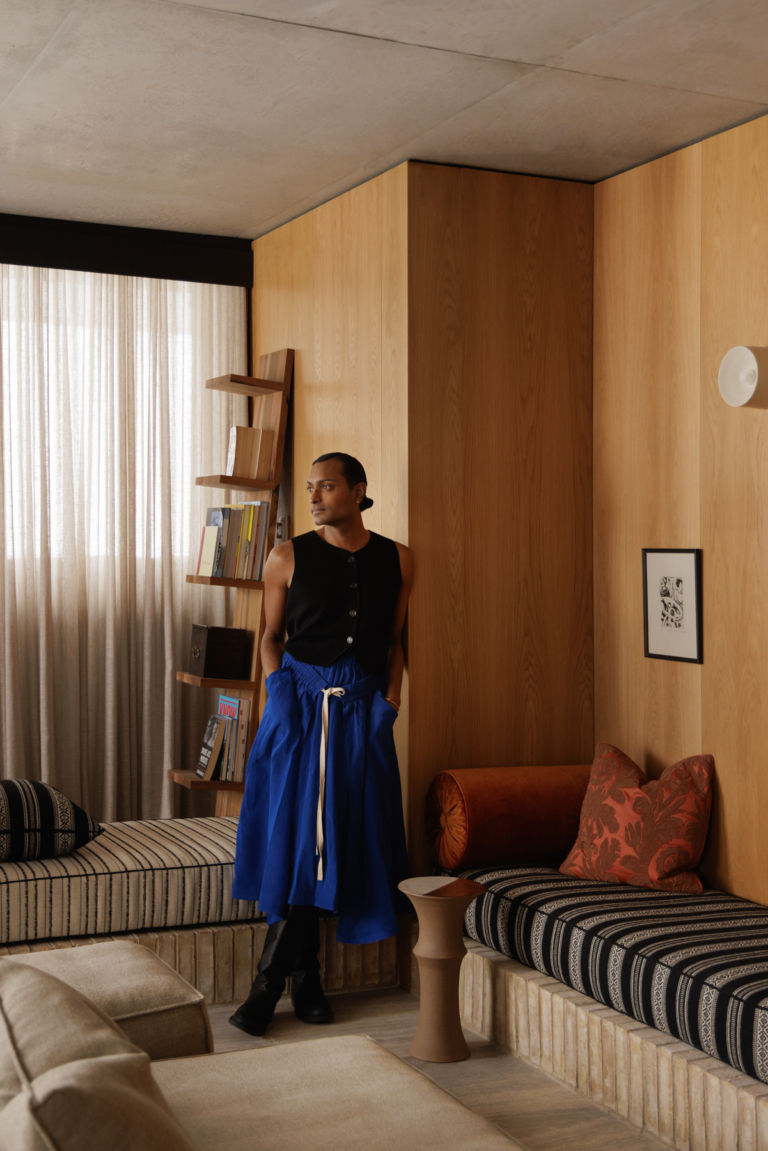
In one of Sydney’s most cloistered eastern suburbs, the Woollahra Hotel was reborn in 2021 after the studio renewed the interiors of the iconic Art Deco corner pub. This is the type of refurbishment that Sydney has often gotten wrong – overembellishing in excess. Understanding the original design and colour code is half the job of renewal; sometimes one needn’t look further than the luscious caramel and brandy tones of terrazzo, timber and tile. The project scooped the awards pool in 2022, in interiors, commercial and hospitality design categories.




Across town, Richards Stanisich restored and repurposed an historic Chippendale brick warehouse as the new headquarters of fashion house Oroton. Before the client purchased the building, Richards Stanisich was asked to advise on its potential.
“We loved the building from the outset,” says Richards. “Originally, we had some grandiose plans to open the whole thing up inside, but the more time we spent there, [the more] we saw its inherent charm. Then it became about stripping out all the extraneous stuff and seeing what this warehouse was made of, then being quite gentle about what we put back in.”


The team exposed original brick walls, hardwood frames and flooring and arranged spaces in a hierarchy over three levels, with design studios higher up into the light. “The spaces are beautifully connected, with sightlines between areas that give a sense of the whole and its individual components. It’s quite cinematic. I feel like it would make a great movie set for a film about the rag trade,” says Stanisich.
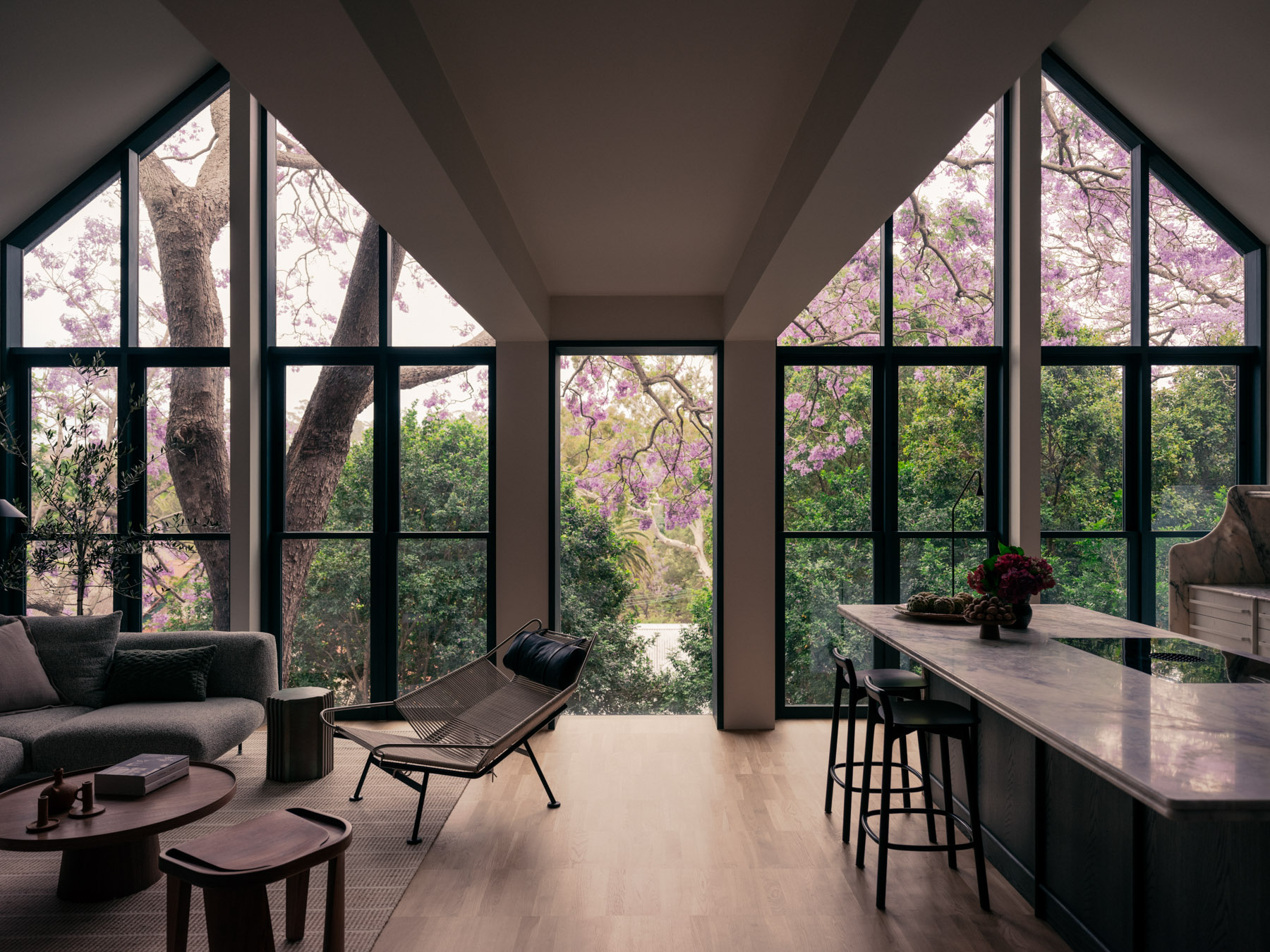
Still in Sydney’s Inner West, the duo’s Jacaranda House was a labour of loving reclamation. The modest Edwardian bungalow with a 1970s rear addition “was badly built, but kind of charming, too,” says Stanisich. “It would have been far easier to demolish and rebuild, but the clients had a small budget, so we had to work out what we could salvage and then make strategic decisions about what was added.” The reworking includes a double-vaulted roofline at the rear to retain an essence of its prior story. The new glazed rear addition is constructed in rot-resistant Accoya wood, stained a teal colour as a contrast to the mauve of the jacaranda tree it frames.


For Vaucluse Residence, Richards Stanisich was not the clients’ first choice of architect. Plans had been drawn for a statement house replacing an unremarkable mock Tudor, “but the clients came and asked us if we thought we could do something interesting with it – and we did,” says Richards. The ground floor was opened up extensively with glazing to lighten the base and improve connections to the garden.
The original roof pitch was retained, but materials changed to blue slate with copper detailing. Inside, the palette is rich – flagstone flooring, hardwood-lined ceilings, wallpaper and brushed-velvet panelling. The jewel in the crown is a fully upholstered conversation pit in the attic, where a window looks directly out to Sydney Harbour.
Approaching architecture from the interiors out has opened up the field of projects that increasingly combine restoration and reuse. On the South Coast of New South Wales, the revision of the 1980s, red-brick Motel Molly was achieved with interventions that charmingly elevate the accommodation. The building was bagged and painted, and the original kidneyshaped pool refinished, with a beautifully tiled outdoor shower, sunlounges and landscaping adding to the atmospherics. “It’s a really sweet little project. The client initially wanted to rename it – they didn’t like the ‘motel’ moniker. But we convinced them that part of its charm was simply being a small motel,” says Stanisich.
Both Richards and Stanisich say their starting point and priority in every project is how the interiors feel and flow. “We don’t seek the big architectural gesture on the street, but we quite like making a whole building work in a different way,” says Richards. The pair have come to architecture via different paths but share a shorthand approach, having worked together for more than two decades. “I’ve come to realise Kirsten and I have a yin and yang approach to design. When a new project comes in, I probably – more conventionally – look at it from a very big scale and work down to a smaller scale, while Kirsten starts from the granular and works her way out. It’s a nice way of working together, because you’re both thinking big and small.”
Stanisich joined SJB in 1996 after having studied architecture at the University of Melbourne in her hometown. It wasn’t a childhood steeped in design but there was craft in her family. “Making things, sewing things. That was a big part of my home life,” she recalls. “I dissed it as a teenager, but it very much helped guide me into studying architecture. And I definitely feel myself leaning more into that as I get older – the crafted essence of how things are made. Jon says that I start a project at the small details instead of the big picture, and that’s probably where it comes from.”
Richards had a happy childhood in Sydney’s North Ryde. “Mum and Dad wouldn’t mind me saying that there was no great design in our house. But I really liked art: I could draw and paint and probably aspired to be an artist. I also liked maths, was good academically and quite pragmatic. I realised – with some parental coercion – that art would be hard to make a living from. Without knowing too much about them, I thought architecture and design might be somewhere I could apply my rational and artistic sides.”


It all began for Richards at Middle Bar in Kinselas in Darlinghurst during Sydney’s post-2000 Olympics euphoria. Middle Bar was a hot new cocktail spot with a VIP view over Taylor Square. It was designed by architecture’s then-new kids on the block, SJB, and it said everything about that time. “I’d had a night out there with friends and loved the place so much, I decided to track down the designers and ask for a job.” He joined SJB and worked closely with Stanisich for more than 15 years, building one of the country’s most successful commercial interiors practices.
In 2018, they decided the time had come to leave and rebrand as Richards Stanisich and really put their stamp on the industry. The year of their launch also coincided with an invitation to the National Gallery of Victoria’s Rigg Design Prize. The theme was Domestic Living and their response was an homage to the handmade, entitled ‘Our Natural Needs in a Digital World’. A tableaux of contrasting elements – from ruched natural linen to neon lights, pottery and domestic objects – their installation was an invitation to feel the intangible yet tactile essence of comfort.
In a profession that’s often reduced to taste, this focus on the natural and the man-made became their manifesto and continues to drive their work today. Currently, the pair are working alongside Yabu Pushelberg on St John’s Wood Square in London, a development of 100 or so townhouses in a new precinct that repurposes an old military barracks. The owner is a former client for whom Richards Stanisich had designed a house in Point Piper.
Working across different typologies – commercial, retail, hospitality, residential – what is the secret to designing projects that are both ‘of the moment’ and above fashion? “Not looking too much at other projects and thinking about how you feel when you go into spaces,” says Stanisich. “What you design is about your feeling when you go into a space rather than visual references. Imagery is everywhere; you have to consciously shut it out.”