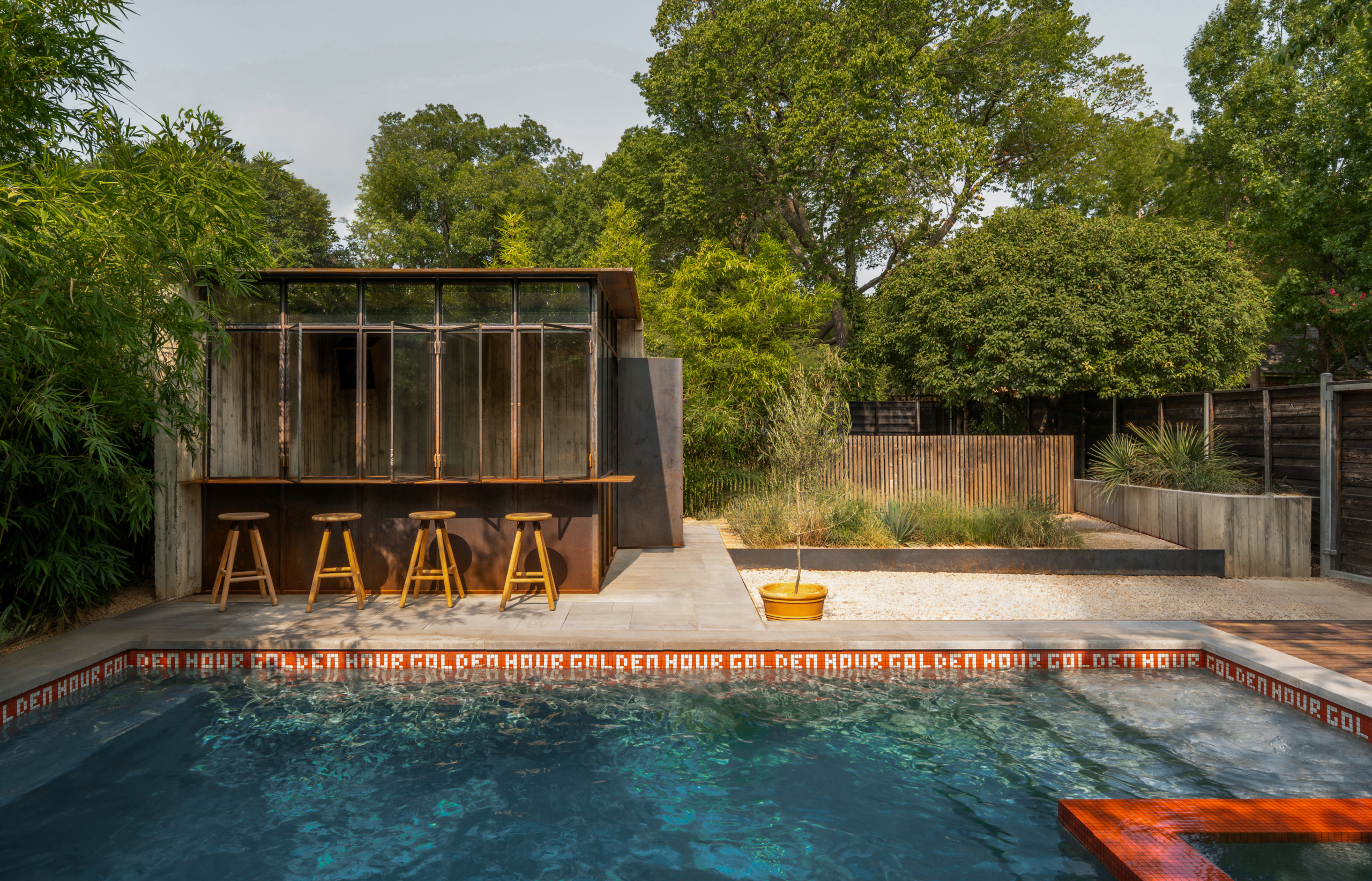
Dallas Pool House
Golden Hour Pools brings its -led approach to Dallas with a working Pool House where architecture, landscape and water are experienced at full scale.
For Golden Hour Pools, the act of building a swimming pool begins with a deceptively simple proposition: make the process easier to understand. Founded in Austin in 2023 by a team of designers and engineers, the Texas-based company has set out to rethink an industry often defined by open-ended customisation, opaque pricing and lengthy construction. Its response is closer to product design than conventional contracting – a refined system of pool sizes, materials and options, delivered through a clearly staged process.
That thinking finds its most complete physical expression in the Dallas Pool House, Golden Hour’s second such space and a working showroom in the Bishop Arts District. Conceived simultaneously as a client-facing environment and an active design studio, the project makes the company’s operating philosophy legible through architecture, landscape and water. Rather than asking prospective clients to piece together samples, drawings and specifications, the Pool House presents the company’s ideas at full scale.
“Most showrooms ask people to imagine the finished product from samples and renderings,” says Alex Szpakowski, the company’s co-founder and CEO. “We wanted to build the experience itself. The Dallas Pool House lets people spend time in a real Golden Hour environment and understand how the pool, architecture, materials and landscape are meant to work together.”
At the centre of the property is a 4.5- x 7.5-metre (15- x 25-foot) concrete pool with an integrated spa. Around the pool, drought-tolerant planting situates the project firmly within its Texas setting, while a compact cabana gives the site an architectural anchor.
The cabana developed from the footprint of an existing shed’s slab, turning an inherited constraint into the organising logic of the new structure. Three-metre (10-foot) board-formed concrete walls are paired with custom steel windows and doors, a sheet-steel roof and raw steel surfaces intended to patina with time. A pass-through counter links the interior workspace with the pool deck; behind the primary wall, a bath and outdoor shower are quietly concealed. “Every decision here is considered,” Szpakowski says. “The space feels elevated, but it still feels like a place where people could swim, work and spend the afternoon.”
That balance is central to Golden Hour’s broader proposition. The company currently offers three core pool sizes – Mini, Classic and Grand – and frames construction as a sequence of clear stages. The aim is not to remove design from the process but to focus it: fewer variables allow materials, proportions, pricing and construction to be resolved with greater consistency. In the Dallas Pool House, clients can experience those decisions in person before committing them to their own backyard, while Golden Hour can use the space to test details and materials before carrying them into future projects.
The Pool House also extends beyond the conventional boundaries of a showroom. Golden Hour describes it as a design studio and neighbourhood gathering place, periodically activated through open swims, dinners, small events and collaborations associated with its community series. In this sense, the company’s ambitions are as much cultural as commercial: the pool is treated not simply as an object to be installed, but as a framework for how people gather.
Austin remains home to Golden Hour’s headquarters and first Pool House, with Dallas marking the second iteration and Houston to follow. Each gives the company a tangible presence while reinforcing the same underlying idea – that the experience of buying, building and living with a pool can be as considered as the object itself.


