
Apartment on the Loop
Billy Maynard Architects’ airy and creative renovation of an Art Deco apartment in Sydney’s Elizabeth Bay transforms the space into a playful, light-filled family home that honours the original building’s spirit.
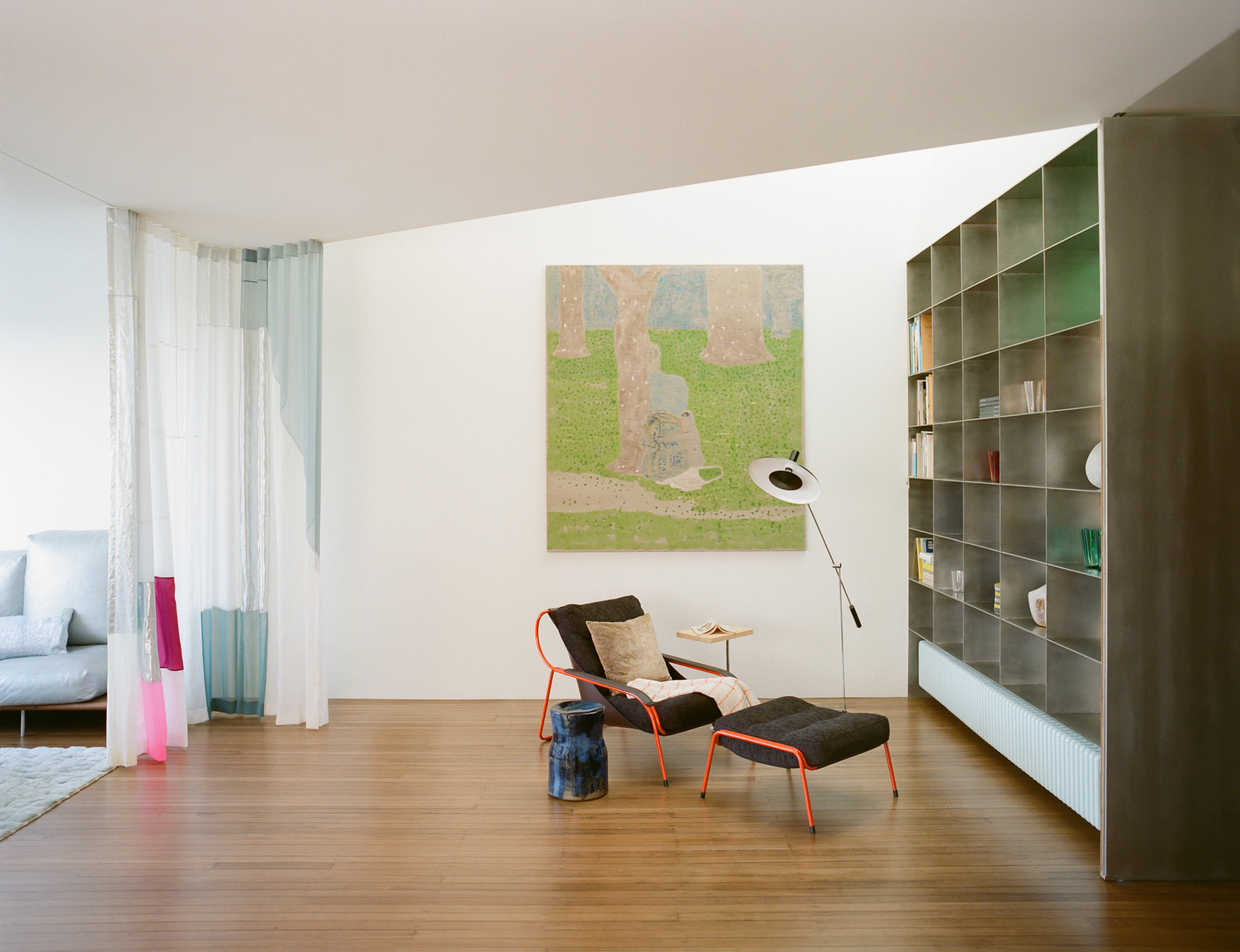
When Billy Maynard pulled up the decades-old carpet of Apartment on the Loop, he found a renovator’s dream: the original tallowwood floorboards underneath. “I think they’re really beautiful,” says the architect, “almost like Donald Judd’s floor in his studio. There’s something kind of otherworldly about them.” While learning that many of the neighbours had replaced the narrow timber boards, Maynard knew right away that they would be central to the home’s character. “They just have so much soul.”

The reworked layout now centres around an open-plan kitchen, dining and living area that takes in expansive views of the harbour and Rushcutters Bay Park.

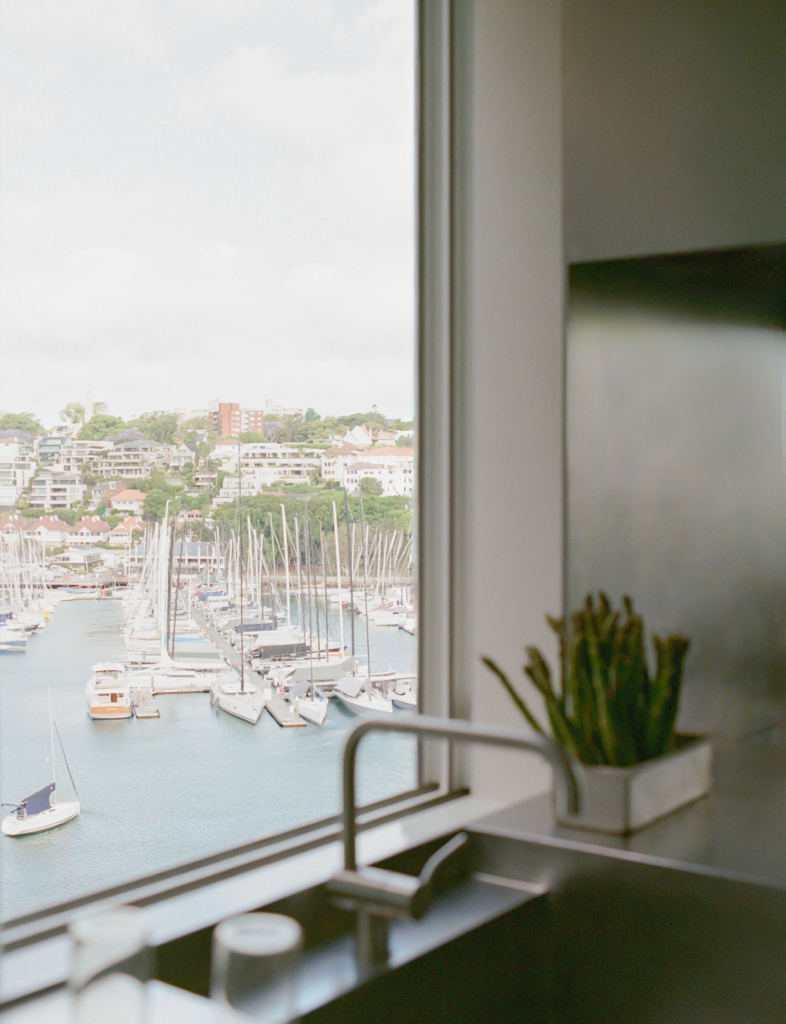

Originally built in the 1930s, the building sits directly on the waterfront at Elizabeth Bay, overlooking the marina’s gently rocking sailboats and impressive Moreton Bay figs. The top-floor apartment had been altered in the 1980s or ’90s, resulting in a warren of small, enclosed rooms with little natural light. “A big part of it was removing these walls and thinking about this as a single, flowing space,” says Maynard of the floor plan. The reworked layout now centres around an open-plan kitchen, dining and living area that takes in expansive views of the harbour and Rushcutters Bay Park. Maynard’s guiding question throughout the project became “How can you bring the spirit of this building through without eroding everything that’s special about it?”
His first port of call was to bring daylight deep into the south-facing plan. To do so, the architect inserted dramatic triangular skylights into the tiled roof – an addition that required intricate heritage approvals and the challenge of manoeuvring a crane onto the steep site. “From a construction perspective, it was quite a complex project.” With no lift access, everything from equipment to “tonnes and tonnes of bricks” had to be carried by hand. The resulting skylights now fill the interior with atmospheric light that shifts beautifully throughout the day.


“These surprises and secrets in architecture are fun. I try as much as I can to bring a sense of levity and soul to every project.”



This brightness is amplified by a glimmering kitchen clad in brushed stainless steel. Maynard traces the influence to Gae Aulenti’s 1971 Altana Palazzo Pucci apartment in Florence. “She used stainless steel in a way where it became far more than what we think of it as just being a benchtop… becoming surfaces that reflect light,” he explains. “It’s not cold as a material. It’s actually quite warm and receives light and colour in quite an interesting way.” Similar to Aulenti’s project, all the appliances disappear behind flush cabinetry, keeping the focus on light and volume.
Lined with warm eucalypt plywood and glowing 1950s Kalmar sconces, the entry corridor was inspired by the building’s walnut-panelled foyer and stained-glass windows. The doors – or portals, as Maynard calls them – to the two bedrooms and bathroom are also hidden, sitting flush with the walls. “The theme throughout is that there are secret doors and you don’t know which ones lead to where,” he says. “These surprises and secrets in architecture are fun. I try as much as I can to bring a sense of levity and soul to every project.”
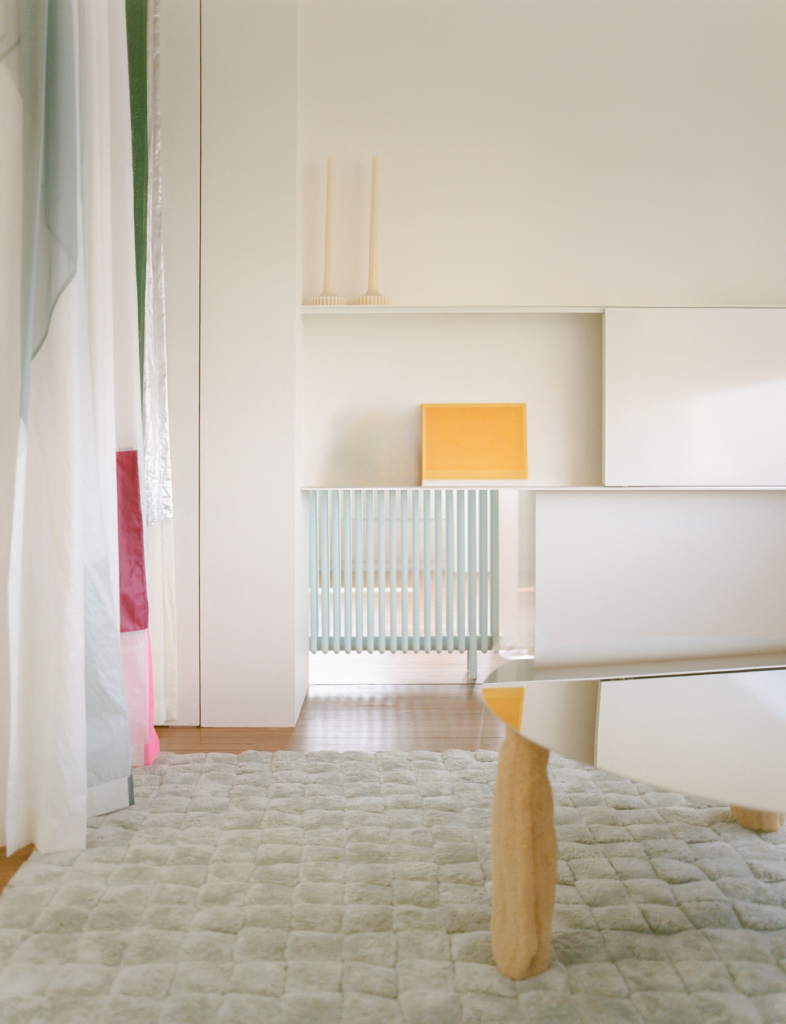
These playful touches continue within Apartment on the Loop, adding a sense of liveliness and theatre: light angles down from the living zone skylight like a stage spotlight, while a semi-circular mirrored ceiling above the dining alcove creates a shimmering reflection of boats on the water. The top corner of the floor-to-ceiling bookcase houses a rippling green-tinted window that draws daylight into the bathroom. Radiators are painted sky blue. Even the hallway’s circular skylight is sliced off at the edge, a “slippage” that Maynard delights in.
The most theatrical element of all is a gorgeous curtain that emerges from a hidden pocket carved into the living room wall. Created by Sydney artist Lauren Brincat, it’s made from spinnaker cloth sourced from the local yacht club, silk gauze and muslin fragments from the client’s trips to Athens. Soft, silvery and semi-sheer, it brings delicacy and translucent movement while also allowing the space to be partially screened off for guests. “It gives the ability to create a little bit of privacy,” he says. “A bit of fun again, a bit of joy.” Brincat’s colourful textiles also appear as curtains in both bedrooms.


Maynard improved the home’s thermal performance with double glazing and a heat-recovery ventilation system, but emphasises that “for me, the big sustainability item is just reusing as much of this apartment as possible.” His overall approach is modest and discerning. “You don’t need to impose or stamp yourself over every part of every project – just work out which bits need love and others that are perfect.” The original bathroom, for instance, with its gleaming green tiles and herringbone-patterned floors, was preserved almost in its entirety – updated with new fixtures, a pink coat of paint and a green terrazzo sink that echoes the colour and form of the building’s entry steps. “The bathroom was exceptional. I couldn’t do a better bathroom,” he says, laughing.
Maynard’s passion for art and design history is present throughout the residence’s purposeful details. The sculptural bathroom door handles are cast from those in Wittgenstein’s Stonborough House, while a spiky Castiglioni pendant hovers in the cooking zone. Alongside these iconic pieces, Maynard designed warm and characterful elements specifically for the apartment: a silver-cushioned sofa, a mangowood dining table and a deep burgundy rug in collaboration with Tibet Sydney.
Overall, the materials he gravitates to are humble, yet together they work to create a serene and luminous atmosphere. “I always like to design with a sense that we’re not making something disposable… this is not a place that I think predicates a certain way of living. Looseness is a good word,” he adds. “You’re not told how to do everything by the architecture.” This flexibility, he believes, is essential – spaces are able to shift with their inhabitants, accommodate a long table for work, entertaining or quiet moments.
By making clever use of light, honouring original materials and adding just the right amount of theatre, the home radiates with the freshness and spirit that Maynard first set out to capture without losing sight of its liveability.


