Brackenbury & Austin
A building that has lived many lives is a bit like a museum: each room is a gallery of memories. Brackenbury & Austin, a circa-1940 structure in Sydney’s Surry Hills recently restored by Studio Shand, embodies this allegory with quiet conviction.
Once a factory for metal lathes and machinery, the building has an enduring vestige in its name, preserved as a tribute to its workshop origins. In many ways, the present-day incarnation echoes its predecessor, but it just as easily steps out of its shadow. As Benjamin Jay Shand, founder and principal of Studio Shand, explains, “Our brief was to create a character space fit for a range of commercial uses.” In other words, a rethink that would reverse the ravages of time to reveal the building’s true heritage while layering in contemporary elements to fortify it for the future.

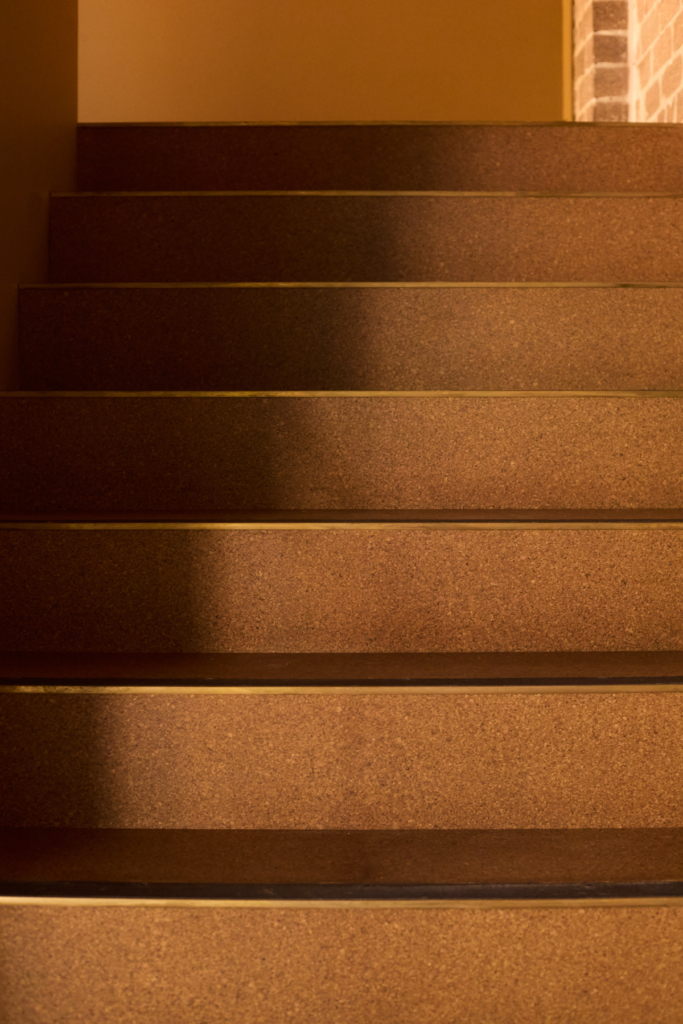
Shand committed himself to preserving the past, restoring original brick and timber wherever possible and crafting meticulous elements matching the building’s heritage where he could not. His rule for anything new was simple: it had to feel as though it had always belonged. The old guided the new, with colours, tones and textures – an earthy pastiche of red, yellow and brown – chosen to mirror history. Concrete grounds the lower level, while cork softens the mezzanine with its gentle grain and acoustic depth.
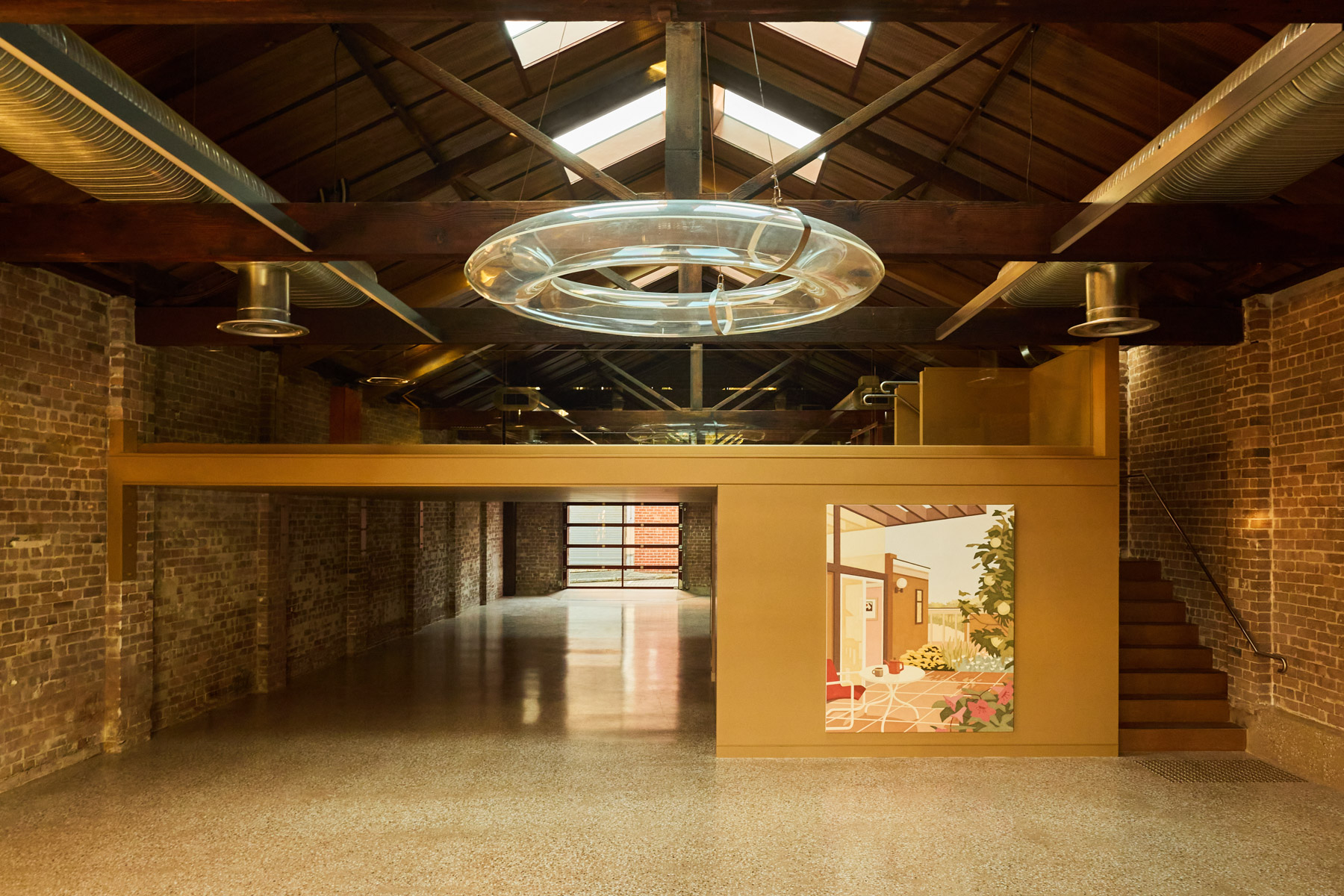
Shand carried the same sensitivity upward, lining the ceilings with timber to add warmth to the volume and reflect the building’s original fabric, and puncturing them with skylights that draw in sunlight. On the walls, he worked with restraint – doing as much as he left undone – peeling back years of paint to reveal the honesty of the original brick and the building’s layered memory.
The mustard-toned central volume is the project’s quiet tour de force. Housing a kitchen, bathroom, storage and services, the compact structure rises across two levels, its mezzanine edged with balustrades formed from existing truss chords, offering a bird’s-eye view of the zones below.
The overall space wears its art lightly, as if each piece had arrived in the same breath as the walls themselves. Paintings by local artists Eliza Gosse and Morgan Stokes nod to the neighbourhood’s shifts with the passage of time, layering contemporary perspectives over its industrial past. Natural fibre rugs by Studio Shand gently cover the floors, while vintage furniture from Australia and abroad mingles with custom pieces, creating a dialogue between eras and geographies.
Here, everything is treated as art, a sensibility perhaps best captured in a striking detail: a transparent Perspex ring previously used as an acoustic deflector designed by Peter Hall and Vilhelm Jordan in the Sydney Opera House. Colloquially known as a ‘doughnut’, it floats mid-air, funnelling light downward and mediating between the terrestrial and celestial.
In the end, Brackenbury & Austin stands as both relic and renewal – a reminder that heritage and modernity can coexist without compromise. And it seems apt that it is now home to a business that innately understands this thinking: renowned interior design studio Arent & Pyke.