Coast Road
A measured approach to an oceanfront site on New South Wales’ Central Coast has resulted in a simple yet sophisticated garden that seamlessly connects with the surrounding bushland.
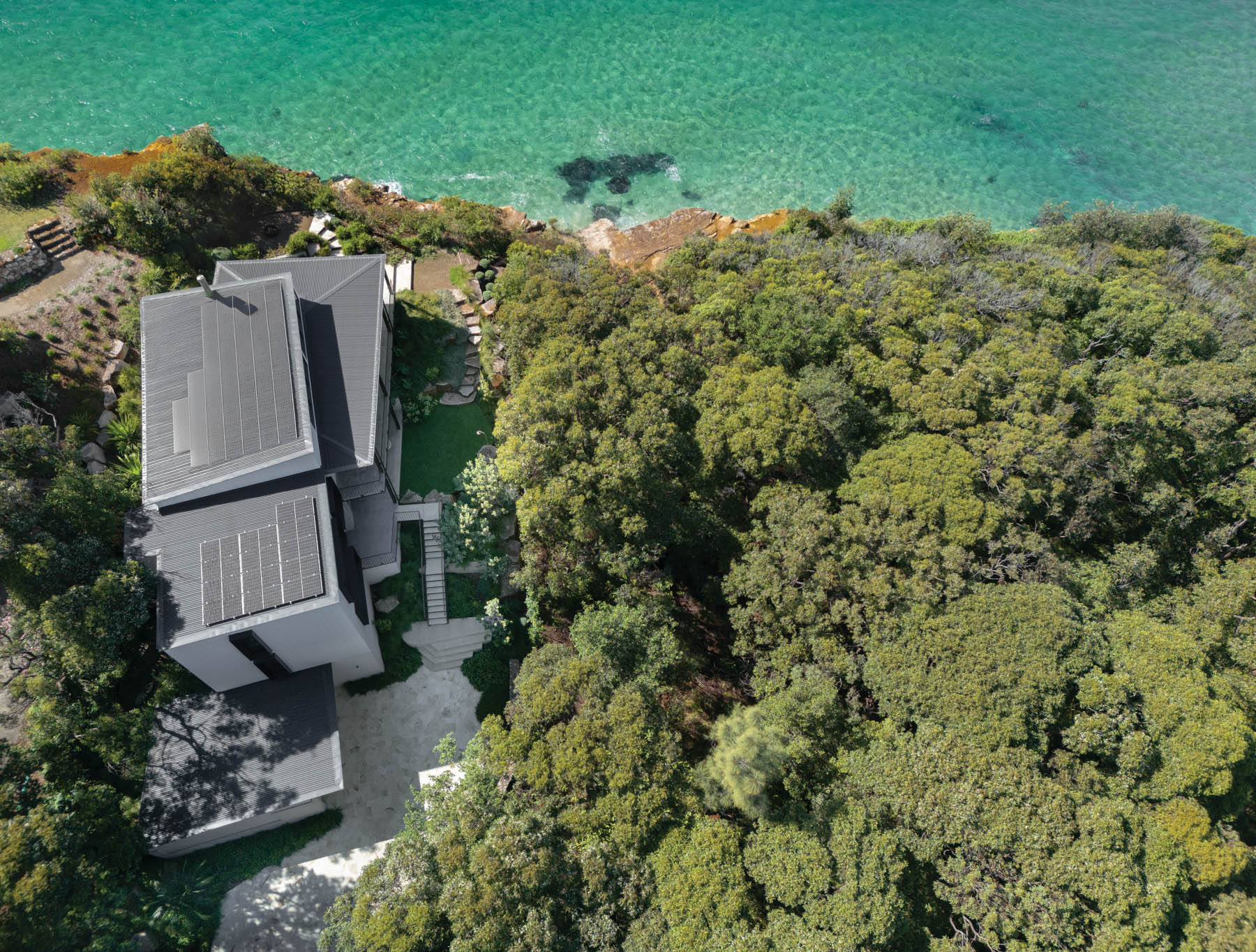
Perched on the headland at the northern end of Avoca Beach on the Central Coast, the site of Coast Road – a house designed by Dianna Thomas Architects – boasts uninterrupted vistas over a sprawling bushland reserve and the Pacific Ocean. The brief was therefore layered: landscape elements needed to be detailed yet simple in materiality, connecting with the location. “The planting palette needed to blend with the native setting and coexist with the site’s natural vegetation,” says Adam Eurell, director of Nature’s Vision Landscapes. “The garden also needed to add to the setting, not detract from the surroundings.”

Upon entry, there is a canopy of turpentine and eucalypt trees, and the driveway is intentionally kept narrow to create intimacy and a sense of arrival. “The end of the drive opens out and the space is much wider, offering relief from the trees overhead,” says Eurell. A Corten steel front gate is set on off-form concrete walls, extending to an angled vertical picket fence that stretches across the site, arranged in a random curved pattern.
Moving closer to the house, balustrades of a marine-grade steel staircase are grounded by two concrete structures. “The staircase sits elevated above the garden and passes through a canopy of Acacia holosericea, underplanted with Lomandra and Dianella grasses,” says Eurell. At the top of the staircase is a lawn where an outdoor copper shower is secured into a naturally flat sandstone boulder, immersing one in the bushland setting.




Further towards the escarpment, a natural boulder staircase connects the lawn to a rear entertaining space, punctuated by swaying Themeda ‘Mingo’ grasses. There are panoramas of the surrounding ocean and coastal escarpments, with the plantings echoing those found near a windswept cliff. Corten steel risers and sandstone flagging treads offer vantage points to pause and absorb the views. “The entire garden works on moving and shifting through the landscape to arrive at a final destination at the top of the site,” says Eurell.
The design approach was about creating an immersive experience while making the most of the unique site by connecting to the existing topography. “We wanted to maintain the site’s sense of place, which would ultimately provide a calming feel,” says Eurell. All exotic bushland weed was cleared, while existing local plant material was kept and further cultivated alongside other natives suitable to the site – including local Indigenous plantings like Banksia integrifolia and Grevillea buxifolia. “Consideration was given to local plants endemic to the area and how they would assist in creating a continuation of the natural landscape,” notes Eurell. “The garden is restrained in its approach when considering planting palette and material selection, but the structural components offer boldness and strong lines, which bring the architecture into the garden.”




The colour palette is dominated by sandstone and rusty tones, punctuated by dark greens and earthy grey hues. “Locally sourced sandstone matches the tessellated tones of the sandstone escarpment above the ocean,” says Eurell. Corten steel – used in step risers, screens and fences – is chosen for its durable nature and ability to weather beautifully over time, similarly drawing on the tones of the escarpment beyond. Meanwhile, concrete pavements complement the palette of the architecture and its meticulous finish elevates its presence in the garden.
However, being a steep site with poor soil quality that required cultivation and enhancement posed difficulties for access and flow. The exposed cliff top and impact of salt-laden winds also limited plants that could be selected. “We overcame the steepness by providing movement through an array of spaces and levels,” says Eurell. “Another obstacle was the painstaking hand removal of an understory of bushland weeds. The entire understory was dug up and loaded onto trucks for removal, which we had to do as the weeds were virtually impenetrable.”
The result is a meticulous and refined garden that thoughtfully responds to the architecture and bushland. Spending time at Coast Road, surrounded by the distinctive sounds of the Australian bush and the waves below, is a calming and restorative experience.