Darlinghurst House
Despite its distinctly urban setting, this restored home in the heart of a busy Sydney hub offers a tranquil respite with its considered layout, innovative design and landscaped pockets.
It’s hard to imagine a more urban setting for a family home than the recently completed Darlinghurst House by Anthony Gill Architects. Located just metres from Taylor Square, the bustling epicentre of Oxford Street and the birthplace of the city’s queer pride movement, this intriguing property is home to a professional couple and their young son. The home straddles a conservative street frontage at one end and a gritty industrial laneway at the other. Its irregularly shaped site – like two adjoining triangles – includes a terrace and a new companion building locked together by a stair and forming a separate laneway frontage.

On a complex site full of constraints – from strangely drawn boundaries to strict heritage requirements – Anthony Gill has achieved a near-impossible task of bringing clarity to the footprint and calm to the spaces: first turning the interior in on itself, before opening it up to the sky. The original terrace was restored, its walls rebuilt using existing bricks from the site and replanned to contain a study on the top floor, tucked into a dormer, and bedrooms on the level below and ground floor. There is also a cellar beside a cocooning television room that’s richly furnished with timber cabinetry and floor-to-ceiling drapes, opening to a private, walled courtyard garden facing the street.
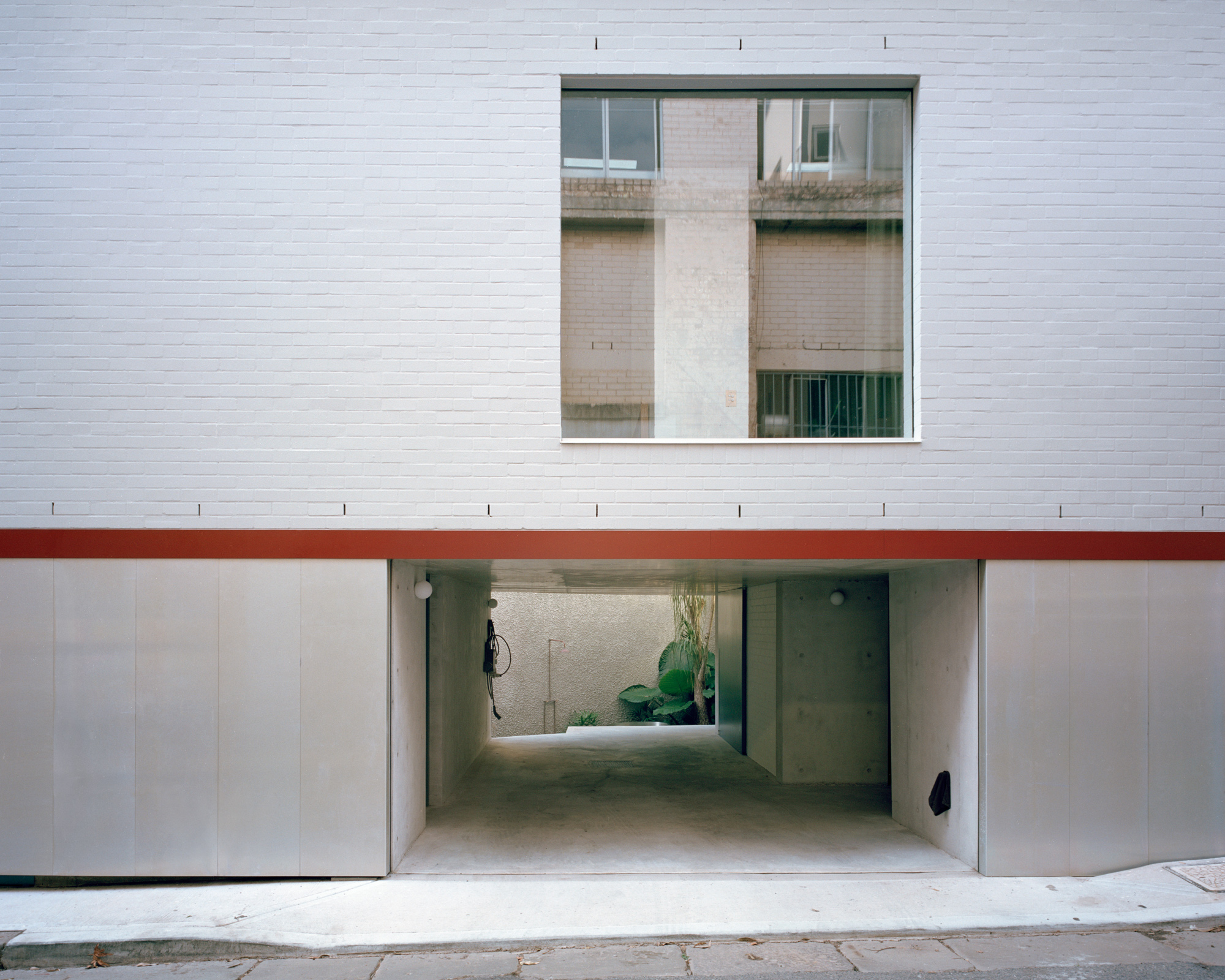
At the rear laneway, a new building of concrete and brick incorporates the garage and guestroom at ground level, main suite above and living area on the second floor. Both structures offer a different street presence – the restored facade marks the end of a traditional row of terraces on Bourke Street, while the laneway frontage draws its material and detailing cues from the back of Oxford Street warehouses to its south.
“There’s a nice relationship between the two geometries and how the buildings intersect,” says Gill. The upside-down, back-to-front layout of the bedrooms below and living spaces above help orient the public spaces towards the light and outlook, while the quieter zones lean more into shelter. Rising through the levels, from garage to rooftop terrace, is a discreetly located elevator; however, the two buildings also connect via a series of staircases, gardens and voids placed externally but within the overall building envelope, ensuring privacy.
“Council were quite happy for us to connect the two buildings at the lower levels but wanted separation higher up – as if the two three- and four-storey structures rise independently – which meant separate staircases for some of the transitions,” says Gill. “So you have one main concrete stair to the middle bedroom level before it splits. You can then use a hanging steel-plate stair to access the study, located in the dormer of the terrace, or continue up the concrete stair to the main living space on the top floor of the new structure. From here, you can access the rooftop terrace from an external steel stair. A friend and colleague, who lives around the corner, came to see the house under construction and thought it was like a little city – with different structures that required separate access. I like that idea, especially in this very densely built-up area.” It’s a nice metaphor, the dwelling as a microcosm of the city.
But what’s also interesting is the treatment of details and the in-between or interstitial spaces – those incidental areas in a floor plan that support and connect the primary spaces, releasing spatial tension, making the whole assembly sing. Details of note include the rough, irregular stone paving in the living space, beautifully tailored drapes throughout, the kitchen’s robust but rich pink stone benches and brick island, and the delightful circular showers looking into planted niches.
Much of the in-between here is devoted to outlook or landscape – key elements in all of Gill’s house designs. While the new rear building adds 173 square metres of habitable space, it incorporates landscaped pockets, green roofing and courtyards totalling a touch over 110 square metres. That’s the equivalent of a three-bedroom apartment’s worth of landscape embedded through the site.

This includes the densely planted gardens behind the open-air garage and guestroom, as well as the walled garden off the television room, which can also be enjoyed from the laundry. There is also the deep balcony planting off the main ensuite and walled courtyards at the bedroom level, providing visual relief and privacy. The external stair from the living space up to the rooftop terrace is another opportunity for greenery, surrounded by dense planting and views over Darlinghurst rooftops to the city and harbour beyond.
Each element forms part of a complex puzzle that gives Darlinghurst House an almost dual identity: polite heritage terrace from the front and richly textured laneway infill from the back, where the new building is less an object than a fragment of the city. Does Gill enjoy the challenge of designing a riddle? “Well, this kind of complexity is challenging. I wouldn’t exactly call it a ‘riddle’, but it’s certainly varied and rich in terms of spatial organisation. That really comes out of having such varied site conditions and competing preexisting geometries. But what that gives us are these interesting leftover spaces between the buildings across all levels that we’ve managed to fill with terraces and gardens.”
Architecture by Anthony Gill Architects. Build by Newmark Constructions. Landscape design by Red Seed Landscapes. Stone by Artedomus. Crazy paving by Eco Outdoor. Lighting by Euroluce. Appliances by Fisher & Paykel.