
Fondation Cartier
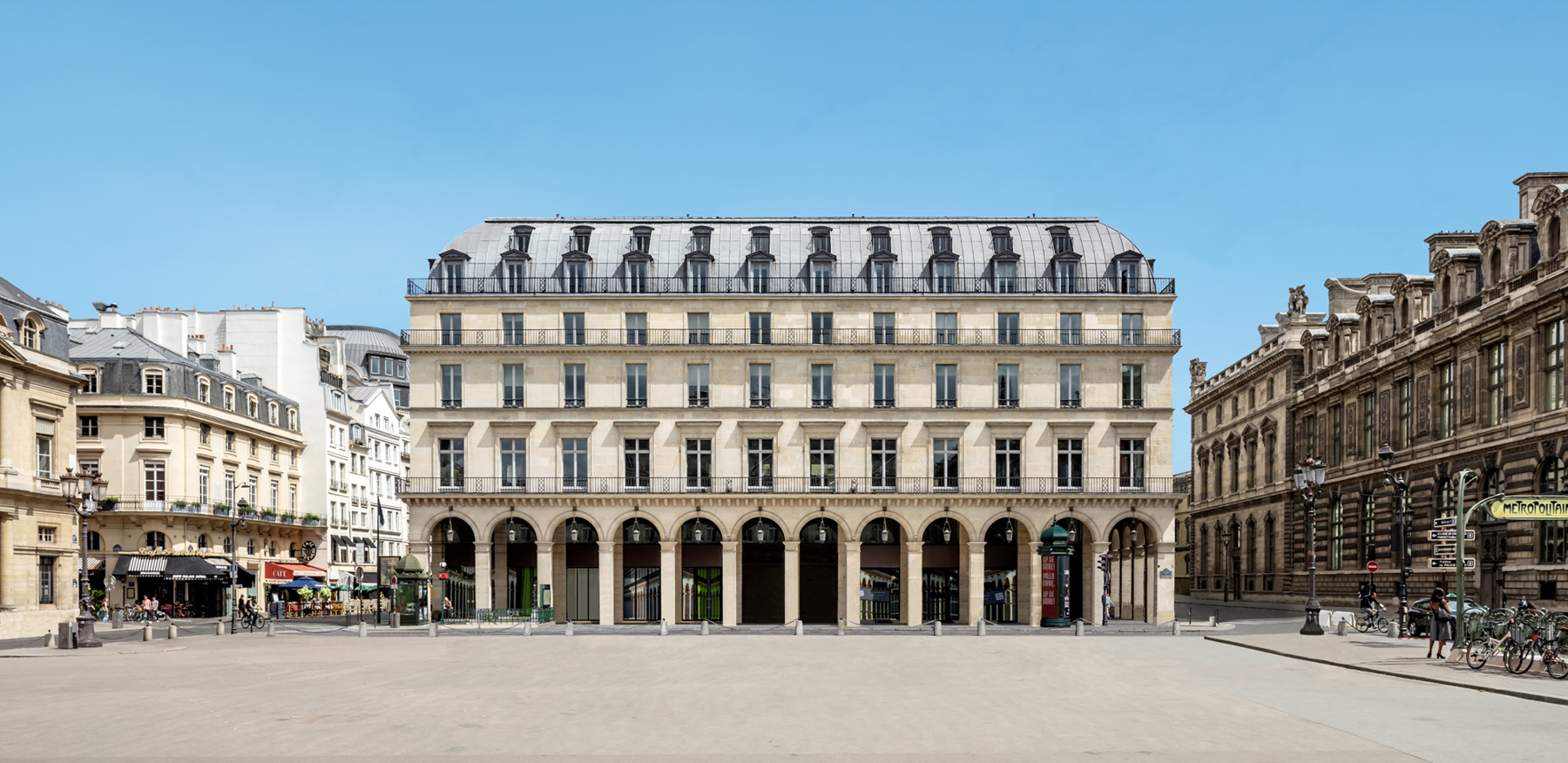
Beyond the jewellery maison gallery’s heritage facade in a prized iconic Parisian location lies a contemporary and innovative rethinking by one of the world’s premier visionary architects, Jean Nouvel.
At 2 Place du Palais-Royal, opposite the Louvre, the Fondation Cartier has taken one of Paris’s most familiar 19th-century facades and quietly rebuilt everything behind it. From the street, the building reads as an unchanged Haussmannian block: limestone arcades running the length of Rue de Rivoli, tall timber-framed windows stacked across five storeys, a mansard roof cresting the skyline. It is only once inside that the scale of the Jean Nouvel-designed intervention becomes apparent. The historic shell remains, but the interior has been stripped back and re-engineered into a dynamic exhibition machine.




The building itself dates back to 1855, constructed during Baron Haussmann’s grands travaux as part of the extension of Rue de Rivoli and originally housing the Grand Hôtel du Louvre before becoming the Grands Magasins du Louvre. For close to a century, the site functioned as a hybrid of retail, exhibition and civic space, shaping Paris’s commercial and cultural life. During the Second World War, a Lancaster bomber struck the building, requiring successive renovations. These lasted into the late 20th century, introducing concrete structural elements but also losing much of the original layout in the process. Rather than attempt a straightforward restoration, Nouvel’s thought was to preserve the external Haussmann facade and arcaded ground plane while rebuilding the interior as a flexible infrastructure for exhibition.
The project directly challenges the notion of architecture as a fixed, finished object, treating space as something designed to be continually reworked. Large internal courtyards – once remnants of the original department store – have been expanded into vertical exhibition volumes capped with operable glass roofs. Within these shafts sit five enormous steel platforms, each between approximately 200 and 363 square metres in area and weighing roughly 250 tonnes, capable of being lifted or lowered through 11 distinct height positions across three storeys.

Collectively, the platforms provide 1,200 square metres of mobile exhibition surface.


The platforms operate via a cable-and-pulley lifting mechanism engineered specifically for this project. Theatre rigging specialists, bridge engineers and building-services consultants collaborated to resolve regulatory questions around moving structures inside a public building – a task for which no established building code template existed. The result is a programmable architecture in which floors themselves become the primary curatorial instrument and the building behaves less like a static container and more like infrastructure.
Collectively, the platforms provide 1,200 square metres of mobile exhibition surface within a total publicly accessible building area of 8,500 square metres, of which 6,500 square metres is dedicated to galleries. When all platforms align on a single plane, they create a continuous exhibition floor plate; when staggered, they form overlapping spatial terraces connected visually by bridges, balconies and walkways that overlook an enormous internal space.



Surrounding the central lift zones are more conventional galleries distributed across the basement, ground and first floors, along with more than 1,500 square metres of continuous balcony space.
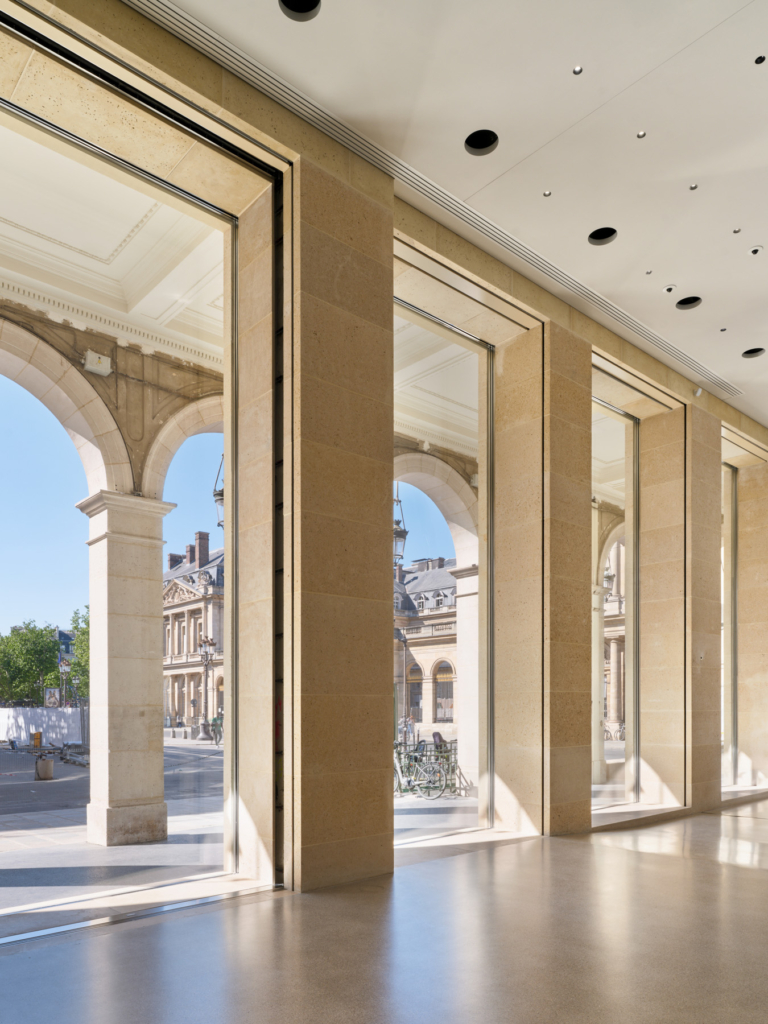
Throughout the interior, concrete columns dating from 1970s renovations have been retained as structural relics within otherwise pared-back exhibition fields. These uprights are now clad in solid Saint-Maximin stone, the same limestone used on the 19th-century facade, so the new work and the old shell speak a common material language even as the building’s occupation has changed.


One of the defining features of Nouvel’s intervention is its insistence on transparency at ground level. Along Rue de Rivoli and Rue Saint-Honoré, the traditional display windows of the department store have been reinterpreted as full-height glazed facades. These largely unframed glass panels run across a 150-metre stretch of the perimeter elevation, allowing the interior exhibitions to be seen from the street while simultaneously opening internal galleries to the surrounding cityscape.
A minimalist glass canopy extends above the arcades along Rue Saint-Honoré, tying into the historic arcades on Rue de Rivoli and Place du Palais-Royal, echoing older awnings and providing sheltered pedestrian continuity while sharpening the building’s role as part of the public realm. Natural light is treated as part of the exhibition infrastructure rather than a background condition. Three large overhead glass roofs crown the major internal volumes, each fitted with mechanically adjustable shutters capable of modulating daylight to full blackout when required.
Shade systems on the tall windows extend that control across the facades. Above these skylights sit planted roof terraces where trees reference the nearby gardens of the Palais-Royal, allowing seasonal shifts in canopy shadow and filtered light to register inside the galleries below and making the roofscape another moving part in the exhibition apparatus.
Materiality within the building underscores both technical necessity and historical acknowledgement. Recycled steel forms the five lifting platforms and their supporting frames, exposed to reveal the building’s working mechanics rather than conceal them. Concrete dominates floor surfaces across static zones.
The existing structural grid has been cleaned up and re-sheathed in stone where needed, but its mass and origin remain legible. Where new cladding has been introduced, Saint-Maximin stone has been reapplied to frame internal apertures and gallery thresholds, tying old and new structurally and visually while refusing the illusion that this is a seamless restoration.
The most fascinating detail isn’t the engineering, but the subtlety of their effect: these mechanical panels are relatively invisible in daily use. All their magic happens behind the scenes and after hours. Platforms move slowly and are reconfigured between exhibitions rather than as live displays for visitors. Over time, regular visitors may experience radically different spatial arrangements, yet the architecture’s operation remains largely in the background. What persists is not a single heroic image but a set of capacities.
Beyond exhibition spaces, the building includes several programmatic components embedded within the overall circulation network. A 110-seat auditorium occupies a dedicated zone finished in Nouvel’s characteristic monochrome red, making it visually distinct from the mineral palette of the galleries. A 160-square-metre bookstore sits near the principal entry, retailing both institutional publications and wider art titles, while the Petit Café provides a smaller hospitality offering within the gallery loop. A larger restaurant and creative bar are set to open in 2026 at the eastern end of the complex, alongside La Manufacture – a 300-squaremetre education centre designed for hands-on workshops focused on craft transmission and process-based learning.
This move to Place du Palais-Royal marks the second major chapter in Nouvel’s ongoing collaboration with the Fondation Cartier, following his 1994 glass-and-steel building on Boulevard Raspail. That earlier project introduced radical transparency to Parisian gallery architecture, blurring interior and garden through continuous glazing and loosening the ‘white cube’ convention of sealed exhibition halls. At the Palais-Royal, Nouvel extends this investigation into flexibility and visibility, but under very different constraints.


