Jacaranda House
In a charming street in Sydney’s Inner West, Richards Stanisich transformed an 1890s Victorian cottage for modern living with a light-flooded extension that embraces a majestic jacaranda.
Like so many heritage projects, the reimagining of Jacaranda House in Sydney’s Inner West began with a problem. Several problems, in fact. The original house, a classic two-bedroom Victorian cottage, had what architect Kirsten Stanisich of Richards Stanisich describes as “massive buildability issues”, all centred around serious damp. Equally of concern was a tacked-on 1970s extension, which “was definitely not done by a master builder,” Stanisich suggests tactfully.

Before the Richards Stanisich team could even begin on the main program – a rear extension that would double the home’s living spaces – major remedial works had to be undertaken. “Essentially, we had to pull the whole front apart,” says the architect. “First, we had to identify where the damp was coming from and then we had to do a lot of ventilation and drainage work, as well as building out walls, to make sure air could circulate.”
While its structural integrity was questionable, Stanisich felt that the extension had a certain charm. “A lot of architects would look at it and go, ‘Absolutely not’, but I thought it had a beautiful sense of internal volume. And it had this funny little cathedral ceiling on one side and, although we had to pull it all down, we used a reference of that old roofline in the new cathedral ceilings.”
Those soaring ceilings are now the defining feature of the two-storey, light-flooded extension, which incorporates a kitchen and living area upstairs and a third bedroom and additional living space downstairs.
Those soaring ceilings are now the defining feature of the two-storey, light-flooded extension, which incorporates a kitchen and living area upstairs and a third bedroom and additional living space downstairs. They’re an ingenious element – not only dramatic in form but performing a confident architectural sleight of hand by making the space seem larger than it is. “When you walk from the old part of the house into the living area and kitchen, you get this real sense of volume,” explains Stanisich. “But the space isn’t actually very big. What was important in achieving that was that we didn’t try to jam a million things into it. Often, projects like this end up looking small because people are trying to put a lot into the floor plan. Here, it was left to breathe a little, and I think that gives you a really nice sense of space.”
That sense is exacerbated by the floor-to-ceiling gable windows, which frame the view of the home’s namesake – a splendid jacaranda tree, the trunk of which almost nudges the walls of the new build. The windows, says Stanisich, “really take advantage of everything that is beautiful about the site”. With the tree’s thick, gnarled trunk almost in touching distance, sitting in the living room is not unlike being in a treehouse, albeit a deeply refined one.
With the tree’s thick, gnarled trunk almost in touching distance, sitting in the living room is not unlike being in a treehouse, albeit a deeply refined one.
While the tree is integral, it’s not an overpowering presence. Colour plays an important role in that, with a distinct division between interior and exterior. The external walls, constructed of environmentally friendly Accoya timber, are stained in a subdued teal, a shade that’s adjacent to the purple canopy and one which works in harmony with the multitude of greens in the garden.
But internally, the palette is intentionally minimalist. “We kept the colours and the textures quite tight, not just to form a subtle backdrop to the jacaranda but also because we had an understanding of the client and what they wanted, which was essentially to create a home they could live in forever. So we didn’t want to design a space that was dominated by any one thing – we wanted to be able to say, ‘You’ve got this to work with and things can change and move over time.’”
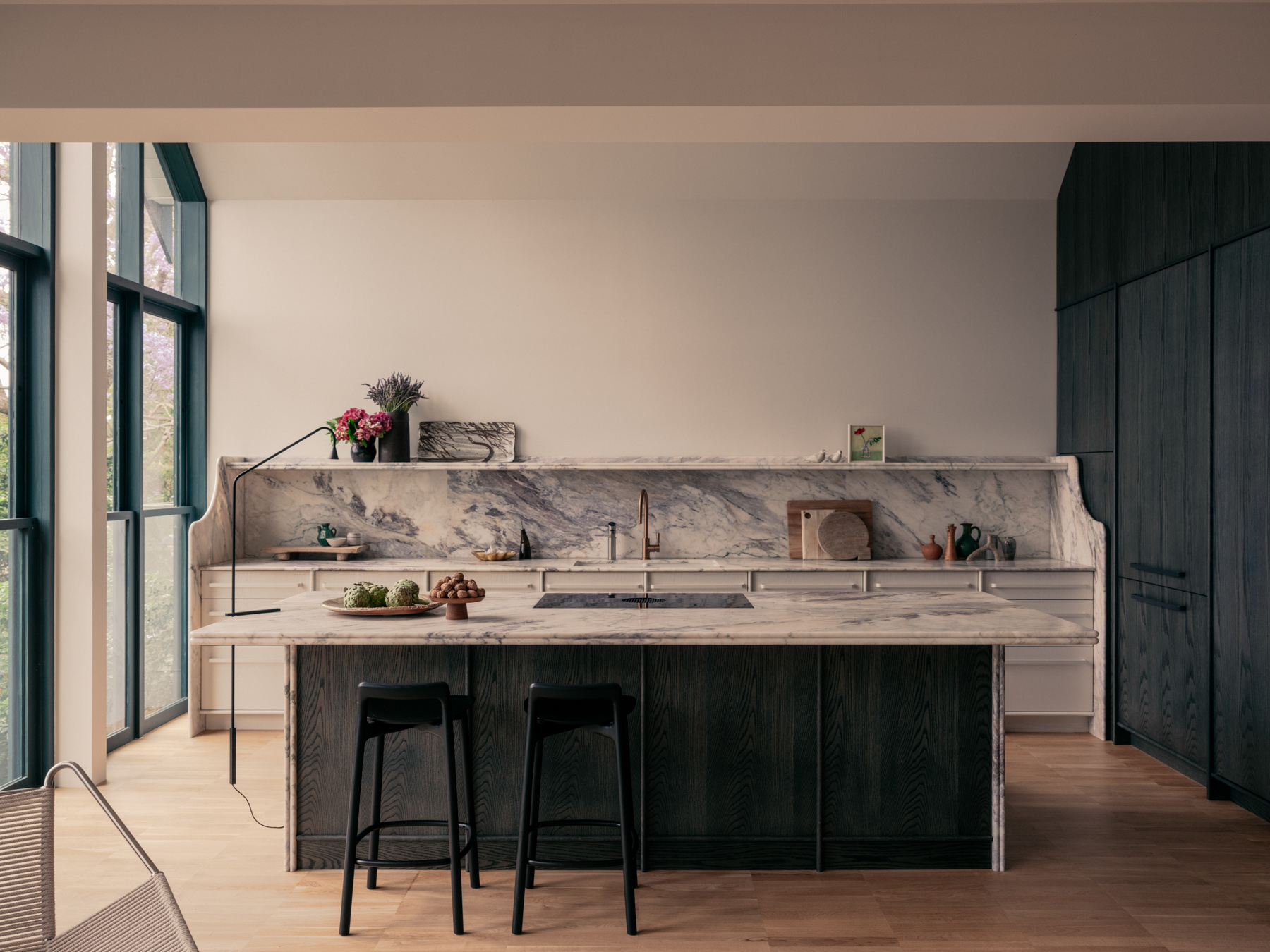
The kitchen is something of an object lesson in how Richards Stanisich uses hue to create depth and visual interest that is underscored by timelessness. The American oak joinery is stained a shade or two darker than the external teal but still retains a throughline, while the subtle maroon and plum veins in the Brescia marble – used in both the countertop and splashback – forge another connection with the jacaranda.
The marble has an intriguing backstory: the clients fell in love with it before the project began, and it was one of the few things the easygoing couple asked to be incorporated. “They just really wanted to make sure the marble had its place. And that’s a really good thing to be part of as a designer – when you have these outside forces that influence how you approach a project, so it’s not just our way or the highway. I also believe that things like the marble are what give projects longevity because we’re creating very special things for each client, things that can’t necessarily be taken to another client or another project.”
“When you look back at the house from the garden, it’s quite hard to tell whether it’s a new build or whether it’s a space that’s been renovated.”
Longevity is a word that crops up a lot when Stanisich talks about Jacaranda House. It not only reflects the clients’ desire for a home that would serve them long into the future but is also emblematic of the studio’s approach. “When you look back at the house from the garden, it’s quite hard to tell whether it’s a new build or whether it’s a space that’s been renovated. And I suppose that translates as us having achieved what we wanted to achieve – that it looks like it’s been there for a while. And that, hopefully, in 10 years’ time, it’s not going to look dated.”
And even though it was removed, embracing the ethos of the extension into the new build also reiterates that thinking. “Many older houses had these funny little extensions done in the 1970s and, maybe because I grew up in that era, I feel like there’s something really valuable in remembering that – to keep something that has history behind it rather than having a house that 100 per cent screams 2024 or 2025. You want something that tells a little about the home’s story.”
Jacaranda House possesses a deep sense of tranquillity, evoked by the subtle play of materials and textures.
Interestingly, the extension eschews our national obsession for indoor-outdoor connection by placing the kitchen and main living space upstairs and the bedroom and additional living area on the ground floor, opening out to the garden. For Stanisich, that inverse arrangement made much more sense. “You just get way better light on the first level,” she says. “And when you’re sitting in the living room, the aspect outside is really beautiful. I think it’s also lovely to have your bedroom off the garden, and having the bedroom and secondary living area downstairs creates an area that offers a little bit of respite and calm.”
Calm just doesn’t pervade the downstairs – Jacaranda House possesses a deep sense of tranquillity, evoked by the subtle play of materials and textures, by the abundance of light, by the measured volumes and, above all else, by the presence of the eponymous, magnificant jacaranda tree.
Architecture and interior design by Richards Stanisich. Build by BWG Projects. Landscape design by Even Spaces. Furniture by District, Ethnicraft and Jardan. Lighting by Euroluce, Viabizzuno and Volker Haug Studio. Tapware by Brodware and Candana.