
Nick Kent
A considered embodiment of its inhabitant and creator, Bondi House reflects Nick Kent’s design ethos through calm, refined spaces shaped by structure, light and landscape.
For Nick Kent, designing his own family home proved to be both a liberating and enlightening experience. His Bondi House – completed in early 2024 – is modest in scale and set within a compact site in Sydney’s east, yet its presence resonates with clarity. In it, the director of Nick Kent Design channels the discipline and refinement of his practice into something more personal: a home that balances structure and softness, precision and feeling.

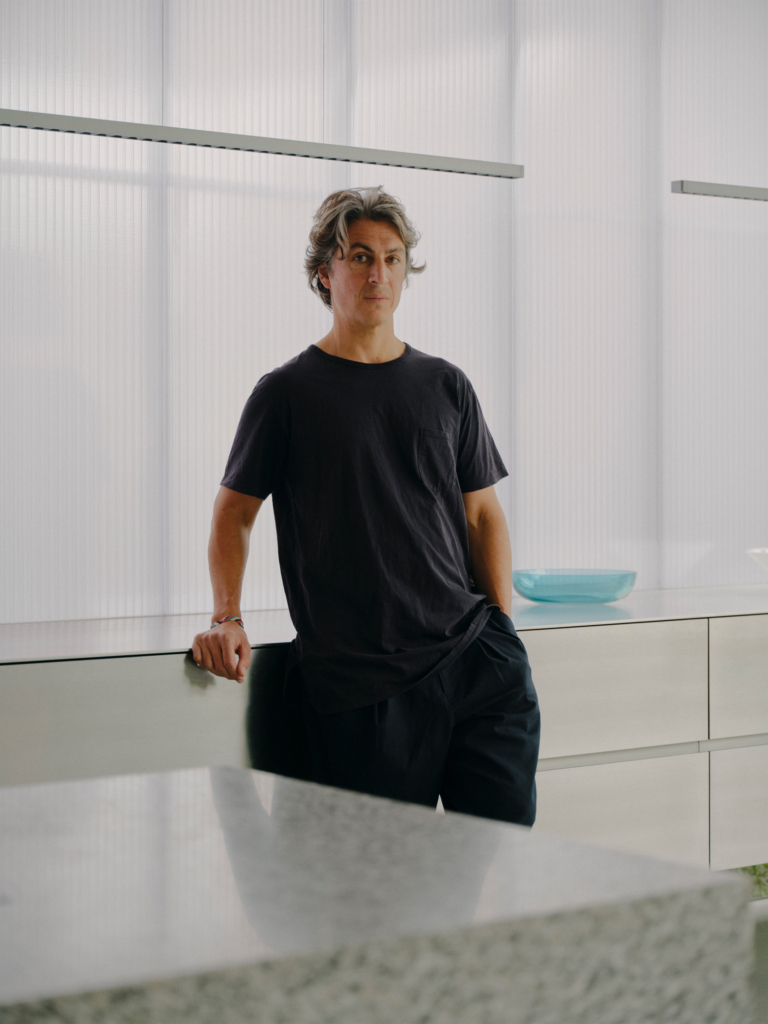
“There was probably more self-consciousness with this project than when working with a client,” reflects Kent. “It’s the first time I’ve done a project for my family … people may think designing your own house is hyper-personal, but I really tried to avoid that.” Instead, he refined the design into something pared back yet intentional. “There was a conscious effort to keep the house as a sort of neutral frame, with an emphasis on what’s happening within and around it.”
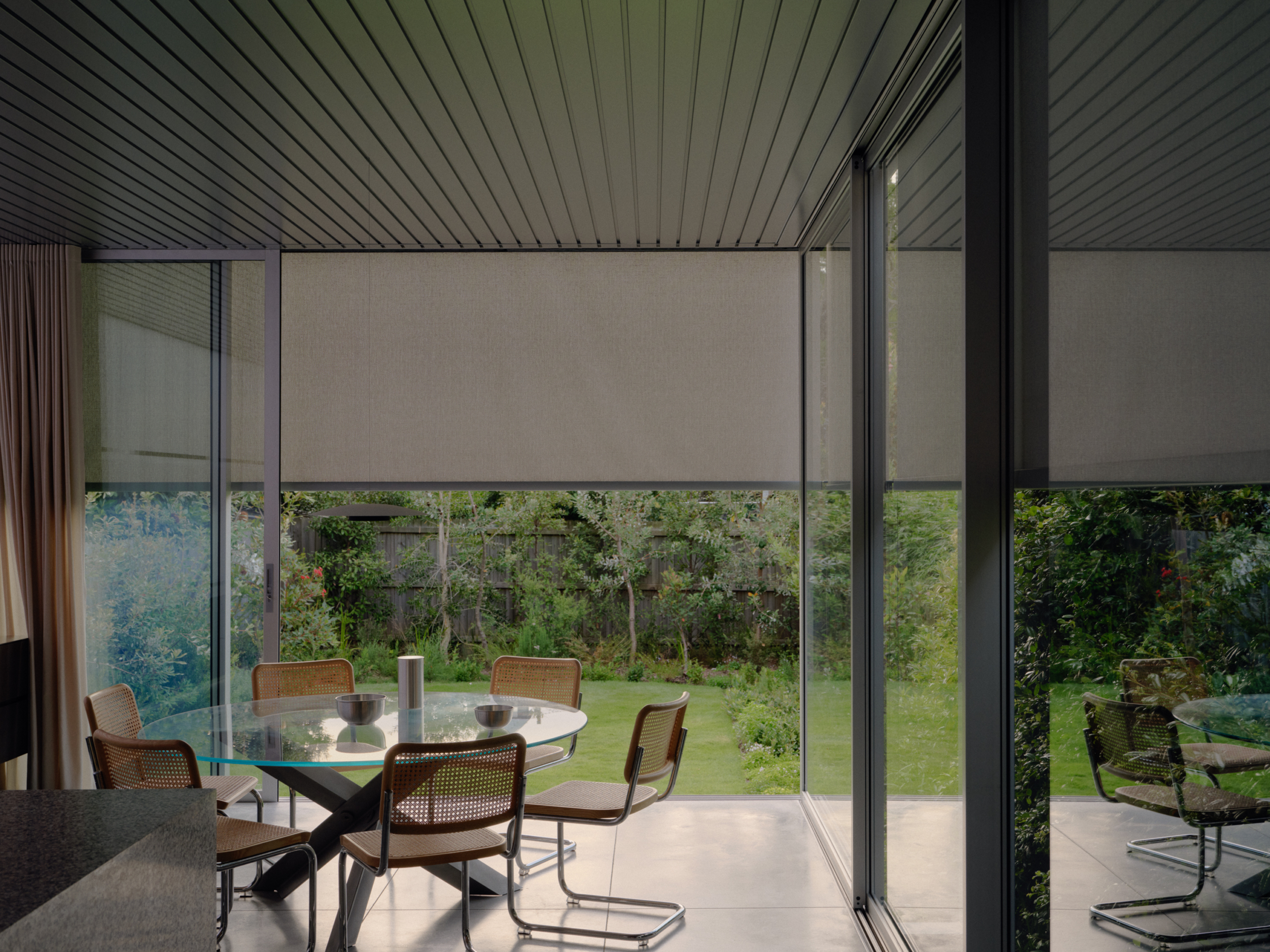
The first impression of Bondi House is one of both rawness and cohesion. Its industrial materiality – steel, concrete, aluminium – is softened by warm timber detailing, nuanced layering of colour and glimpses of greenery. Kent notes that “each project will often have a dominant material,” recalling a previous home he worked on with a curved concrete roof where “everything was about that concrete”. In Bondi House, he “wanted to push basic industrial materials, elevating them to something beyond how you’d expect them to behave.” The resulting palette is restrained yet responsive, shifting in tone depending on the conditions – reflective and luminous at times, grounded and tactile at others.
Kent’s design sensibility leans toward a balance of restraint and expression – a sensitivity that reveals itself in his home’s recurring theme of suspension. At the rear, floating slabs appear to lift the form off the ground. “I’m often chasing illusions of weightlessness,” he says. “With this house, I was after this sort of suspended moment.” This motif of weightlessness carries through to the finer details as well. Pendant lights hover over the kitchen island, echoing the home’s larger gestures of elevation. “There are internal elements that almost hover within the house, while the floor and ceiling planes seem to float within the steel structure,” says Kent. These elements are a subtle nod to the Japanese architecture and temples he admires. “Traditional Japanese architecture probably has the most influence on what I’m doing. I’ve never tried to replicate it, coming from a different time and place. However, when travelling, those are the buildings I keep returning to more than anything else.”
Without the usual client restraints, Kent allowed himself a slower conceptual process. “We certainly spent far longer working on the conceptual stages than normal. There was a lengthy period of refinement where it kept getting simpler … and smaller.” The site itself is about seven metres wide and presented its own set of constraints. “The internal dimension of the house was about 4.8 metres wide,” says Kent, which further narrowed to 4.5 metres after planning for a planted corridor on the northern side. “It had to be wide enough to support mature trees to the height needed.”

This speaks to a defining thread in Kent’s work: a considered relationship between architecture and landscape. “Everything you see planted here is new,” he says. “Originally, there was a derelict cottage, and the garden was completely overgrown with weeds. Once it was demolished and cleared, there wasn’t a single tree on the site.” It was during this construction period that Kent experienced a moment that crystallised the project’s emotional shift. “The house was getting built … it was the end of the day, and the sun was going down,” he recalls. “The whole site was quiet and empty, and it was just beautifully calm. That was the first time I’d experienced it.”
His vision for the garden extended beyond creating privacy; it was about reviving a native coastal landscape. “Ultimately, we tried to reinstate the natural landscape, how the area would’ve appeared before it was covered in houses and buildings.” Now, the landscape acts as both buffer and backdrop. “We have large native trees growing … they’ll grow a couple of storeys high and hopefully give a sense of being part of a greater landscape, rather than just another dislocated backyard. Eventually, we’ll be sort of floating within that canopy.” This sense of seclusion in the middle of suburbia lends Bondi House its sanctuary-like feel – a retreat for the entire family to settle in peacefully.
Though modest in its footprint, Bondi House is rich in detail and complexity. “We were working towards a very simple form that condensed all the ideas that had come before it.” The extended design period gave him space to pare things back and make more deliberate decisions. “The structure does become the finish. So, there’s nothing going over the concrete slabs. There’s nothing going over the steelwork. The same with the polycarbonate.” Essentially, what’s seen on the exterior is what appears in the interior. “That’s really important to me,” he continues. “Expressing the structure externally, you can understand how the building’s put together, with an idea of how it’s working on the inside.”
This kind of clarity calls for a keen, technical eye – something Kent possesses. By exposing the structure and committing early to selected materials, he created a home where every detail is fully resolved. For instance, the polycarbonate cladding shifts in opacity across levels. “I definitely wanted a building that felt light, transparent and translucent.” Surfaces such as stainless steel and aluminium offer varying degrees of reflectivity, while timber – used throughout for cabinetry and storage – grounds the space in comfort. Despite an industrial lean, Kent ensures Bondi House feels deeply domestic. The floor plan fosters closeness; light flows through carefully placed openings, a sliding door dissolves the threshold between dining and garden, and said dining area – anchored by a round table – invites connection. “I’ve always associated architecture or the idea of building with freedom as much as shelter. I guess that’s where this preoccupation with flowing, open-plan spaces comes from. That’s something that’s within this project and others as well.”
Light becomes an expressive element in its own right. “The house looks totally different depending on the day and the season, as it literally reflects the changing weather conditions.” Morning sun reflects off the east-facing steel garage, casting an iridescent glow. Blue bathroom tiles and coloured sheer curtains in the bedrooms add vibrancy, projecting soft hues across various surfaces. Comfort and climate-responsiveness are also integrated into the design. Operable windows provide ventilation; a stair window opens entirely, while the main bedroom at the rear overlooks the garden. Privacy is managed through a combination of planting and steel screening – both protective and porous.
At its heart, the house is clearly designed for family living. As Kent puts it, “in this age – where we’re at and what we’re dealing with – you do want to come home to a place that’s calm and offers some respite.” And that’s exactly what Bondi House offers: a space that responds and grounds. It’s a dwelling of dualities – industrial and warm, anchored and elevated, disciplined and generous. Though Kent insists he aimed for neutrality, the result is anything but impersonal. “When you’re involved with your own house, there’s an affection for the people who built it,” he says. “Afterwards, when you’re living there, and having seen them go to so much trouble, you’re able to appreciate what went into it.” His home is a faithful reflection of someone who designs not just with clarity but with care.
Building, interior and landscape design by Nick Kent Design. Build by Toki Construction.
Appliances by Gaggenau.


