
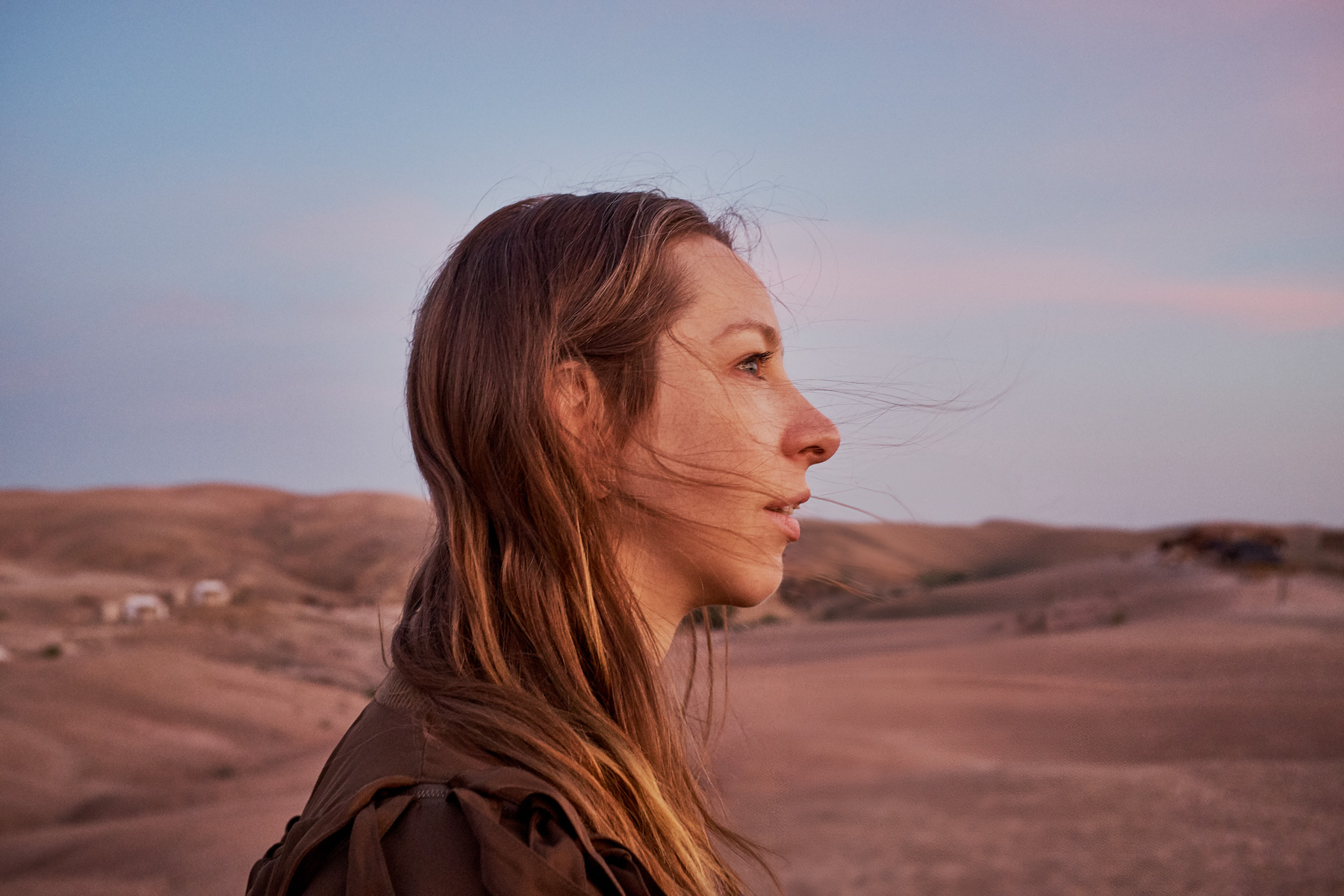
Jessie French of Other Matter
This Melbourne-based multi-hyphenate creative is quietly revolutionising materials with her practice, Other Matter, casting her sustainably minded lens on smarter, eco-efficient means and the ensuing multitude of applications and possibilities.
Among the backstreets of Melbourne, Jessie French is cooking plastic. “It actually looks like a soup kitchen,” the artist explains. Although, the word artist doesn’t quite match the scope of French’s work; add designer, researcher, scientist, inventor, and it’s closer to the truth.

And the plastic she’s cooking is also more than just plastic. The colourful polymers that you can spot French stirring away at in her lab-slash-kitchen-slash-studio are made from algae. Slowly setting into iridescent films, what’s inside these vats will eventually become – among other things – lightweight architectural panels, translucent signage or collectable homewares. The whole process, she says, is equal parts science, design and a kind of culinary magic. Through this kitchen-table innovation, French is quietly reshaping what materiality looks like in the 21st century.
French is the founder of Other Matter, a design studio working at the edge of bioplastic development – or post-petrochemical materials, as she prefers to call it. “We call it a materials innovation studio, because that’s really what it is,” she says. The name reflects a shift in thinking away from the permanence and durability once prized in modernist design, and towards ephemerality, responsiveness and renewal.
Other Matter was born out of a frustration with the way things are made and unmade. “I’d been reading IPCC [Intergovernmental Panel on Climate Change] reports and keeping in touch with all of the doom and gloom going on,” says French. “At a certain point, I really just felt like I couldn’t sit at a desk and do anything else but something that was going to be more meaningful and impactful.” That search led her to algae. Specifically, microalgae, the primordial ancestors of petroleum.
In this sense, French’s work returns plastic to its base code. Petrochemical plastic, as she discovered, is made from fossilised microalgae compressed by millennia of heat and pressure. “I started looking at what we could do with things that are renewable, that are grown in this lifetime,” she says.
The resulting material is biodegradable, non-toxic and can be remelted and remade. It performs well in place of PVC signage and interior films, materials common in exhibition design and commercial retail, which French says are “some of the worst plastics we use in common usage. It’s so toxic. It’s so horrible right through its life cycle.”
Her earliest breakthrough came from within her own practice. “I went to order some wall text, and I was like, ‘That’s made of PVC.’ I know too much about that material now. I can’t have that be what’s going to explain my work,” she recalls. “So I took it to vinyl producers and said, ‘Can you cut my material?’” They could and did. “That was really the start.”
Shortly after, in early 2020, French undertook a formative research residency in Morocco. There, she explored the ecological and social dynamics of red algae harvesting, in particular the production of agar, a substance used widely in the scientific and food industries. Working with marine biologists, aquaculture developers and local female harvesters, she visited Setexam, Africa’s only agar processing facility and a major global supplier of the substance. The residency had also revealed the sophistication of Morocco’s sustainable harvesting protocols, formalised in 2014 to prevent over-extraction through a system of site inspections as well as government-issued permits. The experience not only deepened French’s understanding of algae’s regenerative potential, but it also embedded an ethic of traceability, low-impact processing and circular design that continues to inform and shape the direction of her studio.
From this growing body of material experimentation, Other Matter was formally born. Today, French works closely with CSIRO to refine and scale her materials, aiming to create the world’s first commercially viable algae-based replacement for PVC signage film. “We’re rolling out our own signage films called OM and scaling that to a completely industrial thing to replace PVC signage materials.”
At CSIRO, French collaborates with polymer engineers and food manufacturing teams to optimise production. The work includes developing machinery capable of automating what was once a handmade, small-batch process. “They’re all really excited that something’s made it out into the real world,” she says. “And I’m really excited that they’ve done so much testing.” The partnership has created a vital feedback loop between lab-based research and real-world deployment – something French sees as essential to creating meaningful, lasting change in how materials are conceived and used.
Navigating between these domains is now core to French’s identity. “It was an artistic inquiry,” she says of the early work. “But I guess I also came at it from quite a ‘researchy’ point of view … I was designing a material and a process for myself for my very specific brief.” These days, she wears a number of hats – artist, researcher, manufacturer – each reinforcing the other. “It really depends on what hat I’m wearing,” she says. “Other Matter is kind of the applied side to the practice.”
The potential for her material is vast. Signage films are everywhere: on windows, buildings, exhibitions, at events. Most are single use, made from unrecyclable plastic and leach harmful chemicals as they degrade. “Even a tiny bit of replacement could have a huge impact.”
French’s materials are already being tested in commercial settings. In collaboration with Aesop, she developed decorative panels and scented sheets for its Hainan store in China. “We shipped it in a poster tube. It weighed less than 10 kilos,” she says. Used to wrap columns and ceiling elements, the material replaced quarried marble, achieving a similar effect without the extraction, transport and embodied energy of stone.
That partnership with Aesop continues, with new formats including non-adhesive decals and sensory interiors that infuse calming scents into the material itself. “It absorbs and holds scent really well,” says French. “We did these really huge, scented curtains … when the light hit it, it accelerated the release of this calming essential oil.”
Another milestone came with her contribution to the 23rd Biennale of Sydney, curated by José Roca. French’s installation of large, translucent sheets, patterned with coloured microalgae, explored “this idea that microalgal fossil fuel links to our deep ancestors that are in our plastics”. At the Biennale, she also ran a live lab, melting down the material and remaking it in real time, underscoring its circularity.
Circularity, for French, is a practical imperative. Other Matter’s production method is closed-loop, energy-efficient and adaptable. The sheets can be cut, shaped, rolled, reused and re-liquefied for a new life. “It’s got this capacity to come back like a phoenix,” she says. “You can make it into something else.”
That flexibility extends into the built environment. The material is increasingly being used in architectural finishes, especially in retail and commercial spaces where interiors are refreshed frequently. “We’re really excited about extending into this architectural world where the impact on the environment is so much larger,” says French. “Aesthetics are hugely important for adoption of new materials. They must be functional, but the look and feel are often what gets them across the line.”
It’s why she continues to make exhibition pieces: bowls, panels and vessels that explore light, colour and translucency. Some are in permanent collections at the NGV, while others are designed to degrade, prompting us to reflect on the value we assign to permanence.
“I think there’s something quite poetic about working with a material that doesn’t last forever,” says French. “Why is it that objects or materials that leave a geological mark lasting an epoch are so readily available, with prices not accounting for their enduring environmental burden?”
For now, Other Matter is scaling quietly but confidently. French is working with institutions like The Met and the Smithsonian, and Hauser & Wirth in London. She is still very hands-on and making batches by hand in Melbourne. “We’re still working with limited clients, but we work across the world,” she says. “It’s a global innovation. It’s not just a local one.”


