Layla Cluer
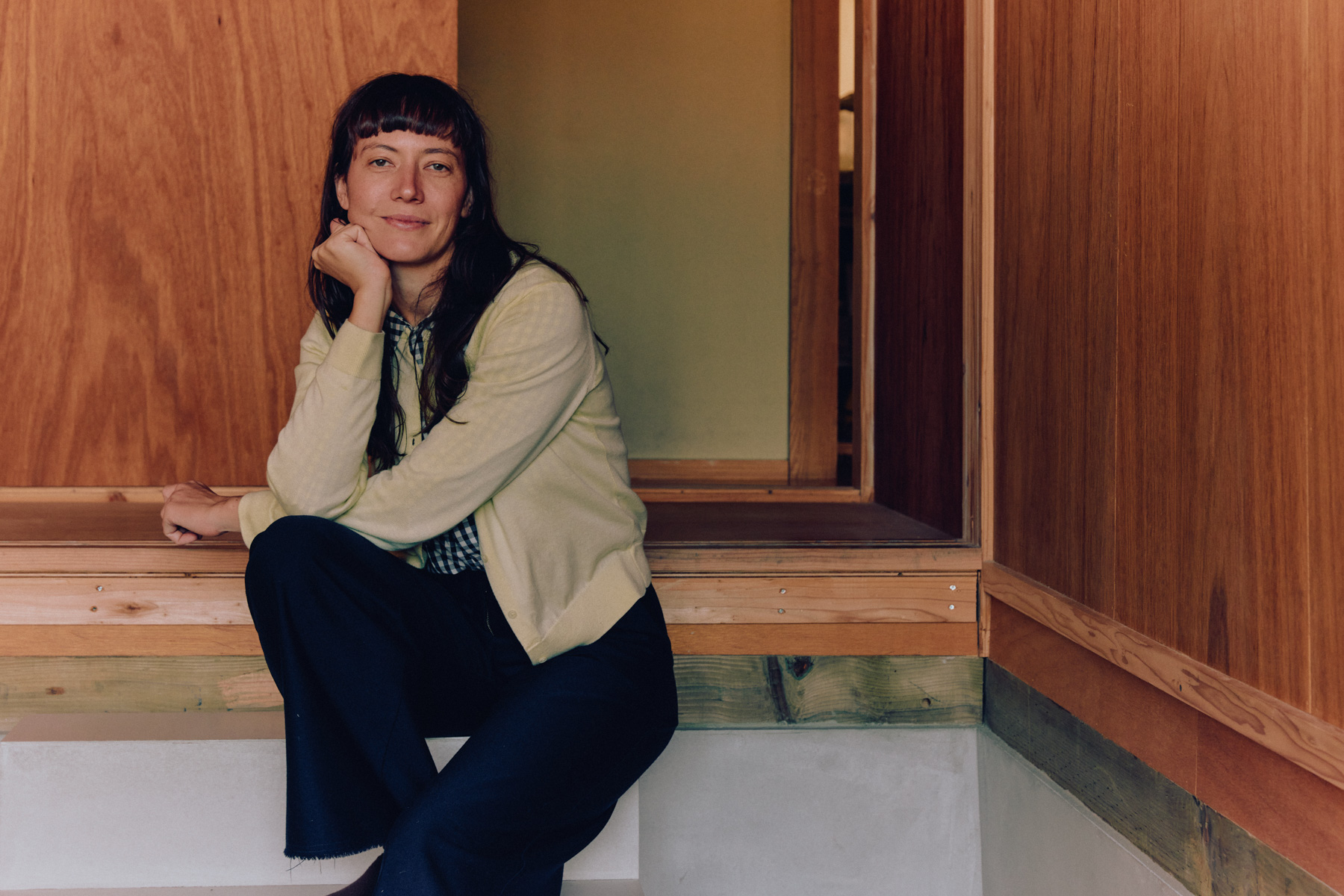
It all began, fittingly, with clay under her fingernails. When designer-turned ceramicist Layla Cluer found herself spending time in a pottery studio tucked under the deck of the house she shared with friends in Byron Bay, she hadn’t planned on building a brand. In fact, Cluer was preparing to move to London for a Master of Fine Art but found herself captivated by the humble process of shaping porcelain. “I got stuck in the mud,” she says, laughing. “I just loved it so much. I was like, ‘Why am I going to London when I’m feeling really fulfilled right now?’”

From that moment of muddy revelation grew Softedge, the ceramics studio Cluer founded in late 2019 after returning home to the Northern Rivers in New South Wales. Today, the brand is known for reimagining the act of eating as artful, with a range of colourful tableware that is beautiful without compromising on function or quality.
Softedge pieces are produced in Hasami, Japan – an historic porcelain town in the verdant mountains of Kyushu Island, where artisans have honed their craft for more than 400 years. Hasami’s unique divided-labour system means that every object passes through many hands before being finished, with each family-run workshop contributing a specialised step in the process. For Cluer, it’s not just about production – it’s about a sense of community. “It’s an amazing thing to see this whole town collaborate effectively to make different pieces,” she says. “There’s this incredible sense of community… everyone’s kind of depending on each other for their livelihood.”
That sense of interdependence shapes the very essence of Softedge. The brand’s name itself embodies Cluer’s resistance to being boxed in. With a background spanning architecture, fine art and curatorial work at RMIT’s Design Hub Gallery, she describes softness not just as something aesthetic but as something conceptual. “I had been working really hard and burnt out a bunch of times, and it was this moment where I was like, ‘I want to lean into being softer with myself,’” she explains. “It can evolve. For me, it was like a layered kind of meaning rather than very singular.”
The duality she speaks of – soft yet strong – mirrors the nature of porcelain itself. It’s a material that requires patience and precision; qualities Cluer has absorbed through her collaborations in Hasami. Each plate, bowl or jug has to go through an intricate process of modelling, moulding and firing, with clay shrinking up to 15 per cent in the kiln. It’s a balance between control and surrender. Cluer designs each piece by hand before digitising it and working with mould makers in Japan to refine the form. “Sometimes it’s about adjusting the thickness of the clay,” she explains. “But I find designing things by hand better because, just ergonomically speaking, you get a sense of how proportionally it relates to the body… I start with hand modelling, then I digitise it, and then that’s given to the mould maker and we go through an iterative prototyping process.
Cluer’s architectural training shows in this method, almost like a balancing act between structure and emotion. But it’s her fine art and curatorial instincts that infuse the pieces with their quiet power. The Rolled Rim dinnerware range, for instance, was inspired by the medieval fable of Cockaigne, a mythical land of plenty. “I was thinking about those long, extravagant meals. It was during Covid that I designed it and I was really missing being with my friends and just having these sprawling afternoon meals… and so I kind of tried to capture that in the design.”
That sense of warmth flows through every curve in her pieces. The Ewer jug in particular embodies generosity, both in size and spirit. “I wanted to create this object that was very welcoming,” says Cluer. “It holds four and a half litres, but it’s cast out of a single piece of porcelain. There’s quite a lot of surface area… and because the handle is hollow, it means there’s lots of area to grab and actually pour it quite easily.”

For Cluer, the table is a place of connection. “I think good tableware should accompany you throughout your life and be there at celebrations and different moments,” she says. “It becomes a witness to your life.” In a time of disposable design, her approach is almost radical in a way. “I feel like there’s this pressure for newness all the time. But with homewares in Japan, everything is tried and tested. You’re aiming to make something that’s a classic… we don’t need so much newness. We want to make things that are lasting.”
From her time in Hasami, there’s a certain philosophy that has been embedded in Cluer’s practice, one of humility before material, reverence for the process and a resistance to haste. she also describes folding her futon each morning in her tatami room there, enacting a ritual of clearing space before beginning again. “I just really love clean places. You’re kind of pruning your own mind,” she says.
When she returns home to the Northern Rivers, that outlook guides her to the table, too. When she thinks of her tableware, she envisions a simple but beautiful scene unfolding before her: “Sunday pasta served family-style, with lots of salads, crusty bread, generous pats of butter and plenty of olive oil. Ideally eaten alfresco.” It’s an image that captures Softedge perfectly – honest, tactile and meant to be shared.
Though Softedge is gaining a following, for Cluer, the work still remains quite personal. She’s expanding into new materials, including fibre-based designs that balance sustainability with form. “And then I’m in the beginning stages of working on a new product line that is also porcelain,” she says. “But it will be slow – I’d rather refine the product than just make something for the sake of making it.
“Am I a designer?” she muses. “I’m one two months of the year. I’m a graphic designer a bit more often. An object designer, that’s for sure.” That self-effacing humour belies the poetry in her work. In a world obsessed with speed and novelty, Cluer’s work in Softedge is a gentle argument for the beauty of slowness – for the curve of a porcelain rim, the gesture of a voluptuous jug and the joy of sharing something handmade.