
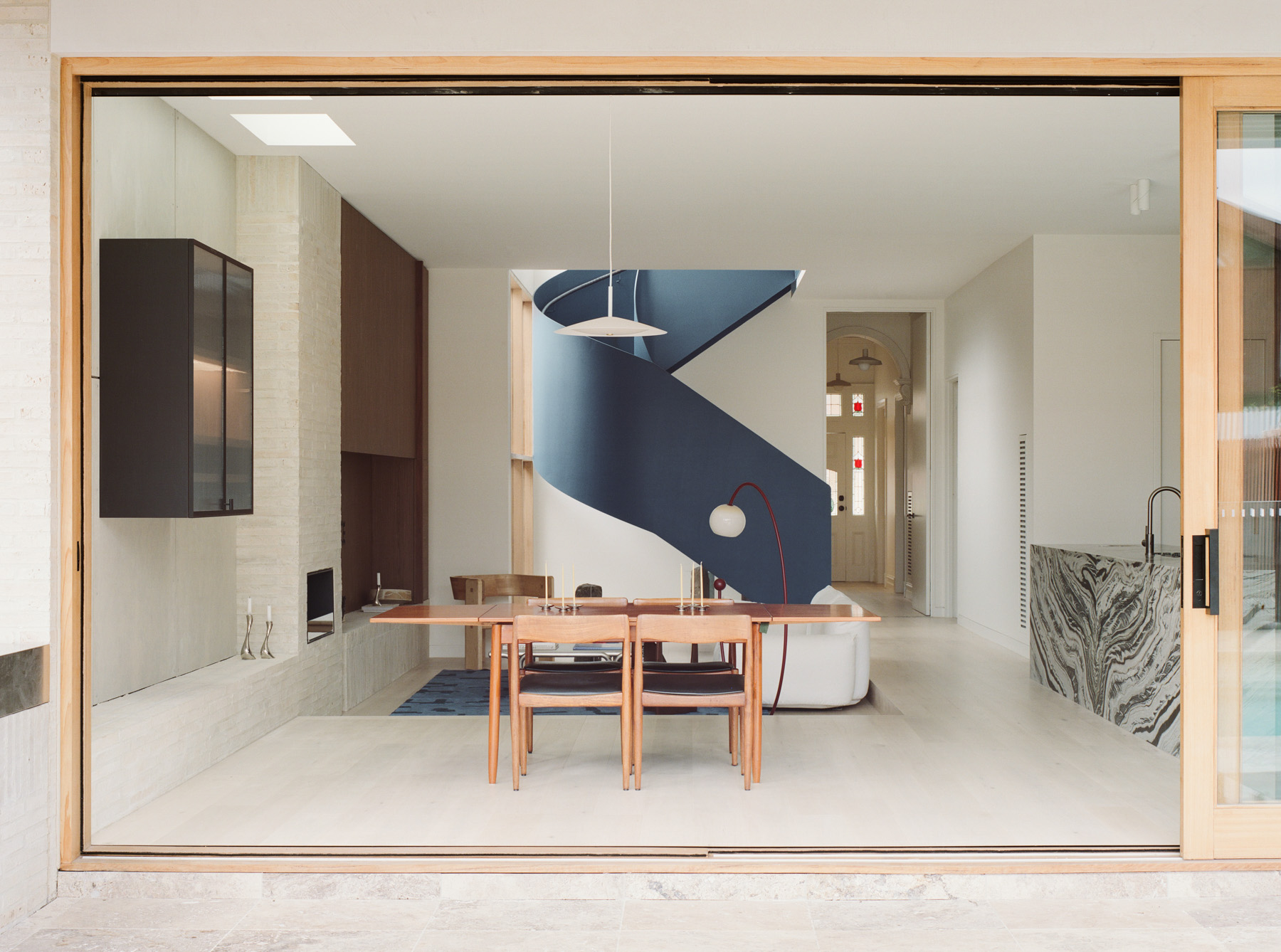
Ramsden
With subtle nods to literature, music and architectural history, James Harbard Architect uses layers of memories and influences to craft Ramsden, a home defined by an enduring sense of familiarity.
In Melbourne’s Clifton Hill, Ramsden is a collage of history, personal expression and material restraint. Designed for architect James Harbard’s long-time friends, the project is guided by trust and instinct, balancing the everyday with a considered architectural language.

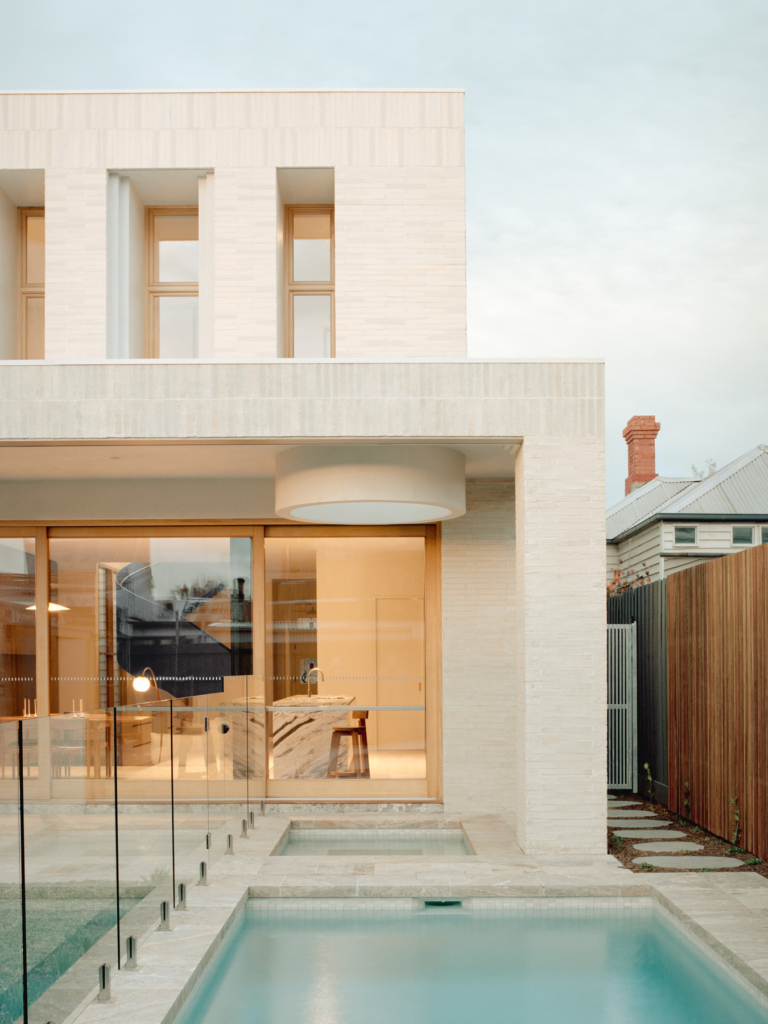
Ramsden is “a family home assembled from fragments of memory. It’s not about nostalgia but about connecting the past with the present in a way that feels natural.”

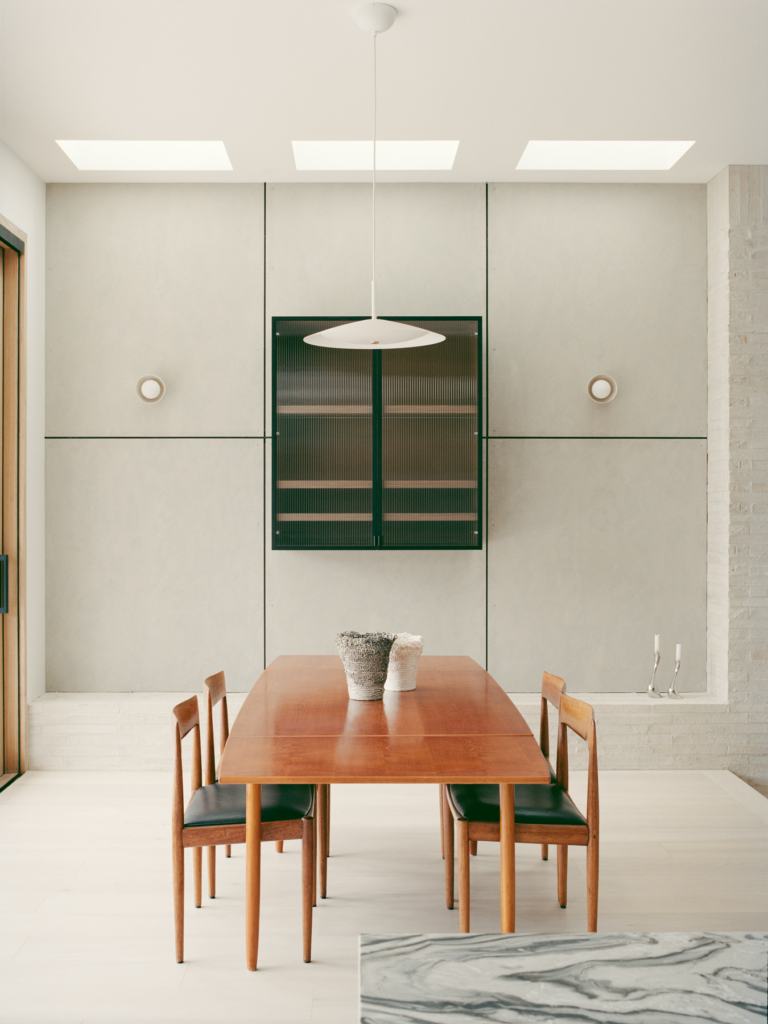
The brief called simply for a functional family home, free of a defined style. “There was an underlying expectation that we were going to try and do something a bit special, but there was definitely no Pinterest moodboard or expectation of what it was going to look like,” says Harbard. This rare creative freedom allowed the dwelling to evolve naturally, leading to a rich dynamic between form, texture and colour.
As the architect describes it, Ramsden is “a family home assembled from fragments of memory. It’s not about nostalgia but about connecting the past with the present in a way that feels natural.” These connections are subtly woven into the building’s fabric: the stair window recalls a childhood home of the client, the kitchen orientation mirrors another. “It was about making it feel familiar to them,” he says. “I don’t want them living in a theme park of 20th-century history – they’re little moments that pop up.”





Harbard’s approach to layering was influenced by his longstanding fascination with writers and musicians who work through collage and rhythm. WG Sebald’s The Rings of Saturn – a meandering reflection on history and memory – was particularly formative. “Sebald’s way of drifting between times and places, blending the personal with the historical, helped me understand how architectural meaning can be built up through fragments.” Similarly, electronic musician Fennesz’s album, Venice, with its looping melodies and dissolving soundscapes, shaped Harbard’s sense of tone and tempo. “It’s that same idea – small moments overlapping to create atmosphere.”
Those fragments are expressed in Ramsden through careful detail and proportion. The plan follows a rational two-storey structure, establishing clarity and order before introducing texture and rhythm. “It’s a clear framework that gives structure to everything else – it allows the smaller, more expressive gestures to have meaning,” says Harbard. Deep reveals at the rear facade, first developed for practical screening, became opportunities to play with depth and shadow. A single exposed steel column in the kitchen adds what Harbard describes as “a dash of tectonic discipline – a moment that balances playfulness with structure”.
Colour brings further cohesion and atmosphere. A deep blue – the project’s defining gesture – appears in the stair, joinery and kitchen surfaces, uniting the home visually and tonally. “Using blue was something we talked about really early,” says the architect. “It’s the client’s favourite colour, and I immediately thought of Gio Ponti’s Hotel Parco dei Principi. His use of blue is so rich and layered, and it’s not just decorative – it’s existential to the project.”
At the heart of the plan, a steel spiral stair painted in Dulux’s Deep Ocean and finished with carpet in Supertuft’s Saskia and a leather handrail acts as both an anchor and gesture. “It’s raw steel, straight-up structural. But once we painted it this deep blue, it became something softer and more welcoming.” The same hue reappears in marble benchtops and flooring details, creating subtle continuity throughout. “If you took the blue out of this house, it would really subtract from it – it holds everything together.”



Ramsden’s atmosphere is calm and grounded, more considered than expressive. “Even though blue’s not a warm colour, it has this effect that softens everything,” says Harbard. “The architecture feels contemporary, but there’s still warmth and familiarity.” While the tone is a defining element, the overall palette remains quiet. Pale render, marble, steel and oak joinery by JNB Interiors reveal texture rather than ornamentation, and furniture and lighting by Dutoit Studio, Nicole Lawrence Studio, Dalton Stewart and Trit House enhance the interior’s meditative quality.
That sense of ease extends to how the home is lived in. Circulation and planning are designed around comfort, with rooms unfolding freely from one another. “I wanted it to feel natural and easy to live in,” he says. “The goal was to create something that didn’t require the family to adapt but still had moments of discovery and small surprises.” Among those are a breakfast bar overlooking the pool and a front library designed around a long-held wish for a book-lined room – gestures that tie function to emotion without overstating either.


Throughout, there’s an underlying confidence in how the design references history without imitation. Subtle details nod to Carlo Scarpa’s handling of thresholds to Mies van der Rohe’s sense of precision and to Ponti’s playfulness – yet these gestures are absorbed within Harbard’s own architectural language. “I’ve always been drawn to the idea of pulling fragments together and seeing what happens when they overlap,” he says. “I love artists who approach their work from a personal perspective, where you can’t quite tell what’s borrowed and what’s original.” In Ramsden, this is evident not only in the details but in the atmosphere itself – measured, composed and quietly familiar.
Four years into his practice, Harbard sees the project as a defining moment. “It’s the first house that I’ve done that I’m genuinely proud of,” he says. “It’s not just about me – it’s about the alignment between the client, the builder and the idea. Everything lined up.”
Ramsden is a home of calm precision and layered meaning, where history and everyday life are held in gentle balance. Through its measured geometry and warmth, it captures a rare sense of depth and ease, revealing how architecture can be both intellectually rigorous and humbly human at once. “It feels unique without being over the top,” says Harbard. “There’s a bit of surrealism, a few surprising moments, but it’s grounded – it’s playful in the right measure.”


