Retail’s Chic Evolution
Once transactional, now curatorial, Sydney’s latest flurry of luxury boutique openings has more in common with the art gallery experience than with a traditional retail offering.
The first half of 2025 saw Sydney become home to three brand new spaces for some of fashion’s most influential names. French houses Chanel and Celine, and Spanish brand Loewe, each opened new flagships across the city that forego the familiar racks and storefronts to create what can only be described as sanctuaries or galleries, with spatial compositions that weave art and design into each brand’s offering. Rather than overstate their presence, each label’s space sharpens it with a series of tactile touchpoints that build on their innate design language.

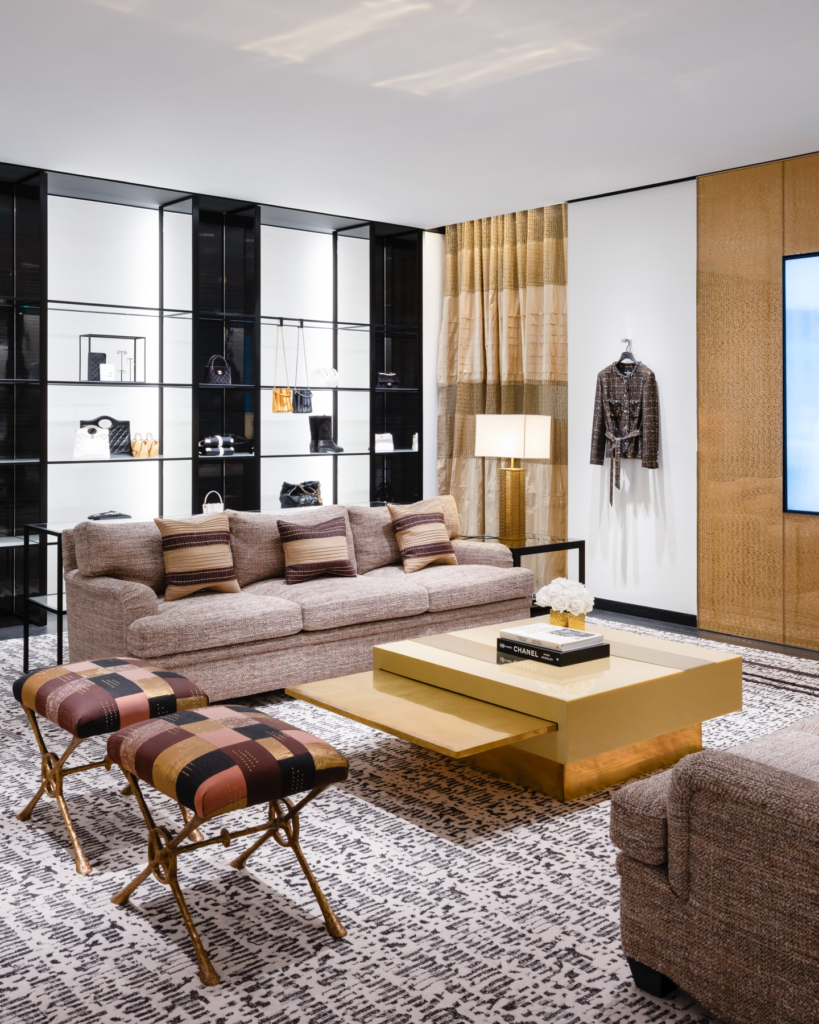
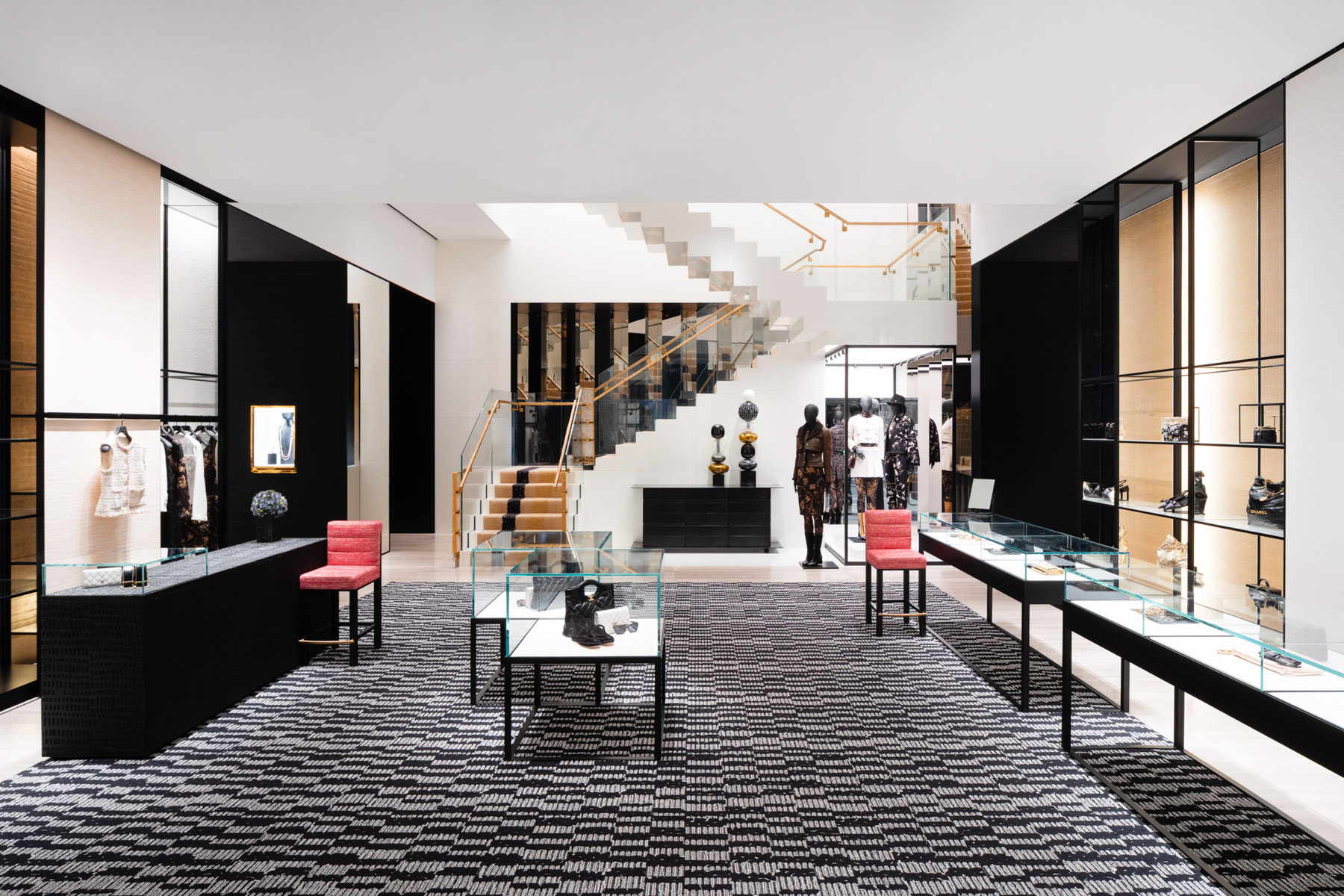
With a new two-storey boutique on Market Street, Chanel leans into a sense of history appropriate for the century-old brand, anchored by the 1936 heritage facade but internally plays out like a study in Parisian tactility, mirrored surfaces, lacquered Coromandel panels, custom antiques and suede upholstery that recall Gabrielle Chanel’s own apartment at 31 Rue Cambon. The maison’s first Australian fine jewellery and watch salon is tucked into a ground-floor wing, its own entrance underscoring its significance. Pieces from Chanel’s patrimonial collection, including high jewellery, rotate through the space alongside recent releases such as the J12 Bleu watch, a ceramic model developed over five years in the brand’s La Chaux-de-Fonds atelier.
Designed by frequent collaborator Peter Marino, the boutique’s interior conveys the brand’s signature understated aesthetic. Quiet passages of suede and stucco are offset by sculptural light fittings, crystal, bronze and a commissioned abstract by Simon Hantaï. Furniture selections, such as a Regency writing desk and Roberto Menghi chairs in tones of ochre and ivory, connect back to Gabrielle Chanel’s own design language. The boutique becomes a mise en scène for the brand’s own mythology.
Upstairs, ready-to-wear is housed in rooms that read more like salons than sales floors. Mirrors, light and negative space are deployed not to elongate but to ease – there is clarity between each zone and a deliberate control of tempo. The effect is less about awe and more about intimacy. Even the acoustics are hushed. As the president of Chanel watches and fine jewellery, Frédéric Grangié noted in the lead-up to the launch that the intention was not to replicate New York City or Los Angeles but to create something that felt distinctly of Sydney: open, luminous, but with gravitas.
Opened in April on the third floor of Westfield Sydney, Loewe’s new 245-squaremetre boutique repositions the Casa concept for an Australian context. The facade alone – latticed, translucent and finished with curved glazed tiles – creates a softened boundary between inside and out. Light is not just admitted into the space but shaped by it. It moves with the day, changing the store’s interior register without a single product having been touched.
Inside, materials talk to each other: concrete next to oak, turned iron alongside ceramic, and a palette that drifts through marine greens and ceramic blues gestures back to the Pacific Ocean. Handmade Spanish tiles ripple across surfaces, their irregularities catching light at oblique angles. It is a subtle but effective articulation of brand code, pulling Loewe’s Iberian roots into a new topography. This is not about contrast but consonance.
Furniture is selected with curatorial precision. Utrecht armchairs by Gerrit Thomas Rietveld, Berin club seating by BDDW and Isamu Noguchi’s Akari light sculptures sit in loose formation, each offering a different mode of rest. Underfoot, wool rugs rework British artist John Allen’s tapestries into woven panoramas of Cornwall’s tin mining district and Seven Sisters on the English Channel coast in East Sussex. These are not embellishments, they are design cues. They expand the notion of what a store should do – display, naturally, but also hold space.
Loewe’s retail logic is anti-performative. The boutique functions like a well-composed home, where leather goods, perfumes and scarves are folded into a larger world of craftsmanship and culture. This includes works from the Loewe Foundation collection, such as ceramic vessels by South African artist Hylton Nel and a life-sized sculpture by Mexican artist Andrés Arna that explores the border between internal perception and external reality. There is an intimacy to the pacing, a sense that clients are encouraged to dwell, not just consume.
If Chanel is theatre and Loewe is the celebration of craft, Celine is a study in cinematic austerity. The new Bondi Junction flagship, at 210 square metres, is part of the global architectural program directed by Hedi Slimane. Arabescato marble and travertine line the space, antique gold mirrors are set into walls of black lacquer, and oak wood is used throughout, contrasting natural textures with high-shine surfaces.
Backlit crenellated mirror panels extend the volume and distort reflection. The space suggests restraint with precision display and sculptural composition. Shoes appear in isolation, products in singular rows – a measured clarity that reflects Slimane’s philosophy of removal over addition.
Furniture is sculptural, rare or custom. It’s also the store that takes the concept of a gallery to its most literal; it’s home to a selection of art, which forms part of the Celine Art Project. In one iteration are Australian artists Elizabeth Newman and Augusta Vinall Richardson. Newman’s oil works on MDF strip away all but the essential – they hold space through absence. Vinall Richardson’s bronzes, shaped from casts of paper and cardboard, explore fragility in solid form. They appear almost accidental and then they hold your attention longer than expected.
What all three boutiques understand is that design is the message. Each brand has used architecture not as background but as vocabulary, a means to communicate more deeply with clients who already know the logos. There is a shared rejection of noise, of repetition. What then remains is material, space and light.
Together, these stores frame a new language for luxury in Sydney. They are not loud, and they are not designed to catch passing traffic. They are considered insertions, designed not decorated. Each one recalibrates retail back towards what it arguably should have always been: spatially intelligent, materially precise and emotionally attuned. In doing so, they also mark a shift in Sydney’s own retail identity. Long defined by seasonal drops and window displays, the city’s luxury landscape is finally engaging in a more design-centric conversation.