
Six Six
On Melbourne’s Little Collins Street, Six Six by Kennedy Nolan reframes the rituals of optometry through a more deliberate lens.
Conceived as both clinic and retail environment, the project steps away from the conventions of its typology, replacing it with something slower, more attentive and spatially composed.

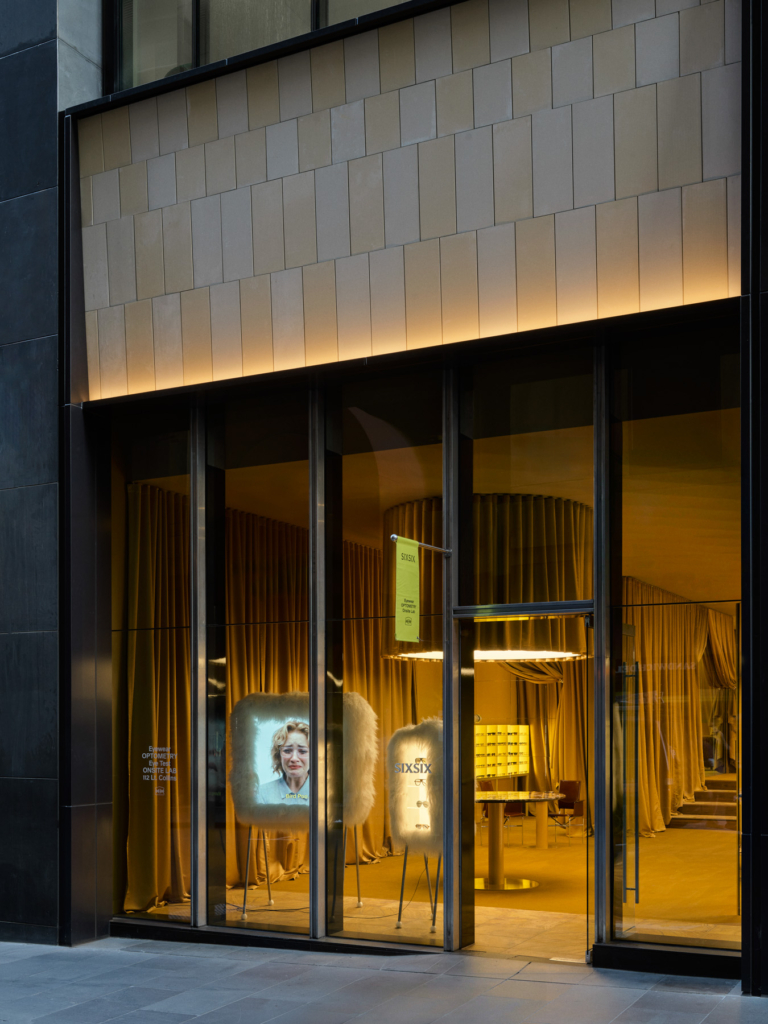
Frames are positioned deeper within the plan, encountered gradually rather than all at once.
From the outset, the brief invited a reconsideration of what an optical store might be. Working with Six Six founders Emma Buckley and Dr Natalie Boffa, Kennedy Nolan approached the project with restraint, prioritising experience over display and atmosphere over efficiency. “We wanted to disrupt the expectation of immediate browsing,” says Patrick Kennedy, director at Kennedy Nolan.
Rather than presenting eyewear in full view, the design holds it back. Frames are positioned deeper within the plan, encountered gradually rather than all at once, encouraging a more measured way of moving through the space.
The first interaction is not with product but with a point of welcome. Staff occupy a central table, which establishes a more conversational beginning, shifting the experience away from transaction. This sense of pacing continues throughout, with moments to sit, pause or step aside. “Choosing something as critical to one’s appearance as glasses takes time and should not be rushed,” Kennedy says.
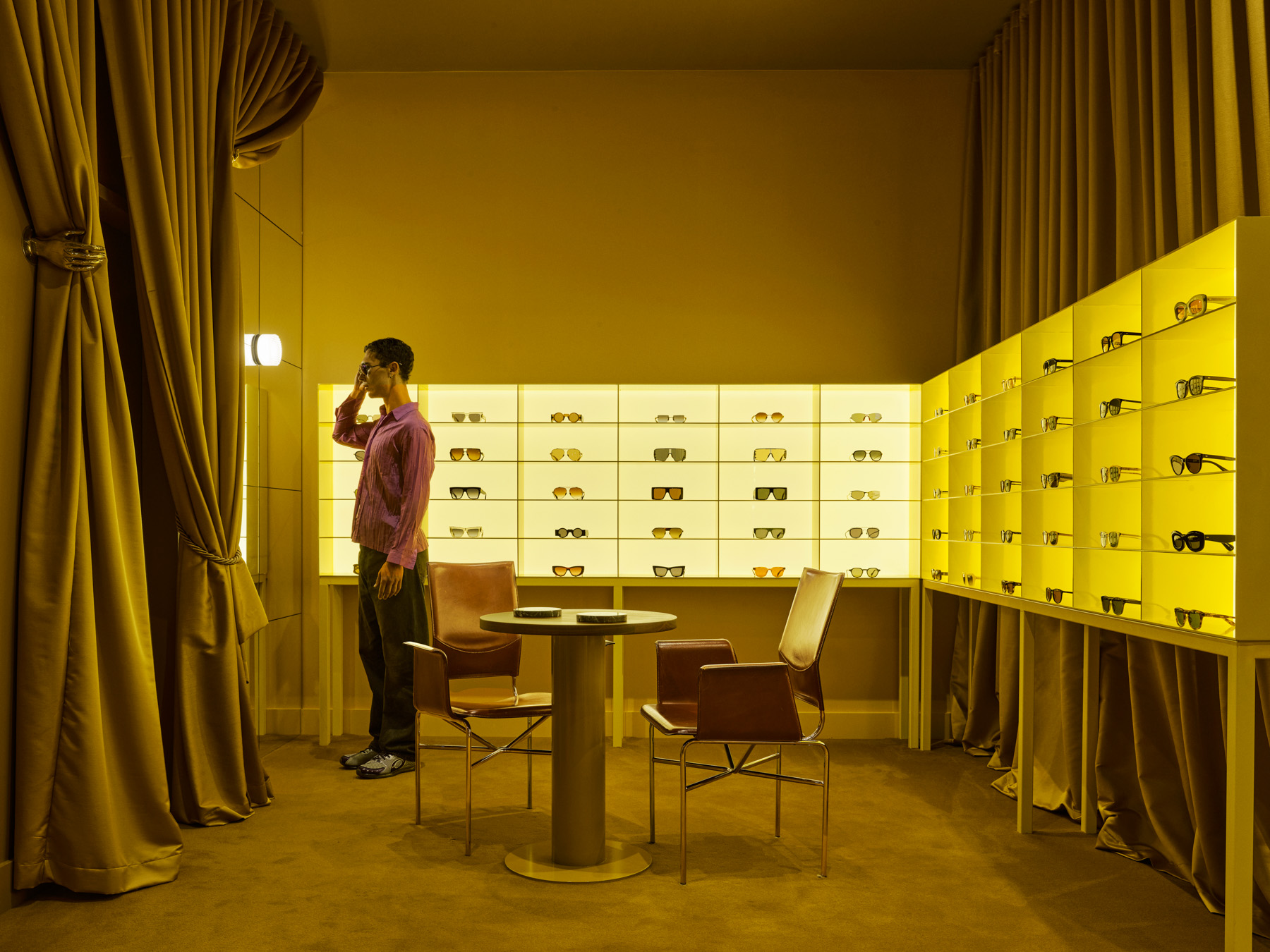
The interior is anchored by a warm, tawny gold – a tone that reads as both backdrop and atmosphere, casting a soft, even light across the room. Around it, layers of texture introduce variation: drapery softens the perimeter, carpet provides soft comfort underfoot, while steel, stone and timber bring moments of weight and contrast without interrupting the overall calm. Rather than defaulting to conventional tones, Kennedy Nolan sought “an energising neutral” that would sit comfortably against a range of skin tones while enhancing the experience of trying on eyewear.
The interior is anchored by a warm, tawny gold – a tone that reads as both backdrop and atmosphere, casting a soft, even light across the room.
Attention is given to how the space feels in use. Sound is absorbed through soft finishes, reducing distraction and allowing conversations to remain contained. Mirrors are positioned to offer a degree of privacy within the open plan, creating smaller zones within the larger room. These gestures acknowledge the intimacy of the experience: the act of trying on glasses, seeing oneself differently and taking time to decide. For Kennedy, this meant ensuring that “the other senses need to be de-stimulated” so that focus can remain on the visual task at hand.
Towards the rear, the clinical aspects of the practice are revealed more subtly. “Our design celebrates the technical work, placing it in a lab that is visible through a dichroic glass wall, appropriately obscured by this ‘architectural’ lens,” Kennedy says.
Mirrors are positioned to offer a degree of privacy within the open plan, creating smaller zones within the larger room.
Six Six is defined by its restraint. It doesn’t rely on a singular gesture but on a series of measured decisions that shape how the space is encountered. The result is an environment that feels calm and assured – one that encourages a slower, more considered way of choosing, where time becomes part of the experience itself.


