Dolly
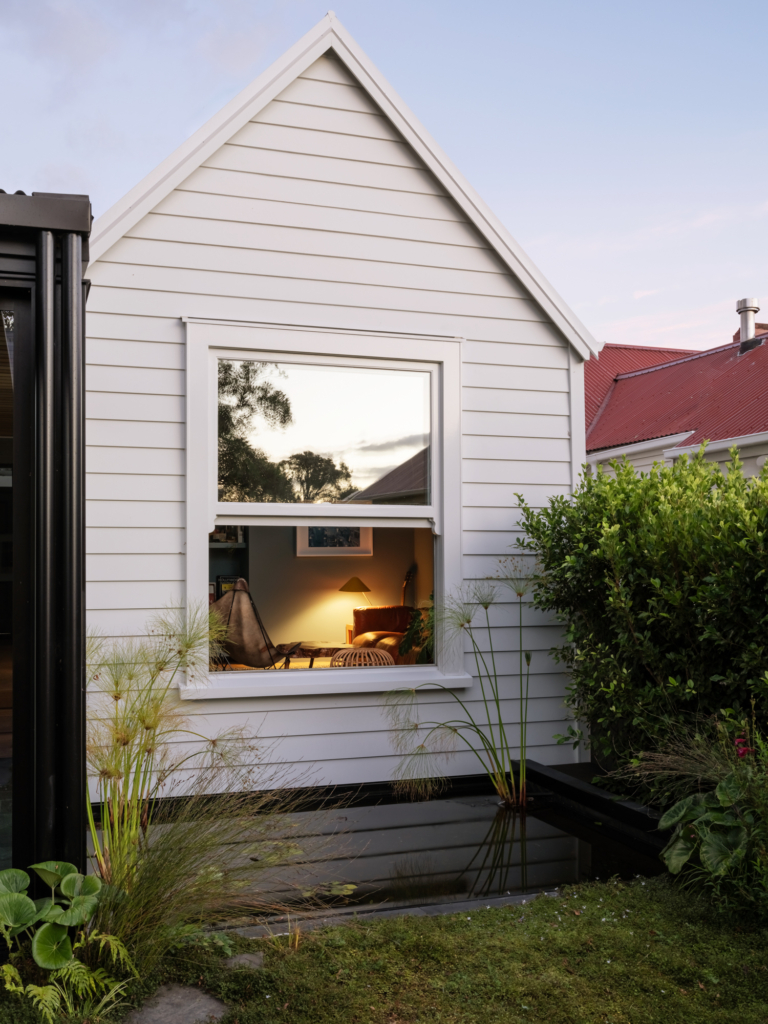
Architect John Irving’s Auckland home deftly balances charm and restraint with characterful touches, including an old-fashioned picture window, weatherboard cladding and gabled forms.
After viewing his future home for the first time, John Irving, whose studio is located just over the hill in Auckland Central, quickly sketched his plans to ensure that his vision for a courtyard-focused dwelling for himself, his partner and his daughter could be realised. He found that it could, and a year or so after he purchased the property with a clear intention to reimagine it, work on Dolly began.

The extensive scope involved demolishing the “raggedy add-on bits at the back” and building a new rear extension around a central courtyard, as well as completely reworking the existing interiors. Firstly, the cottage was raised above head height in one fell swoop in order to facilitate access to the rear. “We lifted it up high enough to get diggers through to the back, poured the back slab, then plonked it back down again,” says Irving, who adds that “it’s easy to do – these cottages are basically garden sheds.”
Once the home was returned to its rightful place – albeit set one metre further back from the boundary to allow for off-street parking at the front – it was pared back and restored. The “icing and frilly bits” that had been added over time, including latticework and a decorative balustrade, were removed, and the weatherboard cladding, shingled roof and original windows were replaced, attuning the house more closely to its utilitarian, workers’ cottage heritage.
Driven by the contrast of old and new, Irving has instated differing yet complementary design languages for the front and rear. The cottage is defined by immersive yet airy spaces, often realised in tone-on-tone palettes. In the living room, the walls, ceiling, architraves and window frames are entirely doused in a deep shade of cyan, and both bathrooms have been laid top-to-toe in mosaic tiles – one in forest green and another in a blueish grey – the all-encompassing effect of which Irving describes as “like being underwater”.
The hallway is wide and bright, with a soaring ceiling, and a large skylight brings abundant sunshine into the heart of the dwelling. Conversely, the new volume at the rear is stepped down, with a lower ceiling lined in cedar panels. This is an important juncture, emphasised by the change in floor level and ceiling height, as well as a shift in materiality. “I’m obsessed with the theatre of arrival,” says Irving. “For any project, when I imagine someone visiting for the first time, I like to have a spot where you have your wow moment. In this project, it’s right there at the end of the hallway.”
Conceived as a space that reaches out to yet also feels contained within its environment, the rear extension has darker tones, reams of texture and a number of strategically placed windows. The program is orientated around the courtyard, which features surfaces both paved and planted, as well as a pond. “Everything spins around the courtyard, and you mentally borrow that space,” says Irving. “It’s interesting how small something can be and still feel very luxurious.”
Skylights and windows are integral to creating this sense of welcome. In the living room, an east-facing picture window captures views of the neighbourhood, perfectly framing the city’s iconic Sky Tower. The rear gabled volume features two high-level triangular windows that span the form’s width. Constructed from single panes of glass, they offer seemingly endless views of the sky and nearby tree canopy, opening the compact space to its context and elegantly belying Dolly’s tight suburban condition.
Despite the many openings and connections between inside and out, this rear space can be extremely cocoon-like, a feeling enhanced by the shadowy tones and textures. For instance, the kitchen is in a predominantly dark palette with a polished stainless-steel splashback, and the walls are a sumptuous shade of military green that reflect the hues in the planted courtyard and surrounding greenery.
“Everything is moody,” says Irving. “There’s variation, colour and warmth, and that really brings it to life.” Much of this variation comes from the slate flooring, the surface of which has infinite movement. “Slate is a stone I’ve always loved because it’s split, not cut, so you get veins and an innate unevenness that’s much nicer underfoot than a cut stone.”

There are many things Irving loves about Dolly – from the tactility of the slate and the cedar-lined sauna to the sound of trickling water coming from the pond – but one of his greatest joys is to simply sit in the rear volume during the evening, with the lights low and the woodfire burning, and look out at the courtyard. For Irving, the embrace of sanctuary easily comes to mind, and that’s just what Dolly is.
Architecture and interior design by Studio John Irving Architects. Build by Urban Space. Landscape design by Xanthe White Design. Engineering by Constructure. Joinery by APL Window Solutions. Flooring, stone and tiles by Artedomus. Appliances by Fisher & Paykel.