Matakana Inlet House
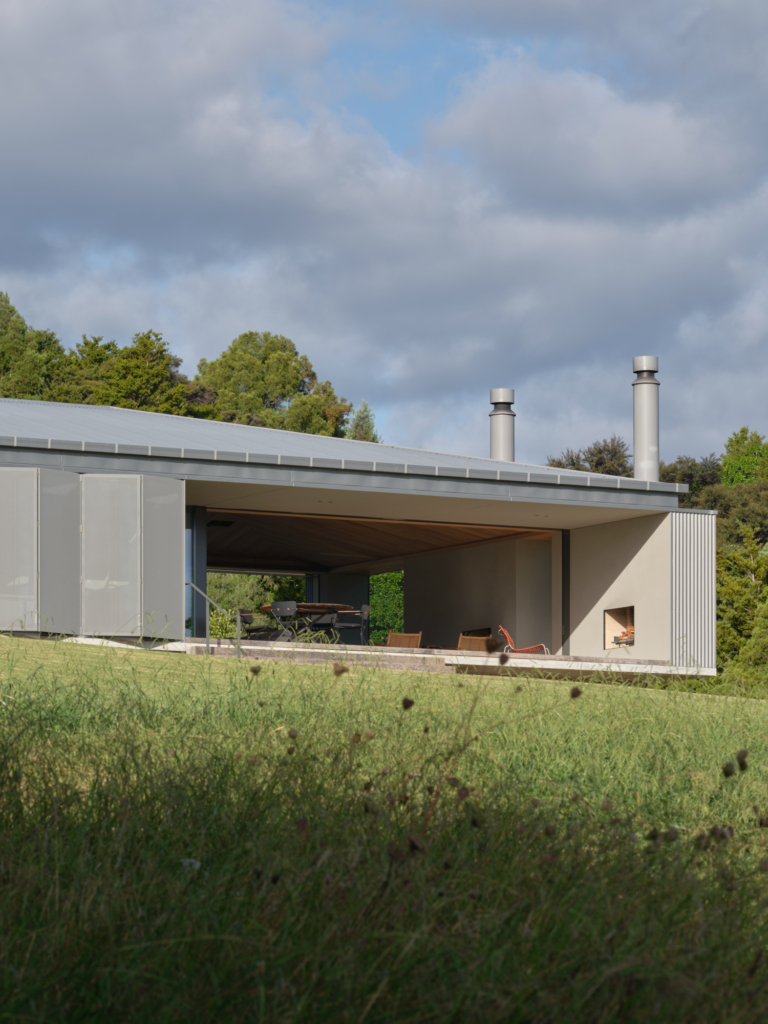
This rural home by Fearon Hay presents a modest facade and an elegant simplicity of design, allowing the focus to rest on the magical views and the purity of the pastoral setting.
Great architecture can proclaim itself with a roar or a whisper, but sometimes it’s the quieter, more modest designs that are the most impressive. This hillside home north of Auckland comes under the latter classification, a simple box design that impresses through its seamless dialogue with the sloping land.




The site presented Fearon Hay with equal parts challenge and opportunity. The hill slopes down to the water, affording the site tranquil, bush-fringed views over Matakana Inlet. On the flipside, it also rises behind Matakana Inlet House like an overzealous protector, shielding it from the elements while also blocking a substantial amount of light from the north. “With the north sun rising up and over the top of the hill, what we needed to do was create an outdoor space where you could enjoy the sunshine from morning through to the middle of the day, and then try to create another space on the other side of the house, which allows you to take in the evening sun over the water,” says director Jeff Fearon.
This challenge drove the design of the house into a narrow rectangular format, cupped by outdoor spaces on both sides of the living zone. Walls of glazing allow the entire space to open up completely – on warm, still days, the interior becomes a thoroughfare for one to wander between the courtyard and the elevated verandah, which is positioned to appear perched, almost floating, above the land as it flows down to the water. When the weather is inclement or a sense of intimacy is desired, the glazed sliding doors can be shut, still allowing light and views throughout. These spaces have their own personalities, from the sheltering embrace of the courtyard to the extroverted openness of the deck, but each is anchored by a fireplace, which provides a visual connection between all three zones, as well as a welcoming warmth.


Shelter was a focus on both sides of the design. The courtyard is snuggled into the contour of the hill and embraced by walls on all sides, while on the southern (water) side, the Fearon Hay team incorporated a wall of folding screens, giving Matakana Inlet House an extra layer of architectural interest as well as even more flexibility. These screens can be partially or fully retracted, opening the home to the elements and the full impact of the views. When closed, they bring a sense of depth to the interior spaces. Made from perforated aluminium sheets, the screens filter the views yet maintain transparency and allow soft light and gentle airflow to permeate.
The aluminium was chosen for its durability in the face of demanding coastal elements, a consideration that also dictated the other exterior materials: predominantly concrete and zinc sheeting. “The palette is based on the idea of the materials weathering and enhancing their appearance over time,” says Fearon. The other driving force was the clients’ request for simplicity, to complement the site and match their vision of a modest rural retreat. “The architectural palette … was very much planned for that idea of a house in the country, a very simple silhouette and a single material to clad both roof and walls.”

A sense of simplicity likewise inspired the interior design, which was created in collaboration with Amelia Holmes; it has “almost a homogenous material palette, the whole space feeling like it has been carved out of one particular material,” says Fearon. Pale oak was selected for its warmth and taken from the floors up over the walls, ceiling and cabinetry. Narrow timber blades at clerestory level contribute subtle shadow play and draw the eye up to the ceiling, the gentle pitch of which is emphasised by the variation of the timber boards.
“The oak flooring, cabinetry and the ceiling and wall linings give a very consistent and homogenous feel to the space itself, and they also have a sense of warmth and tactility that directly complements the exterior palette of slightly tougher materials.” Coupled with judicious injections of plaster and stone, the overall effect is of serenity and harmony with the natural setting.


All design decisions ultimately came back to the location and its tranquillity. Matakana Inlet House seeks to engage with the land at every opportunity, from the picture windows that frame slices of greenery – a lush alternative to the more obvious water views – to the landscape design by Andy Hamilton, which captures the variation and organic shapes of the existing bush, and the exterior materials, chosen to complement the environment as they age. For Fearon, there was an intention. “It is purposefully seeking to create a sense of calmness and connection to the land, using the gardens and the surrounding spaces to unlock the lifestyle that comes with living in this part of the countryside.”
Architecture by Fearon Hay. Interior design by Amelia Holmes. Build by BMS Construction. Landscape design by Andy Hamilton Studio.