Phoenix Central Park
Phoenix Central Park is a quietly radical structure set in the inner-Sydney suburb of Chippendale, borne from a rare collaboration between architects Wardle and Durbach Block Jaggers.
Art and motion guided every decision in its making, an ideology that reveals itself in the building’s fluid, sweeping curves.
“Architecture by its nature is a collaborative framework of creative endeavour,” explains John Wardle, founding partner of Wardle. “The deep friendship and remarkable conversations that drew us together over this sustained period of time are quite profoundly registered in the building that exists in Chippendale today.”
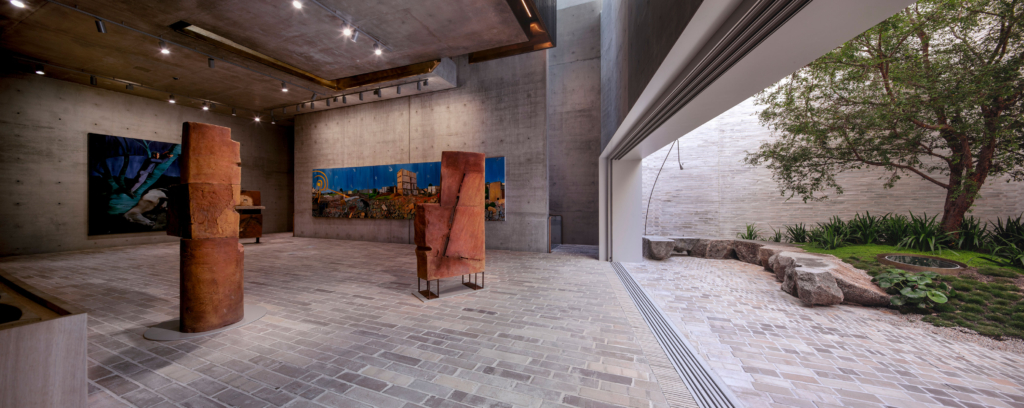
The two teams worked closely but focused their attentions on different parts of the project. Durbach Block Jaggers took the lead on the astonishing performance space, while Wardle designed the gallery; they came together in the outer courtyard, a breathing space that belongs to neither and both at the same time.
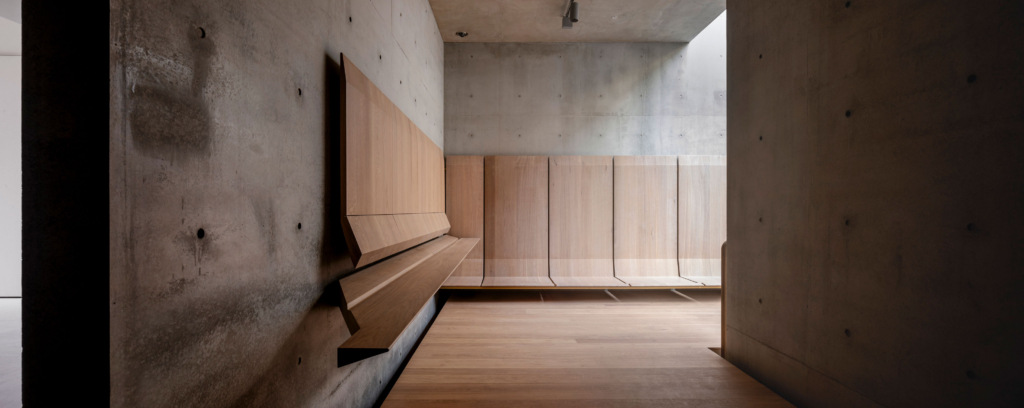
For Wardle and his team, the gallery raised an intriguing question about what exactly makes a private art gallery different from a public or commercial space. As they worked through the client’s incredible collection, two answers emerged. “I came up with two primary drivers, which lasted for the duration of the design: journey and intimacy,” shares Wardle. “These five tiny chambers, each one big enough only for one person and one work of art, really exaggerate the possibilities of intimacy in these discrete and separated spaces.” It was this quality of unfolding revelation that physically shaped the architecture.
The performance space sparked a similar question for Durbach Block Jaggers. “The brief was that there was no stage, there was no seating, there was no singular way of using the space,” says director Camilla Block. The response was bold, dropping the floor and lifting the ceiling for a triple-height room with curved wooden ceilings that prompts immediate awe. A direct stair and a spiral ramp offer two very different journeys through the space, the ramp doubling as a performance circuit with musicians often performing progressively up and ending on the balcony.
Material choices carry the same ambition and Wardle’s team sought to render prosaic materials newly fluid, pushing the boundaries of familiar forms. “The brickwork itself was treated like a veil, a light material, as it pushes against the edges of the skylights. Almost like a piece of fabric, it becomes soft as it registers the pattern above. It was immeasurably difficult to do – I celebrate those bricklayers.”
For the client, longevity was always the point, and that aspiration quietly changed the nature of every conversation. “Judith [Neilson] always said she wanted it to last 100 years. And there is a longevity in the materials we used, the detailing and the energy in bringing it all together. That changes the discussion; it isn’t about how quickly or cheaply you can build it. What’s the legacy? And that’s Judith,” shares Block. “Everything around this building was to accord with that requirement – to make it durable, adaptable, but built to last forever. And when you look at the extraordinary craftsmanship that came together in its making, it is a building that will be here for a long time”.