Pohutukawa House
Pohutukawa House settles into its environment with the ease of something that has always belonged there: weathered, restrained and deeply connected to the landscape around it.
For Nick Smith, director of Smith Construction, the project was shaped as much by its setting as by the family who would inhabit it. “This is one of Northland’s great strips of coastline,” he says. “There’s a lot of respect for the environment here, as well as the history dating back more than 100 years.” Rather than imposing itself onto the site, the intention was to create a home that blended into the landscape and enhanced it quietly.

The arrival sequence begins with an understated lobby that gradually unfolds into a generous central living area – expansive in scale yet intimate in feeling.
The sense of seclusion was immediate. Although located on a public beach, the property feels remarkably private, concealed within layers of established landscaping that the owners had carefully nurtured long before construction began. The brief called for a retreat that could comfortably hold an extended family – somewhere robust and relaxed rather than overly precious. “They wanted a home to live in,” Smith says. “Not just a piece of art that you can’t touch.”
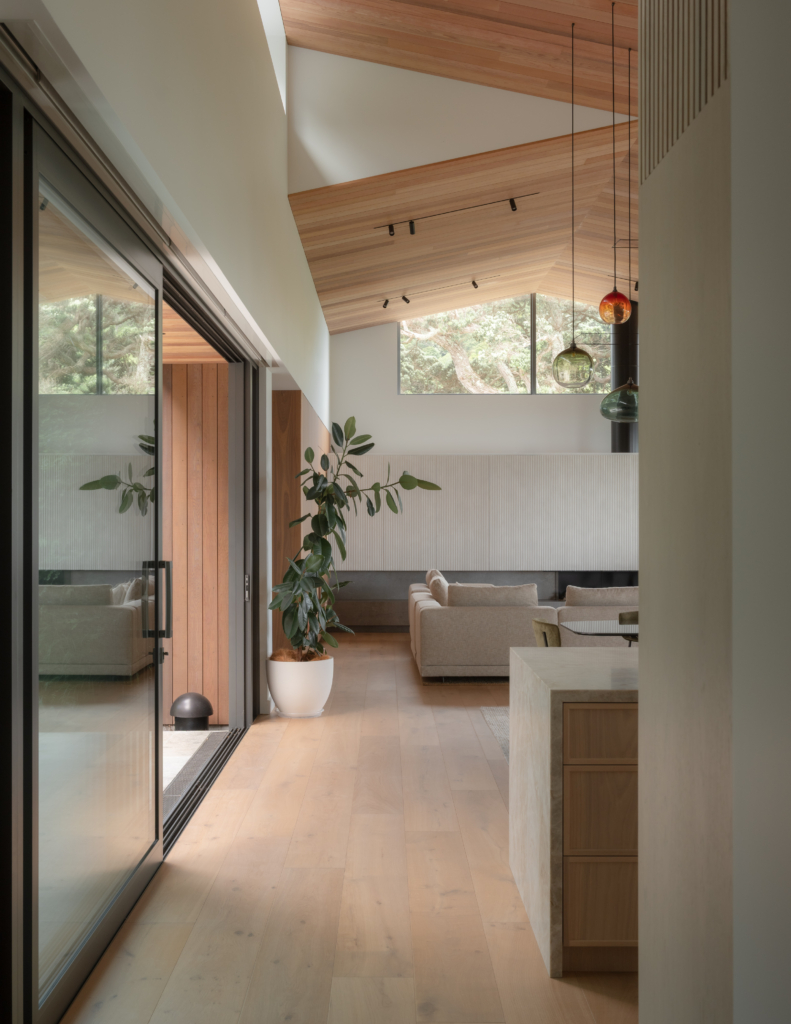
That thinking informs the entire spatial experience. The arrival sequence begins with an understated lobby that gradually unfolds into a generous central living area – expansive in scale yet intimate in feeling. From there, the house branches into a series of smaller retreats: a snug for movies by the fire, an art studio tucked beside an indoor-outdoor garden, guest accommodation concealed further down the corridor and, at the very end, a secluded main suite complete with indoor and outdoor bathing spaces.
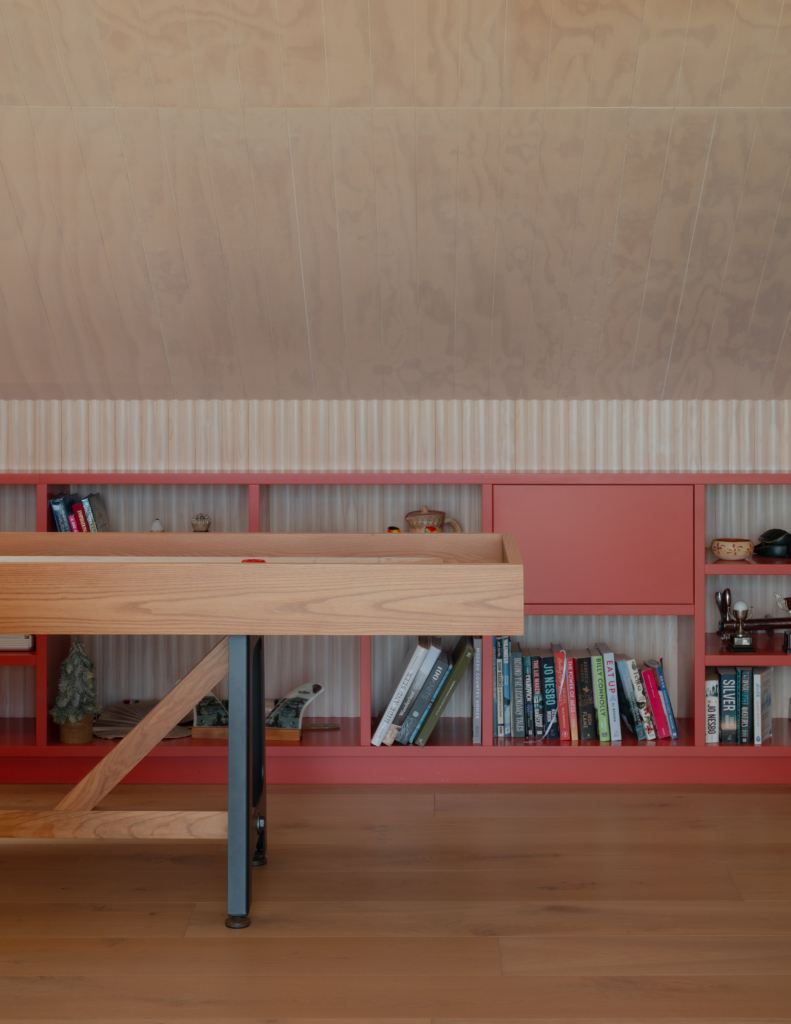
Elsewhere, the mood shifts towards recreation. Across from the main house sits the boatshed, topped by a tiki bar with a pool table, foosball table and uninterrupted coastal views. Despite the varied program, the home maintains a strong sense of cohesion, achieved through an intentionally restrained material palette and meticulous detailing.
Central to that cohesion is the flooring by Forté. Chosen in the Siltstone finish, the timber introduces warmth and tactility while reflecting the muted tones of the surrounding dunes and weathered coastal vegetation. “We were drawn to its colouration,” Smith explains. “The aged and rustic finish is sympathetic to the coastal environment around here.”

The wide-format boards were selected specifically to complement the scale of the interiors. Running continuously through the shared living spaces, they establish a visual rhythm that strengthens the home’s connection between indoors and outdoors. The flooring becomes less of a decorative layer and more of a grounding device – something that quietly stitches together timber ceilings, concealed detailing and framed ocean views.
Practicality was equally important. Smith notes that the use of pre-finished boards provided consistency in colour throughout the build while streamlining the construction process on site. Without the need for sanding and finishing after installation, efficiencies were improved and the risk of damage during construction reduced considerably.
Like much of the home, the flooring works hardest when it goes unnoticed. It supports rather than dominates, allowing attention to drift naturally towards the surrounding landscape: the stone pathways, floating staircases and carefully preserved planting that soften the site’s multiple levels. Every element feels calibrated to encourage ease: hidden air-conditioning systems disappear into timber-lined ceilings, pocket doors slide silently away and pivot doors conceal private spaces in plain sight.
For Smith, Pohutukawa House ultimately came together through the collective effort of craftspeople who understood the value of restraint and precision. The home doesn’t clamour for attention. Instead, it offers something rarer along the coast: a deeply liveable retreat where architecture, materiality and landscape move in quiet unison.