
Riley Street
Set on a quiet stretch of road in Surry Hills, Riley Street is a considered renovation of a classic Victorian terrace.
The project reimagines a long-overlooked home, restoring a sense of warmth and character to both its interior and exterior. Akin Atelier approached the renovation as an opportunity to balance its historical qualities with the spatial and sensory needs of contemporary inner-city living.


When the client first discovered the property, it had lost much of its original charm. An imposing front wall had replaced the expected palisade fence, a square dormer jutted awkwardly from the roof and cobwebs clung to worn surfaces. Inside, steep, rickety stairs and a collapsing balcony hinted at years of neglect, while the overgrown backyard and patched alterations spoke to a house in limbo.
For Akin Atelier, led by founding director Kelvin Ho and architect Ben Feher, the project became an opportunity to reimagine what the terrace could be. The brief was practical – optimising space – but the design extended beyond functionality. Inspired by the neighbourhood’s creative history, the interiors were reimagined as if former occupants – a mixture of ceramicists, musicians and artists – had left fragments of their lives behind. Materials, artworks and furnishings were curated to evoke that craft-driven past, creating spaces that feel personal and layered.
A restrained palette of robust materials underpins the home. Solid timbers, masonry and aged brass recur throughout, offering an enduring quality. Unlike many terrace renovations that prioritise daylight, this design embraces a moodier, more inward-looking atmosphere. Windows are carefully positioned, and a mix of timber shutters, sliding screens, Roman blinds and curtains allows residents to manipulate light and privacy throughout the day.
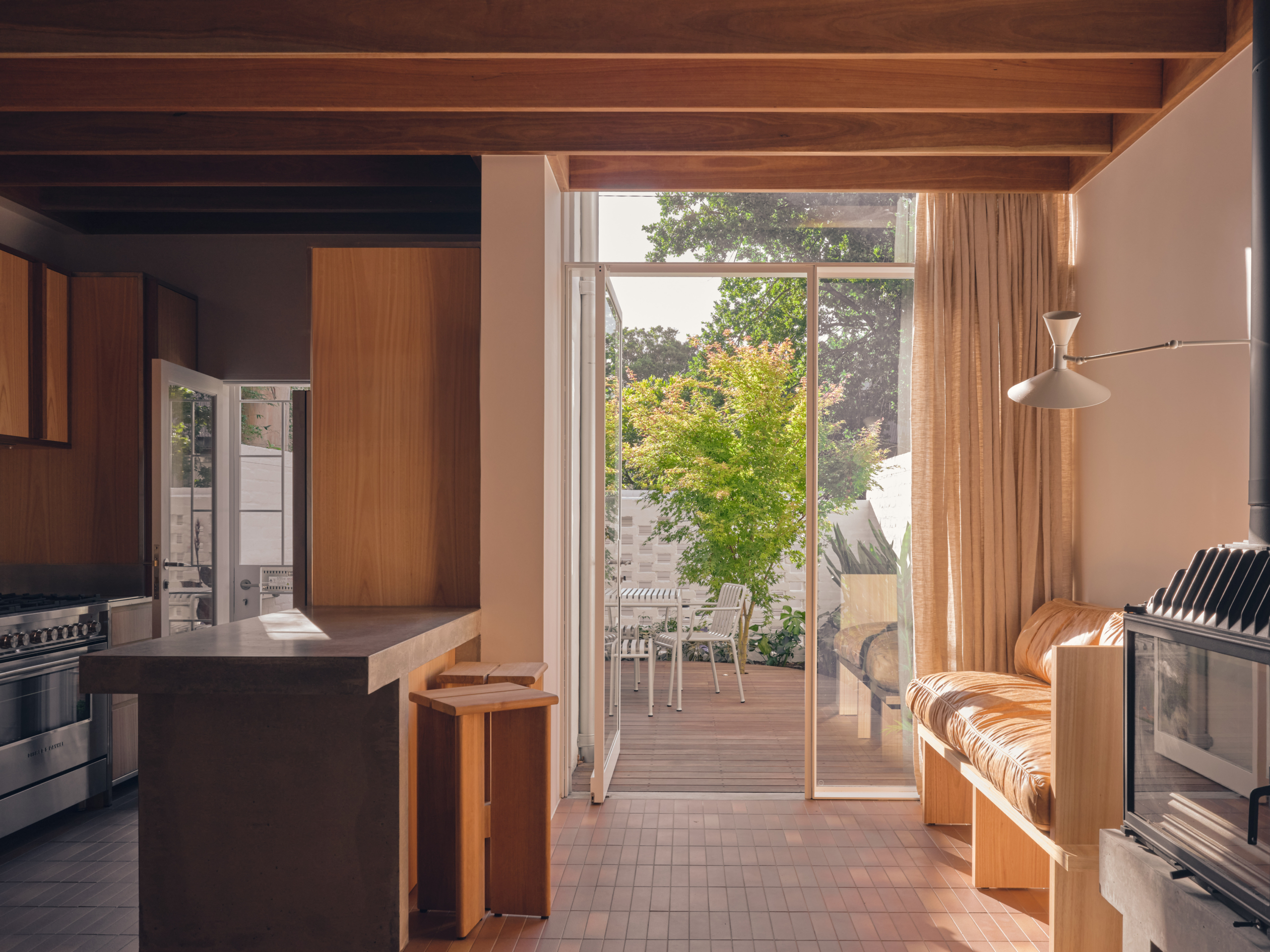
Communal areas occupy the ground floor. A street-facing living room provides a cosy introduction, while a newly built courtyard at the rear opens to the sky. The largest space, a hybrid kitchen and dining area, is anchored by a leather-wrapped sunken lounge. Exposed hardwood ceiling joists nod to Surry Hills’ garment-making past, while a ceramic-tiled floor and cast-concrete bench emphasise the home’s handmade qualities. Extending the sense of space, large steel-framed doors and windows draw in the afternoon sun and create a visual connection between the kitchen and courtyard.
A sweeping timber staircase forms the dwelling’s central spine, leading to the upper levels where bedrooms, ensuites, a study and laundry are arranged. The street-facing facade has been subtly refreshed in cool, muted hues, concealing the richness within, while the rear addition – clad in custom-fluted solid timber – offers a glimpse of the meticulous joinery and detail. Riley Street balances nostalgia and contemporary living, revealing a private, tactile interior behind a poised facade.
Architecture and interior design by Akin Atelier. Build by Robert Plumb Build. Landscape design by Dangar Barin Smith. Artwork by Lucy Anderson, Daimon Downey, Ash Leslie, Marcia Priestly, Stephen Skinner, Bec Smith and Chanel Tobler.


