Issue 19 Feature
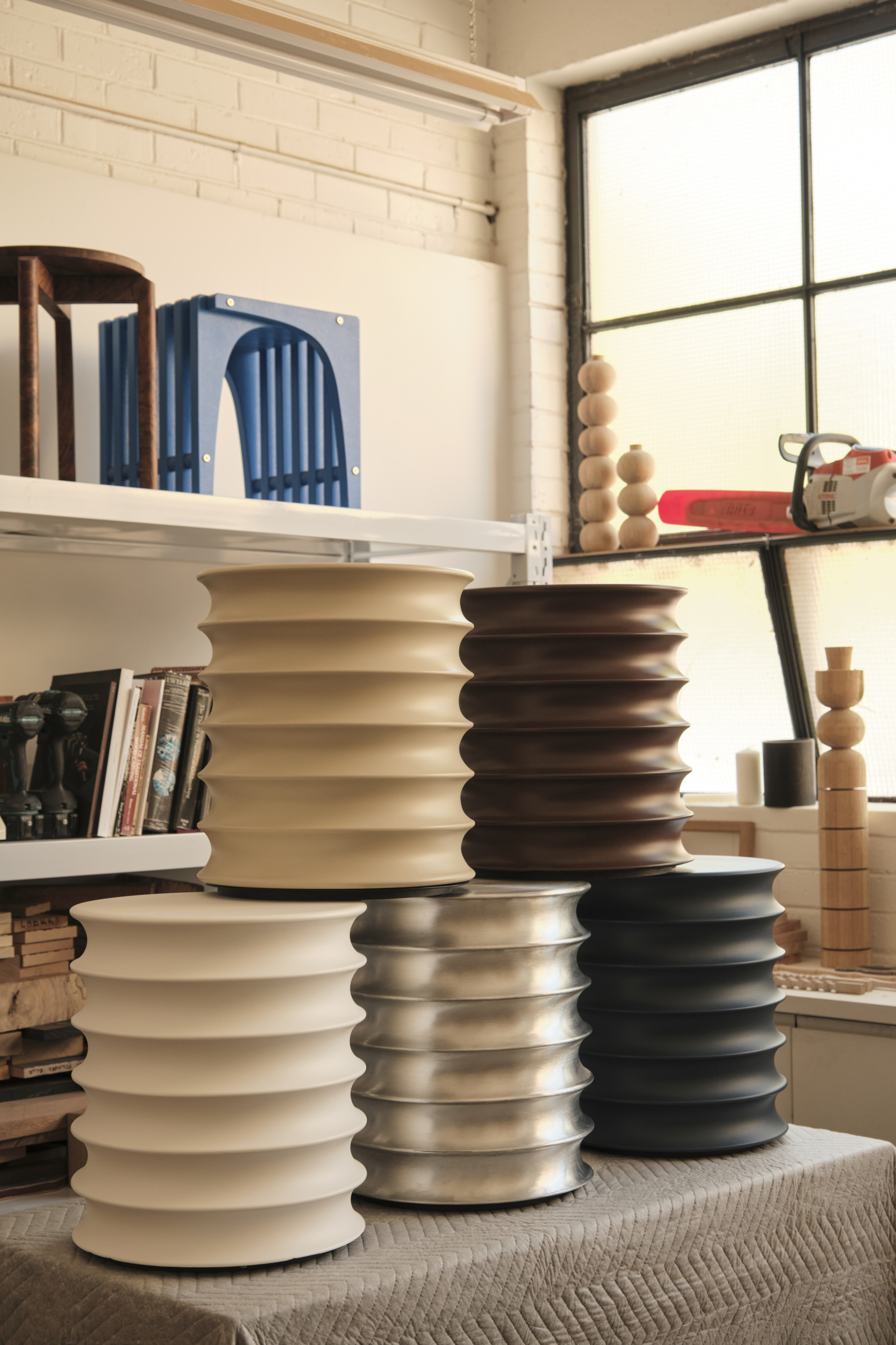
Melbourne designer Zachary Frankel brings a spirit of exploration to his furniture, sculpture, lighting and objects, continually pushing the boundaries of craft and material use. His North Fitzroy showroom, Hotel House, offers a dedicated space to view his unique and evolving practice.
Zachary Frankel’s path to furniture design began, unusually enough, with jewellery making. With a desire to create something more utilitarian and practical, he turned to a pre-apprenticeship at Holmesglen Institute before working in furniture production. He eventually made the leap and established his own practice in early 2020. “The idea was that I was going to spend six months to a year just making my own furniture, sculpture and lighting,” says Frankel. “I didn’t know where it was going to take me.”

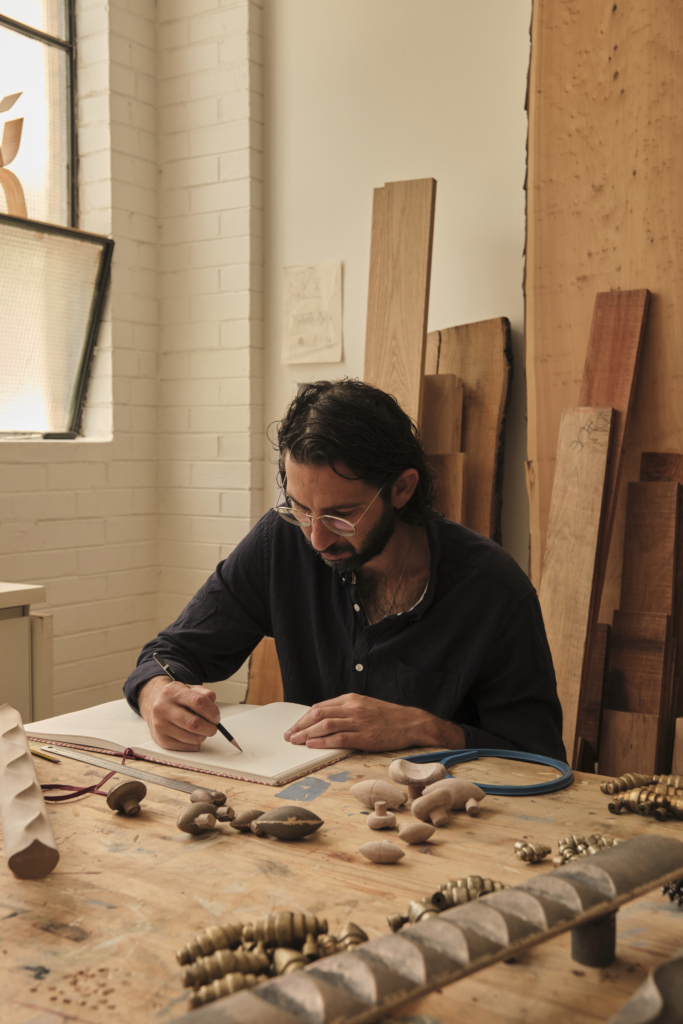
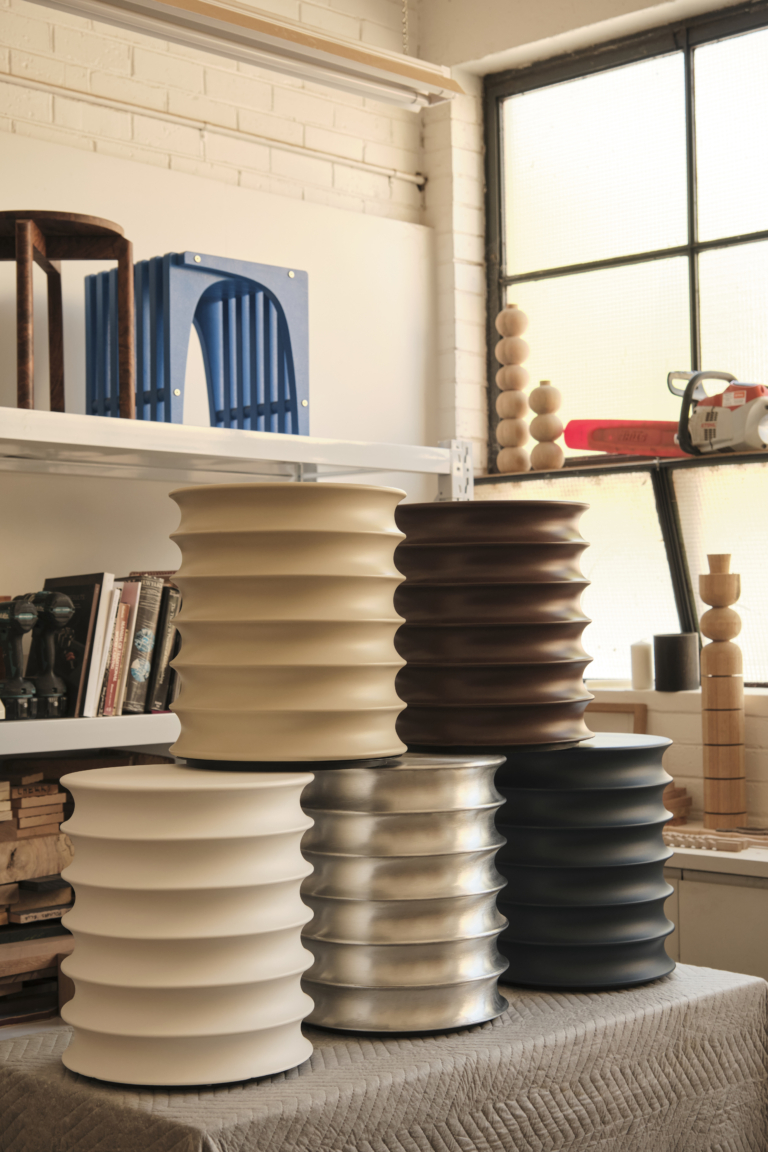
Today, Frankel’s practice is threefold; he sells a range of self-designed products on his website, he completes custom commissions for interior designers and architects, and he has a body of experimental exhibition work. He produces playful pieces in a range of forms and materials, from colourful Art Deco-inspired mirrors to sculptural side tables made from salvaged Cypress pine and ambient standing lamps in aluminium, oak and hemp.
He notes that no two days in his studio are the same. “I naturally feel most comfortable with experimenting in technique and material then seeing where it goes,” he says, “but I have also pushed myself over the years to learn 3D-modelling software, so sometimes my process is very material-forward and hands-on, and sometimes it’s computer-driven and based in industrial design.” For instance, in 2022, he produced a recycled plastic furniture series using post-industrial waste that was executed entirely digitally.
When asked what drives him to keep exploring different forms and materials, Frankel says, “I just enjoy learning something new … I enjoy the challenge.” He comes to his work with an open, artistic sensibility and doesn’t confine himself to the formal constraints of furniture design. “I’m quite active in this idea that I’m doing this for fun, so that I can experiment and try new things and see where it takes me. The products are a result of that.”
Frankel draws inspiration from a variety of historical styles, including Art Deco, classical Chinese, medieval and early renaissance European furniture, as well as post-war Italian architects like Vico Magistretti, Achille Castiglioni and Carlo Scarpa. “I think that’s a really sweet spot in modern design where you have a strong emphasis on craft, but there’s a lot of playfulness. It’s modern without being cold and clinical.”
Frankel’s Old New cabinet brings together many of these influences. Traditional in parts yet contemporary in execution, the piece reimagines the 16th-century linenfold motif inspired by classical Chinese furniture. It was entirely hand-carved with time-honoured tools. “I wanted the whole thing to be an ode to tradition because a lot of my work uses modern techniques,” says Frankel. “It was just a way of having done something that felt like the long way round.” It took him around two years to complete and was exhibited during Melbourne Design Week in 2024.
This innovative spirit continues at Hotel House, his new appointment-only showroom and studio, which sits within a heritage 1850s building in North Fitzroy. He designed all of the interiors, including the pendant and wall lights, creating a space for display and community-focused events. “It’s been interesting to see how my work exists in a space where it all lives together,” he says. “It was also a fun experience dipping my toes into interior design, which I hadn’t done before.”
Meanwhile, client commissions continue to expand the scope of Frankel’s practice. Recent collaborations have seen him creating point-of-sale counters and furniture for Viktoria & Woods retail spaces with interior designer Annabel Kerr. He is also developing a new iteration of his timber Flute side table, previously reimagined in brushed aluminium for Hyde Melbourne Place. The updated aluminium version will be released, along with a range of textured powder-coated colours.
Looking ahead, Frankel is preparing to launch Verra later this year, an evolution of his growing range of boutique bronze hardware, including the much-loved Croissant cabinet handles. “I want the handles to have a life of their own and to be a bit more commercial,” he says. “Having its own name will be better for architects to specify and for it to have its own identity.” In 2026, he will present new work as part of the inaugural design sector at Melbourne Art Fair.
Driven by experimentation, shaped by craft and informed by history, Frankel’s practice is an ever-evolving reflection of his desire to create without constraint – though he is decidedly down to earth about it. “The idea is that I make what I think is interesting,” he explains, “and hopefully that will in itself be something that’s interesting for other people.”