House Gretchen
House Gretchen by Lintel Studio is a quietly radical reworking of a heritage terrace into a bright and lively home that celebrates colour, texture and art in Sydney’s Inner West.
Located in the suburb of Newtown, House Gretchen emerges from behind a heritage facade, sitting flush within a row of turn-of-the-20thcentury terraces. Designed by Lintel Studio for an artist couple and their teenage son, the dark terrace was updated into a light-filled and inspiring “forever home” with a striking experimental layout.

From the outset, the project presented significant challenges. Ageing building materials and water damage meant the historic terrace had to be entirely rebuilt. Lintel Studio carefully restored the facade and two front rooms to heritage standards, with subtle updates including underfloor air-conditioning and bespoke wall panelling. The team then took the opportunity to completely reimagine House Gretchen’s existing rear extension. “We chose not to swell beyond the original envelope,” says architect Emiliano Miranda. “Instead, we asked, ‘How can we do something exciting with the footprint we have?’”
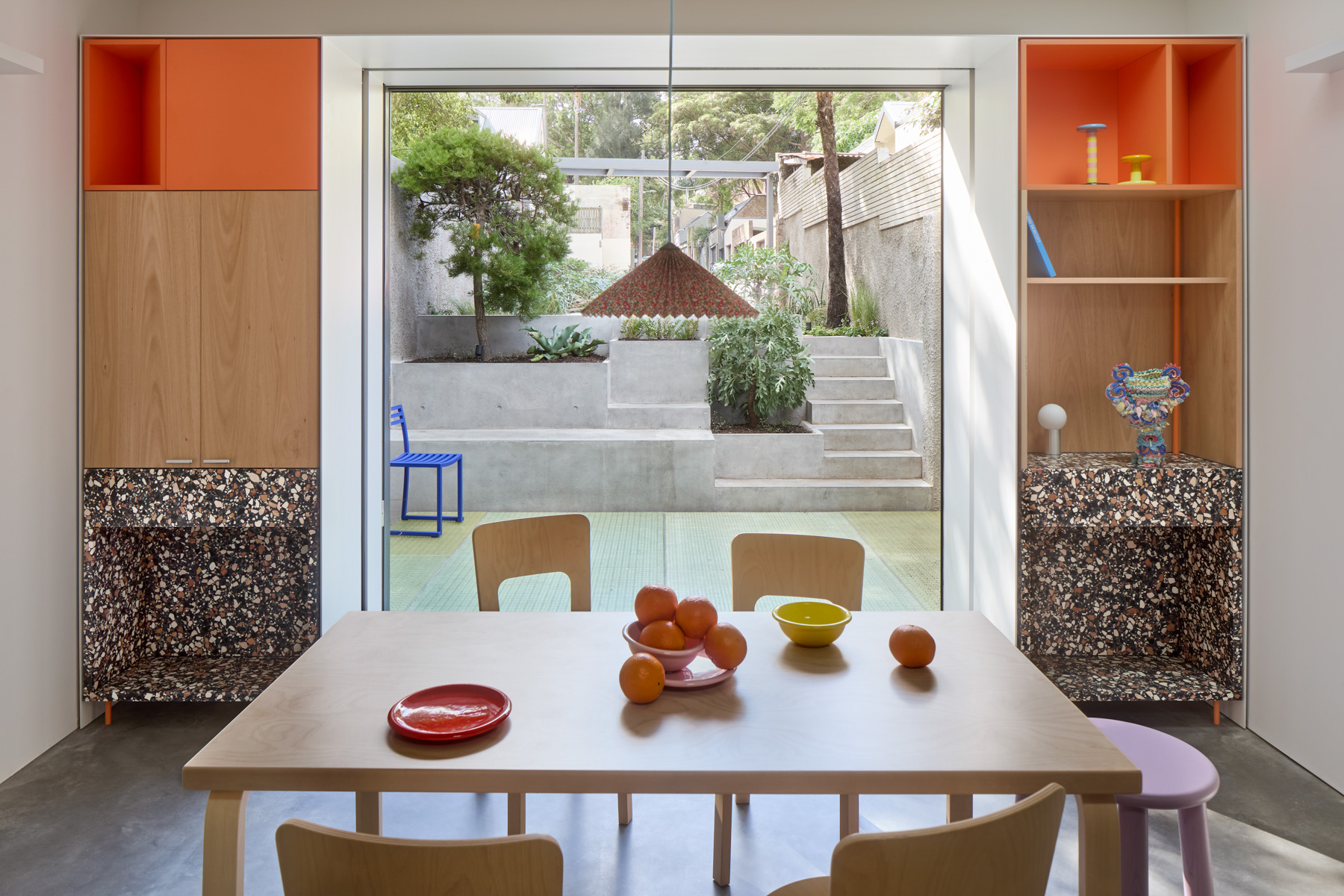
As visual artists, the clients’ brief was broad and unconventional – with the request for an orange kitchen a fruitful jumping-off point for the Lintel Studio team. “The design embraces the eclectic tastes and masterful knowledge of colour and pattern shared by its inhabitants,” says Miranda. “It seeks to nourish their creative spirits while fulfilling everyday needs with a balance of mischievousness and sophistication.”

That orange kitchen became the centrepiece of the home. Inspired by the spatial ideas of Lina Bo Bardi, Sou Fujimoto and David Chipperfield, the design revolves around a central cube – a compact, multi-functional core that houses the cooking zone, a hidden walk-in laundry, ample storage and space for entertaining along its four sides. Placed at the darkest point of the house, the cube is illuminated from above by skylights set into a concave ceiling. The room’s layout flows around it, allowing for moments of connection and separation.
The citrus hue was selected with care by Lintel Studio. “We settled on a colour that would throw light and intensify when turned in on itself, but that did not overstimulate the home environment,” says Miranda. Its presence is balanced by light timber veneer, chunky terrazzo and handmade tiles in earthy tones. White-rendered walls and polished concrete floors give the room gallery-like proportions, allowing for plenty of wall space for the clients’ expansive art collection.
This bold and joyful approach to materiality continues within House Gretchen. “With a predilection for mischievous geometries and high-key colours, the clients preferenced a risk-taking schedule,” says Miranda. “We worked collaboratively to integrate an eclectic interior into the scheme while considering its enduring appeal – timelessness was not so much our pursuit, but rather relevance into the future.” Terrazzo benches, pastel-hued joinery and coloured glass transoms create layered textures, while the kitchen’s orange is echoed in the tapware and delightful custom bathtub.
Meaningful, personal details are embedded throughout. Handmade bedside tiles were sourced from a social enterprise in the United Kingdom supporting women who have experienced trauma. The timber floors were salvaged from the client’s high school gymnasium, still flecked with painted lines from basketball and netball courts. The house number is finished in the distinctive ceramic piping of artist Ebony Russell, a friend of the couple, while a tiled wall mosaic in the garden – in muted greens, browns and yellows with pops of cobalt blue – was designed by the clients themselves.
House Gretchen also seeks to address common issues with Sydney terraces – namely, a lack of light and ventilation. Reorienting the internal courtyard and inserting strategic, angled skylights in the main bedroom and kitchen allows natural light and fresh air to flow in. The cooking zone now opens onto a bright rear garden, where a permeable recycled FRP boardwalk floats above the earth, allowing native grasses to grow through. The clients can enjoy the courtyard for relaxing or entertaining, while plantings of ferns and banksias screen off the car spot and rear laneway for greater privacy.
Passive environmental strategies underpin the project. From improving its thermal performance to choosing low-VOC paints and natural finishes, decisions were made with the long-term health of both the clients and building in mind. “We worked to achieve what Simon Guy and Graham Farmer call ‘eco-medical sustainability’ – avoiding sick buildings that degrade our wellbeing,” says Miranda. “House Gretchen exemplifies the potential for material reuse and passive sustainability to be thoughtfully implemented in inner-city contexts of contemporary living.”
The outcome is a home that lives and breathes along with its inhabitants; one that is joyful, generous and experimental, reflecting the clients’ personalities as well as the ethos of Lintel Studio. “It has been a joy to see the clients make the space their own,” says Miranda. “Lintel’s core values are both architectural and social – how responsible design solutions can promote inspired living and how building can be a process that is rewarding, instructive and enjoyable to undertake.”
Through its compact footprint, vibrant palette and sensitive use of materials, House Gretchen is a home that honours both its heritage and the clients’ distinctive individuality, brought together by a spirit of generosity and collaboration.
Architecture and interior design by Lintel Studio. Build by Robert Plumb Fix. Landscape design by Dangar Barin Smith. Structural engineering by Partridge. Civil engineering by JHA Consulting Engineers. Joinery by Kinship Customs. Furniture by Anibou and District. Artwork by Ebony Russell and Emily Galicek.