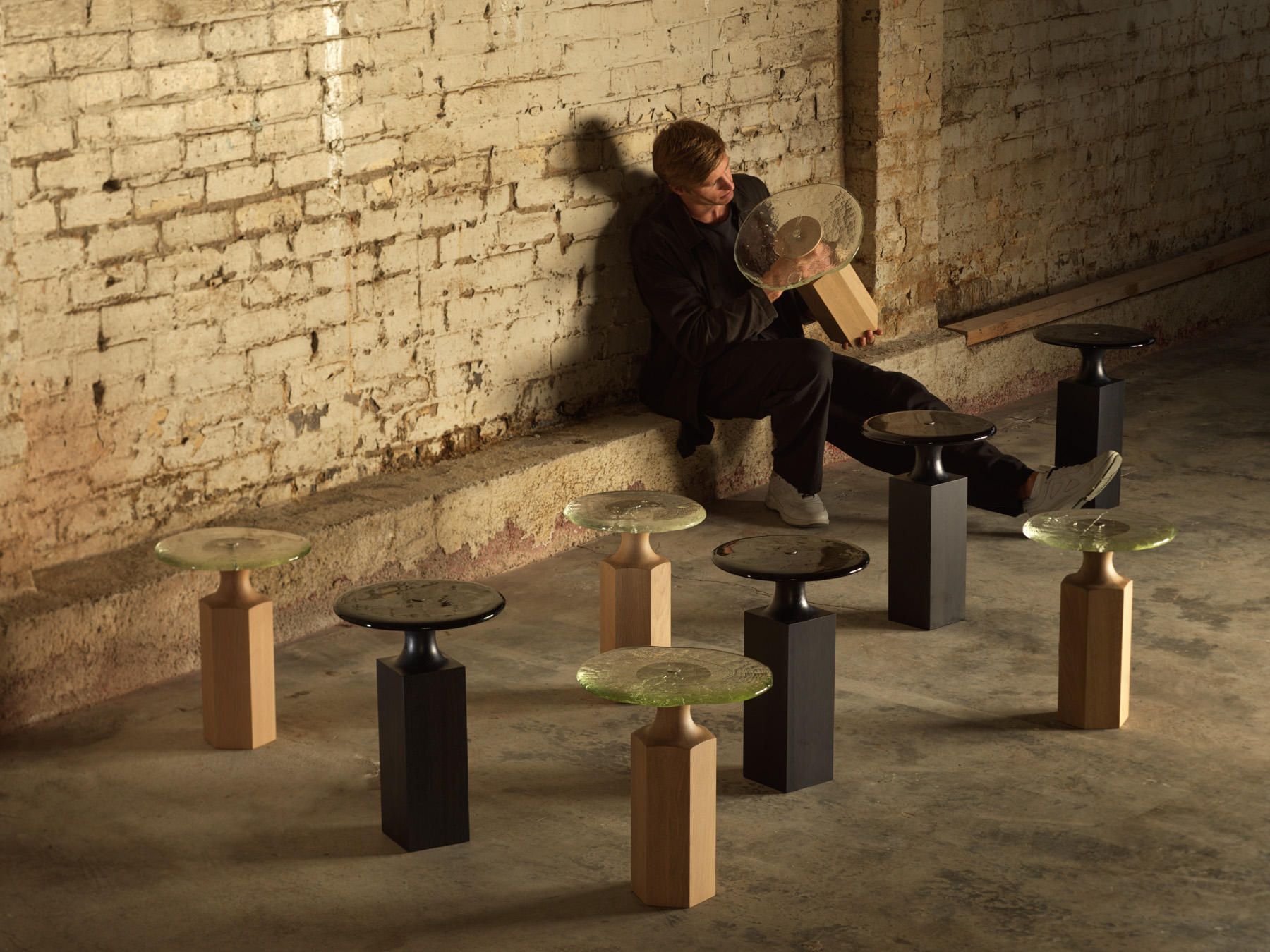
Bouba-Kiki Side Tables
The warmth and solidity of timber meets the coolness of hand-poured glass in this jewel-like, limited-edition furniture collection.
With more than 25 years of crafting heirloom-quality furniture under their tool belts, the team at Woodwrights have an undeniable way with wood. But in their latest collaboration – with the creative director of Wonder, Buster Caldwell, who also worked on Woodwrights’ flagship Auckland showroom – they have introduced a playfully contrasting element to the company’s material palette, one that elevates their bespoke furnishings to jewel-like objets d’art.
“The brief began just as a casual conversation around introducing glass into our material library,” explains Huxley Trewavas, Woodwrights’ head of business development and sales. “Together with Buster, we were drawn to the concept of ‘timber meets glass’ and how that dialogue could guide a collaboration.”
The result is a limited-edition release of side tables in two designs, Bouba and Kiki (only 15 of each are available). Both join impeccably worked timber bases with glass but with an impish interpretation of the latter material – organic discs by Auckland glass artisan Luke Jacomb. These are hand-poured and allowed to retain the ripples and bubbles of the molten material so they appear like drops of water, held in gravity-defying suspension above the solid timber bases.
The tables are a yin and yang pair, one with a light, almost whimsical character; the other a dark and brooding Mr Darcy. Bouba features a pale oak hexagonal base, with an elegant neck reaching up to balance a clear round of glass, in which effervescent bubbles are captured. By contrast, Kiki feels more serious, with a sharply angled square base in moody black, a smoky charcoal glass top and a little extra height, which adds to its grounding presence.
From the precise angles and smooth curves of the timber to the organic wabi-sabi finish of the glass, Bouba and Kiki are designed to bear the mark of the maker – and this elevation of craftsmanship is the common ground between the two very different materials. For Woodwrights, Trewavas explains, this philosophy is rooted in its connection to place: the people and terrain of the brand’s New Zealand home.
The tables are a yin and yang pair, one with a light, almost whimsical character; the other a dark and brooding Mr Darcy.
“The landscape naturally influences our approach, from the materials we use to the forms we create, and it’s all brought to life by local hands, which craft each piece in our own factories,” he says.
Similarly, the provenance of the glass is woven through every piece in a process Trewavas describes as “backyard alchemy”. Caldwell worked closely with Jacomb, who cast each piece on a stainless-steel bench in a simple Avondale shed, the perfectly imperfect finish marking each of the glass tops as one of a kind – bespoke pieces for curated spaces.
“We see these pieces as versatile objects, equally at home as a jewel-like statement in a home, a special moment within a retail space or as part of a design-led office environment.”
Each of the side tables can be displayed alone or they can stand together, the character of each emphasised by the contrasting company of the other. And both serve to continue the legacy of Woodwrights, which Trewavas describes as “enduring, refined, warm and versatile. We create pieces that are designed to be lived with.”


