Bank Street House
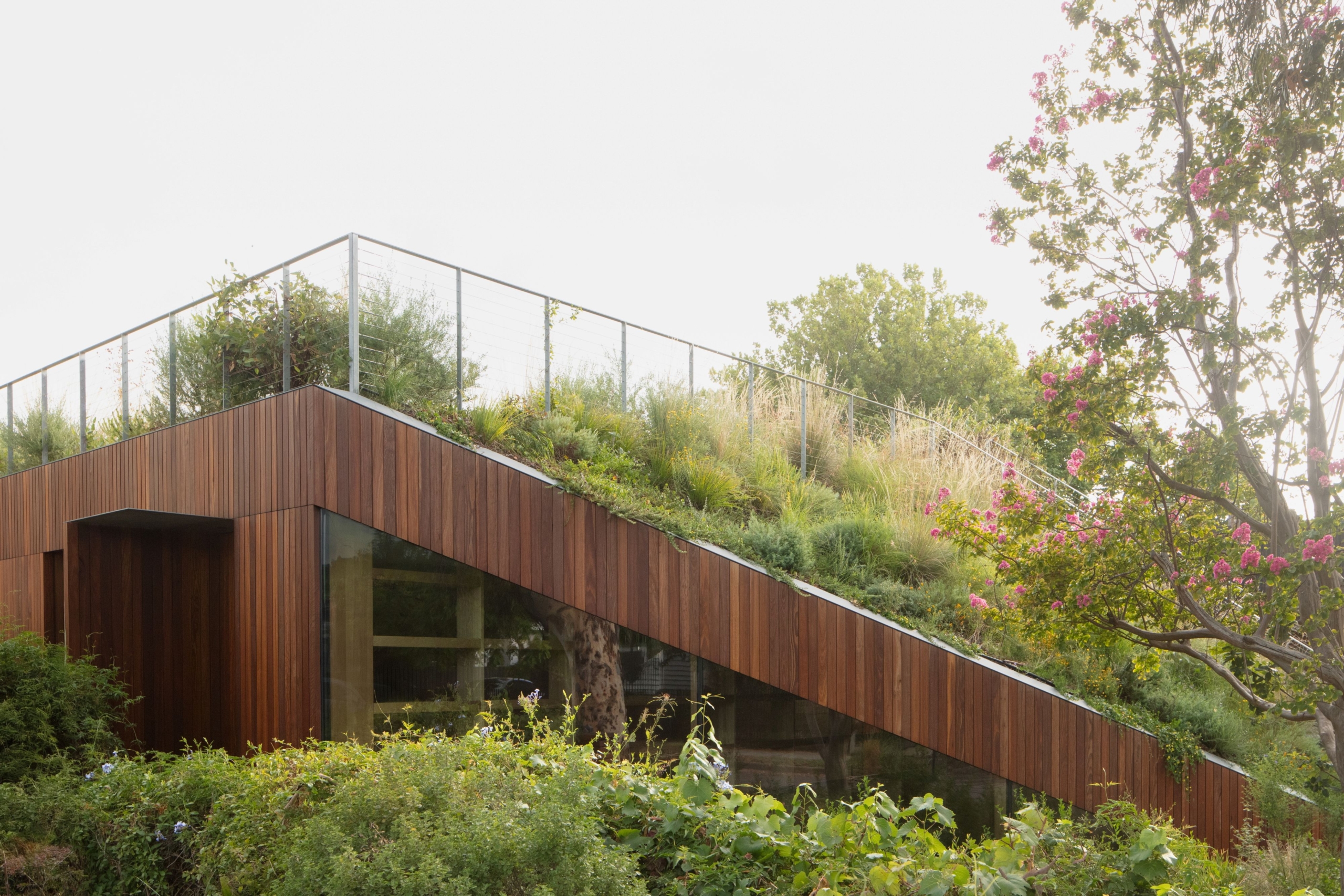
At the end of a quiet Northcote cul-de-sac, a low reclaimed-timber form sits half-swallowed by planting, its habitable green roof rising gently toward the sky. Designed by Melbourne practice Prior Barraclough, Bank Street House achieves something rare: it finds generosity in restraint.
The site previously held a structurally compromised two-storey dwelling, with 240 square metres of floor area and 300 square metres of garden. The new house inverts those priorities entirely, reducing the internal footprint to 190 square metres while expanding the outdoor area to 500 square metres. Its roof does double duty as usable space above and verdant canopy below. This sense of continuity is amplified by planting that runs from footpath to rooftop, allowing the whole property to read, from above, as an unbroken garden threading quietly through the neighbourhood.



Directors and co-founders Dennis Prior and Michael Barraclough describe their practice as working through formal, spatial and material coherence, and Bank Street House gives that commitment built form. The front facade aligns with neighbouring dwellings before inflecting to frame the court, stepping down to the footpath so that children playing in the cul-de-sac can move directly up onto the house itself. Here, the threshold between public and private softens. The clients, a couple with three young children, wanted a home that could participate in the social life of the street, and Prior Barraclough responded by making the roof a kind of shared amenity.
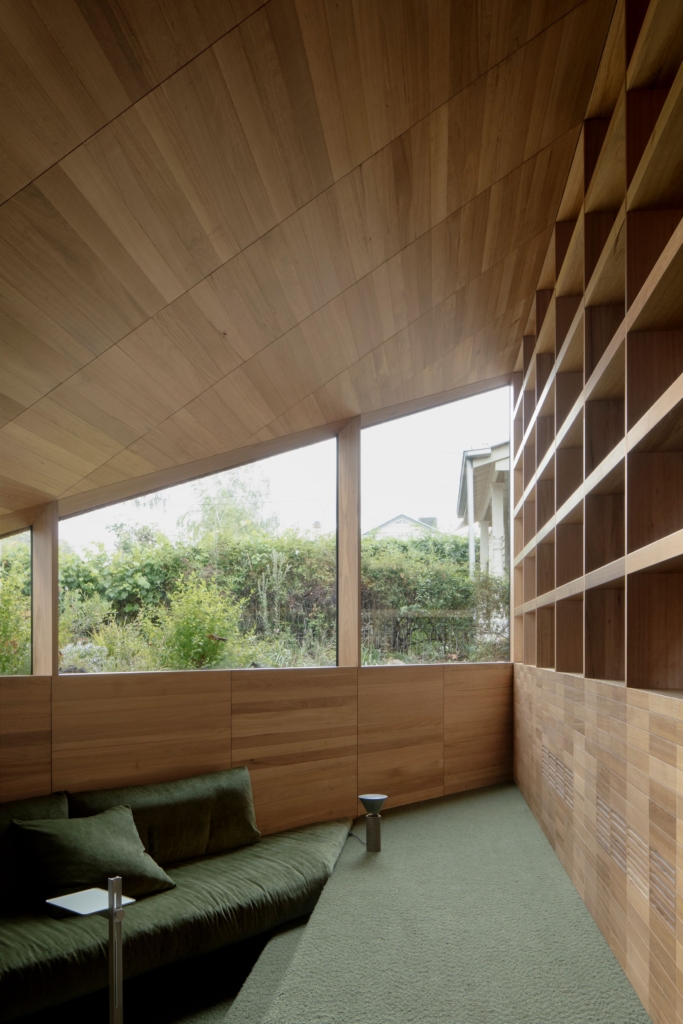
Internally, the plan is organised as four modest rooms running between two living zones. To the rear, the kitchen, dining and living open up to the garden through a full-width glazed wall, while at the front, the house does something more inventive. The sunken lounge drops below ground as the roof folds sharply down above it, producing a cathedral-like ceiling that feels both dramatic and enveloping – well suited to reading, rest or the kind of chaotic children’s sleepover that renders the distinction moot. The room functions as lounge, library, study and entry gallery at once, condensing what suburban convention would typically stretch across several dedicated spaces into one adaptable, characterful volume. There is no ensuite to every bedroom here, no walk-in pantry, no front fence.


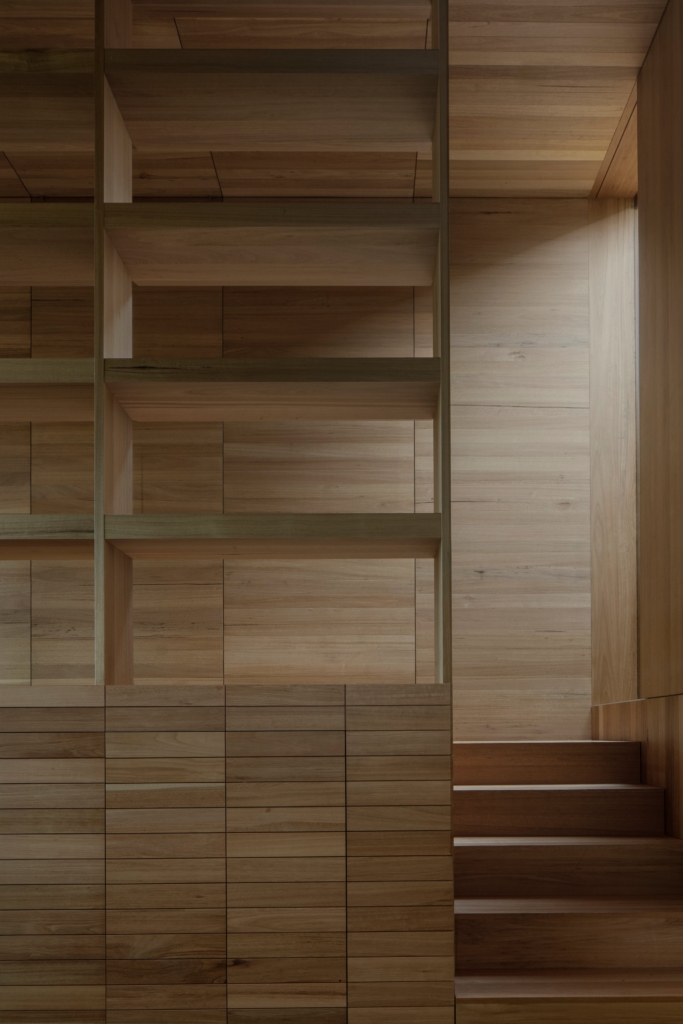
The facade system is similarly economical in principle and exacting in execution. Sliding timber-lined panels on the east and west elevations operate across four positions: admitting light, enabling ventilation, blacking out for sleep or shading against heat. Conventional hardware disappears from view, so the exterior can subtly shift character across the day without fuss or flourish.
Reclaimed timber is consistently used within the home – appearing in cladding, windows, doors, shelving, hooks, benches and air-conditioning grilles – creating a warm, consistent character without feeling overly strict or rigid. A 75-millimetre grid, derived from the width of a single board, guides the plan and resolves the more complex junctions where the module meets the angled front facade.