Glass House Summer Party
At the 2026 Glass House Summer Party, Knoll staged a one-day installation that reimagined the landmark Connecticut residence through colour, tactility and a contemporary dialogue with modernism.
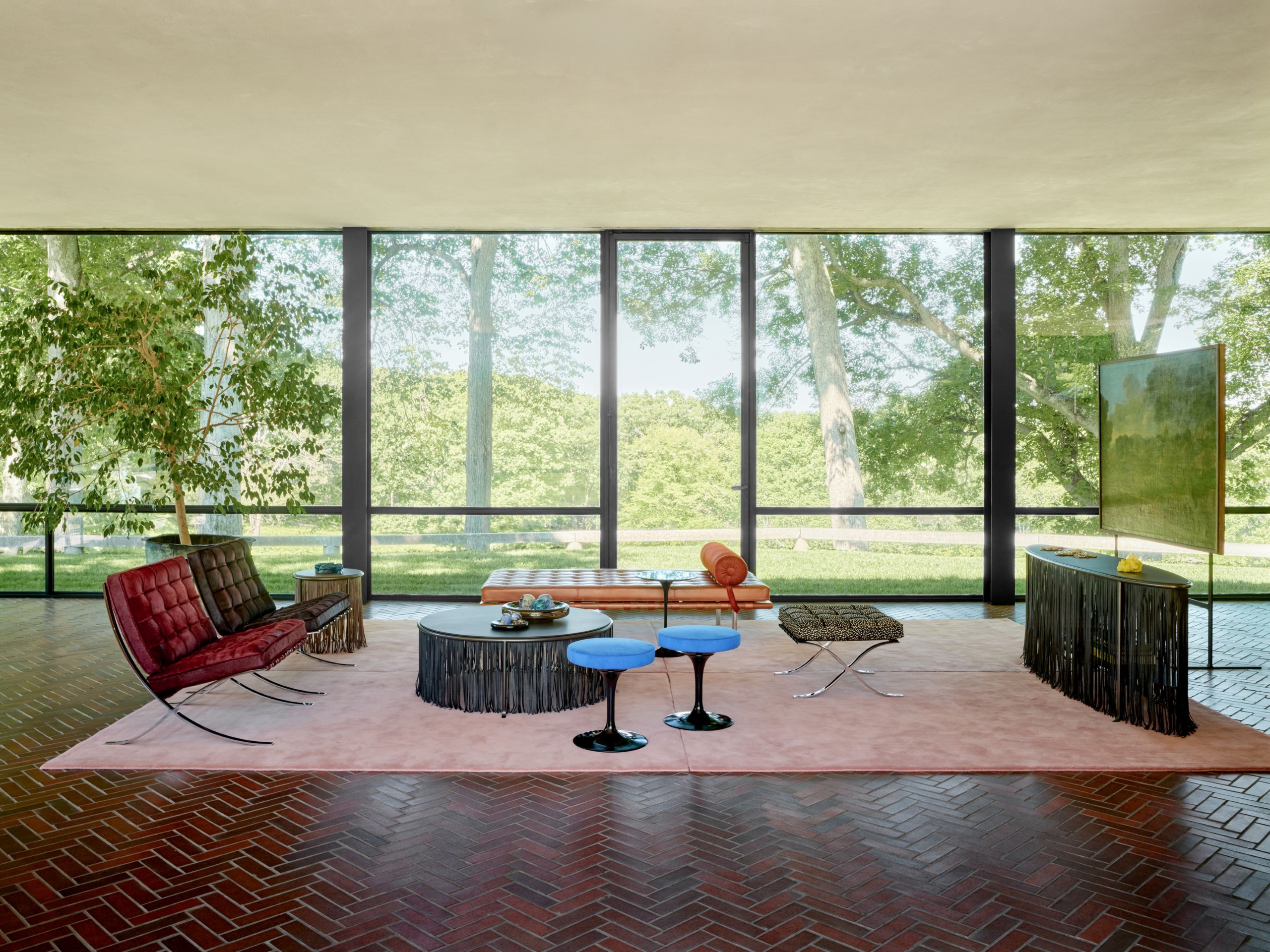
At this year’s Glass House Summer Party, Knoll returned to one of modernism’s most revered architectural settings with a one-day installation that reimagined the landmark interior through a contemporary lens. As presenting sponsor of the 2026 event, the furniture and interiors brand transformed the Glass House into a sensorial environment – one in which material, colour and form were considered as part of a singular spatial experience.
Rooted in the property’s legacy as a site of architectural clarity and cultural exchange, the installation honoured the original sequence of spaces while gently reframing the way visitors encountered them. Celebrated modernist pieces by Mies van der Rohe and Florence Knoll were placed in dialogue with the work of artist and designer Dozie Kanu, the latest talent to join the Knoll portfolio. Together, the collection spoke to Knoll’s enduring commitment to designing in conversation with architecture.
“The Glass House is a very minimalist space, so we thought it would be interesting for this project to explore how we could use the same components but make it sensual and soft,” says Knoll creative director Jonathan Olivares. “Knoll has taken this concept a step further by infusing the interiors with warmth and sensuality within the strictness of the minimalism.”
Throughout the installation, iconic van der Rohe designs – including Barcelona chairs, a Barcelona daybed, Brno tubular chairs and Tugendhat chairs – were reinterpreted in unexpected velvets, patterns and expressive materials. A palette of soft pinks, burgundies, purples, browns, metallics and spotted finishes softened the architectural rigour of glass, brick and steel, while a layered landscape of rugs connected the interior scenes to the surrounding environment.
Dozie Kanu’s newly launched table collection for Knoll formed a central part of the installation, marking its North American debut following its presentation at Salone del Mobile in Milan. Drawing from Nigerian craft, African ceremonial dress and Texas cowboy culture, the pieces introduced a tactile and animated counterpoint to the home’s disciplined geometry. “We love how the reimagined classic Knoll pieces play and interact with Dozie’s designs,” Olivares says. “We want people to sit, touch and discuss.”
That invitation to engage with the interior was especially significant. For the first time, visitors were encouraged to sit on and touch the furniture pieces within the Glass House, shifting the experience from observation to participation. It was a subtle yet meaningful recalibration of the site’s modernist legacy, one that considered the emotional and physical experience of design as much as its formal presence.
“It’s incredibly powerful to be able to put introductions from an emerging designer next to pieces from one of the most powerful designers that we know of,” says Debbie Propst, president of global retail for MillerKnoll, of the relationship between Kanu and van der Rohe. “They sit so comfortably together, it’s really remarkable. That is the magic of the Knoll portfolio.” In doing so, Knoll’s installation continued the founding spirit of the Glass House as a place for artists, makers and ideas to converge – not as a static monument to modernism, but as a living environment capable of renewal.
In doing so, Knoll’s installation continued the founding spirit of the Glass House as a place for artists, makers and ideas to converge – not as a static monument to modernism, but as a living environment capable of renewal.


