Donald Judd
The recent restoration of Donald Judd’s Architecture Office in Marfa, Texas signifies Judd Foundation’s ongoing commitment to sustaining the late artist’s extraordinary legacy and showcasing the continued relevance of his pioneering work.
By the late 1960s, Donald Judd had become restless with the confines of New York’s art scene and frustrated by the lack of permanency available to exhibiting artists. This unshakeable feeling, combined with a desire for more space, led him to Marfa in the high desert of West Texas. Armed with a vision to bring together art, architecture and context, Judd conceived an entirely new place for himself to live and work, forging a profound legacy and consequently positioning this arid town as an important cultural destination.

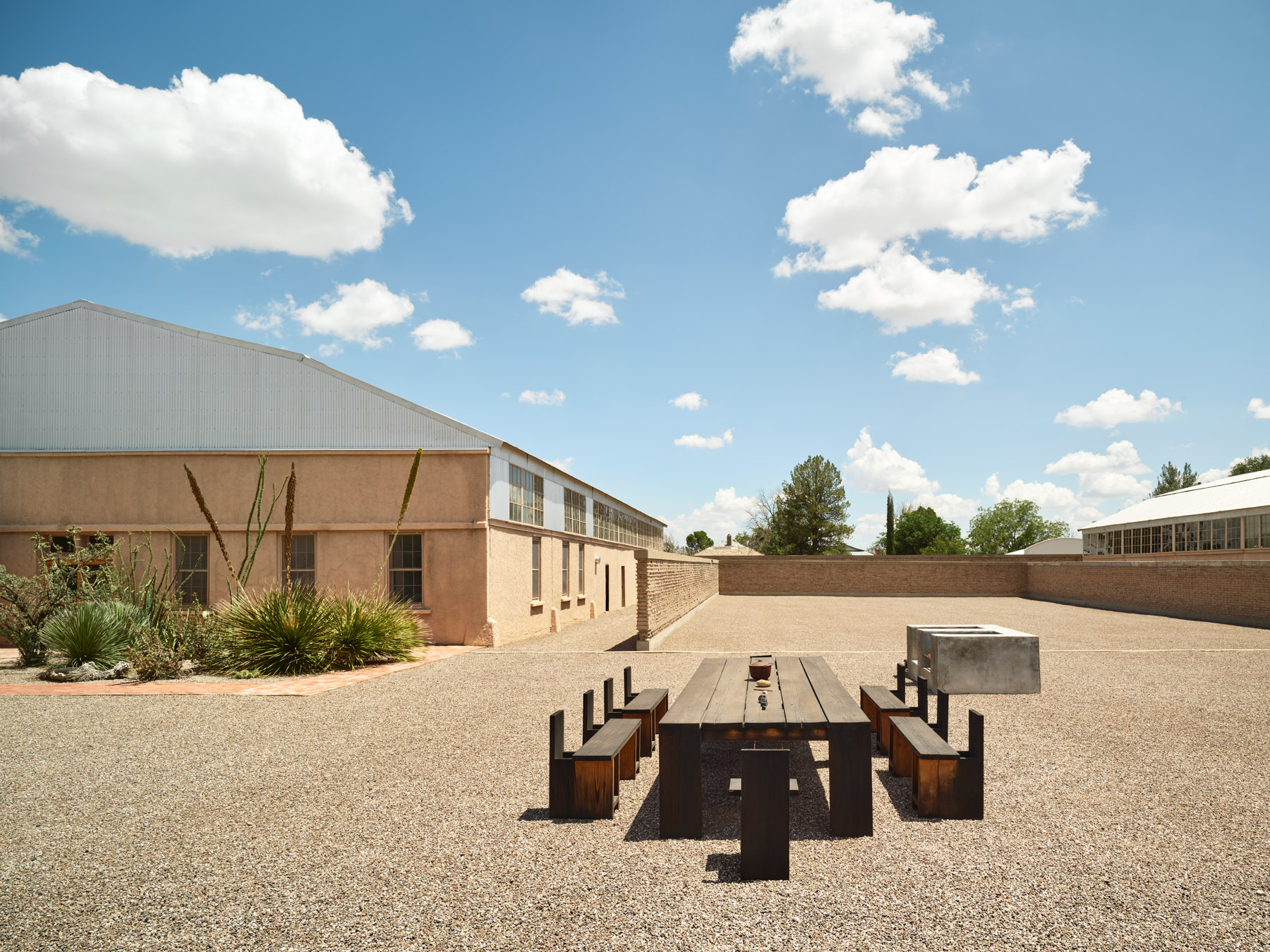
In the two decades before his death at the age of 65 in 1994, he had acquired and renovated more than 20 buildings in Marfa, including La Mansana de Chinati or The Block, a complex of buildings and the home of some of his first large-scale architectural projects and installations. Judd also purchased many historic buildings as businesses closed or relocated to the outskirts of town, including the old bank and grocery store, which became his Architecture Studio and Art Studio respectively.
“He didn’t have a grand plan. He was living in the moment, creating as he went and being quite intuitive,” says Judd’s daughter, Rainer Judd, president of Judd Foundation alongside her brother, Flavin, the artistic director. Their father’s ongoing motivations, however, are known; he believed the space surrounding his work was as crucial as the work itself and was deeply committed to ideas around preservation, restoration and pragmatics in the context of the built environment.
In 1990, Judd purchased the two-storey, turn-of-the-century Glascock Building for use as his Architecture Office. The space’s seven-year restoration, which was halted in 2021 due to a fire, is reopening to the public this year and marks the first major building project to be completed in the Judd Foundation’s long-term restoration plan for its buildings in Texas. The foundation completed a landmark renovation of 101 Spring Street in New York – a five-storey, cast-iron building that served as the Judd family home and Judd’s own studio – in 2013.
Honouring the artist’s thoughtful approach to preservation and deep reverence for craft, the Judd Foundation has worked to meticulously restore the Architecture Office in collaboration with Schaum Architects. The project included repairing and repointing the red brick facade using traditional masonry techniques, replacing exterior timber window frames, installing energy-efficient glazing, rebuilding historic timber and copper elements by hand and refinishing original brass hardware.
As Rainer explains, the restoration also concerned preserving her father’s architectural interventions and upholding his original vision for the building as a space dedicated to thinking about architecture. The ground-floor office contains design prototypes, plans and architectural models of many of his projects, including the Bahnhof Ost Basel building, his former Swiss residence, Eichholteren, as well as a collection of his iconic furniture pieces in plywood and metal. The building’s original pressed-metal ceilings, decorative architraves and timber floors sit in pleasing contrast to Judd’s veneration for minimalism – both in the way he lived and the things he made.
Upstairs, there is accommodation for visiting researchers as well as space for public programs among paintings by John Chamberlain, furniture by Alvar Aalto and more of Judd’s own pieces. An innovative outside-air system ensures optimal interior conditions at all times by sensing the desert’s temperature and adjusting accordingly to protect and preserve the furniture, artwork, drawings and models.
Judd’s architectural output, which comprises his work across Marfa, New York and various European commissions, was lesser known than his artistic practice. But in fact, Rainer suggests that at the time of his death, it was merely in its infancy. “If he had lived past 1994, there would have been so much more movement in this area because that part of his life was in immense growth, and I think he was very excited,” she says. “I believe it was the beginning of an era for him where he saw himself doing a lot more architectural work over the following 10 to 15 years.”
Though he was perhaps on the precipice of a more focused architectural practice, his affinity for the field can be traced far back. In his 1987 essay, Art and Architecture, he wrote: “I’ve always been interested in architecture. I remember doing drawings of houses with porches around them, improved houses, at thirteen or so.”

Fuelled by a craft-driven background and widely recognised for a dogged commitment to the principles of minimalism, Judd was openly critical of contemporary architecture, preferring the pragmatism and usefulness of things like “dams, roads, bridges, tunnels and storage buildings”, which he believed comprised “the bulk of the best visible things made this century”.
These inclinations strongly reflected his broader artistic philosophy for simplicity, material honesty and precision and Rainer cites his “turnbuckle” floor works as deeply redolent of this ethos. Made from coloured, translucent Plexiglass, the internal construction of these definitively simple geometric units is visible, rendering it essential to the identity of the finished work.
Much of the Judd Foundation’s mission is grounded in sharing these ideas with the public through activations, events and guided tours of The Block and The Studios in Marfa, and 101 Spring Street. Though distinct from the Judd Foundation, The Chinati Foundation – the contemporary art museum Judd established in 1986 where some of his large-scale works are permanently installed – is similarly aligned.
This raison d’être reflects Judd’s belief in an integrated approach to life, which ultimately suggested that ideas should not only be read about or observed, but also lived with, felt and experienced – preferably without constraints relating to time or space.
Rainer hopes her father’s non-conformist ideals and fearless attitude will not only be upheld by the foundation but relayed to the many people who continue to seek out and engage with his work in its many forms, scales and contexts.