Gordon House
Postmodern character is revived with distinctly Italian accents at Gordon House. Designed by Greg Natale, the home’s grandeur is grounded by an intentional sense of approachability, composing a balance between vivid design and restraint.
Greg Natale, long drawn to honouring heritage homes, aligned closely with the owners’ enthusiasm for Italian design and flair. Inspiration for Gordon House is drawn from Memphis Milano’s radical postmodern constitution, expressed through a colour palette grounded in blue, green and merlot red, punctuated with accents of canary yellow and coral pink, drawing each space together.
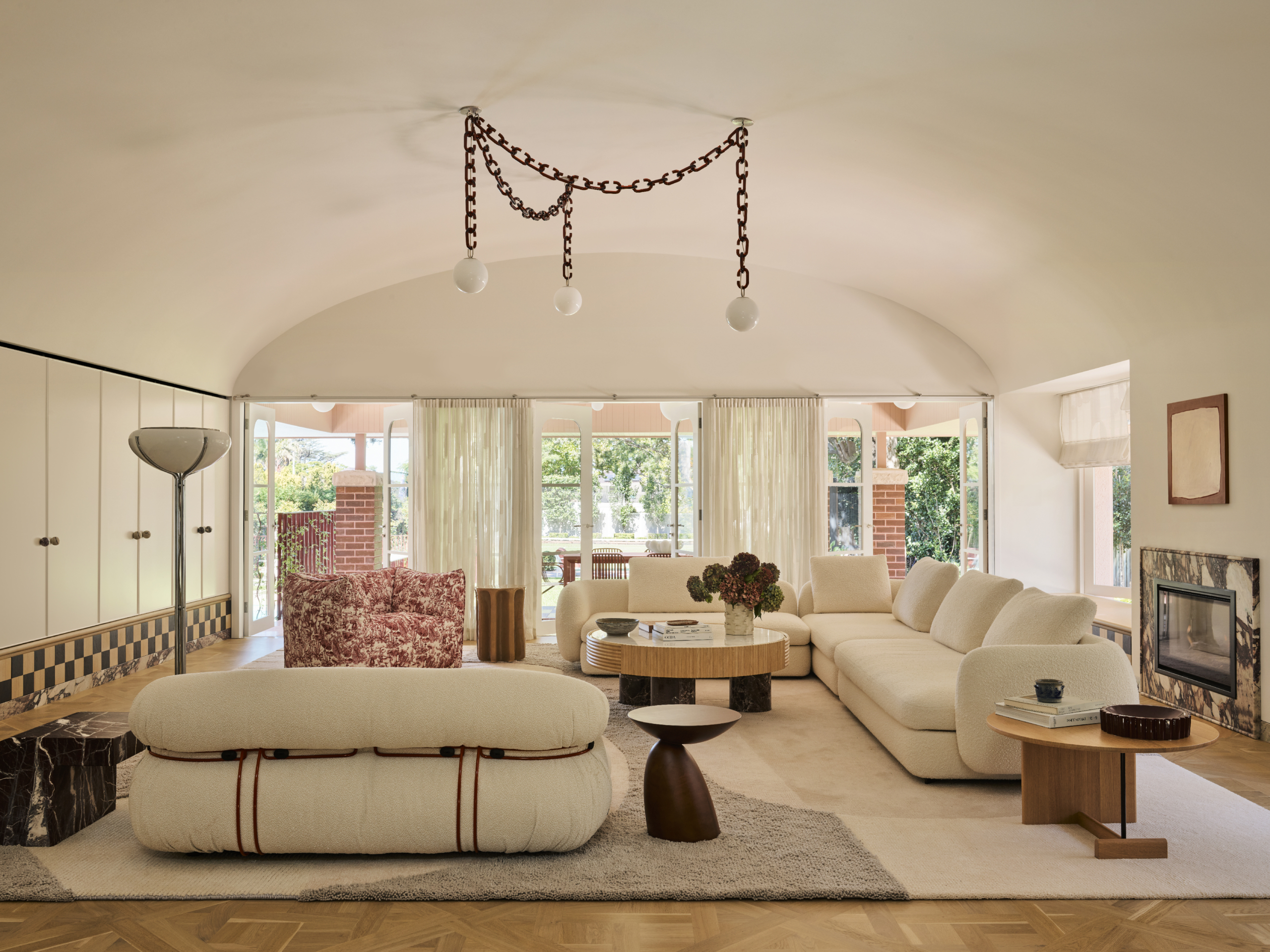
Further nods to Milanese mid-century design appear in perforated details and warm timber accents, while classical Italian references are evident in round fluted highlights and marble forms. Murano glass pendants, chandeliers and sconces act as defining elements, anchoring each room’s individual picture. The result is a collective design language of expression and subtle glamour.

Originally built in 1918, the heritage-listed Federation-era bungalow sits seamlessly within its neighbourhood of Gordon, in Sydney’s Upper North Shore. A renovation in the 1970s left it with only fragments of its original character. Recognising the potential, the owners sought to reinstate details lost to time and change while introducing a distinct eclectic sensibility. Original leadlight windows remain a subtle cue to the past – atypical to the contextual heritage – alongside painted window frames, columns, terracotta roof tiles, and a tiled veranda and garden entryway, all finished in tonal hues for a contemporary interpretation. While the exterior is understated, the interior reveals a striking contrast to what passersby might expect.
A sense of grandeur is felt through the home’s expressive use of colour, moments of theatre and considered embellishment, yet Natale notes, “It was equally important the home never felt pretentious or uninviting.” Beyond the front door, hardwood timber parquetry leads to a grand foyer where the staircase takes centrestage, its postmodern-inspired metal balustrade curving its way overhead. The statement Calacatta Viola marble tread introduces a defining stone found throughout the home to the kitchen, bar and powder room’s red wine cabinetry, its white and maroon echoed in selections from the lacquered console by Kazuhide Takahama for Cassina. Much like the Zellige tiles found in each ensuite, these material decisions act as a thread between spaces, even as colours and patterns shift from room to room.


“Moving through the home now feels immersive and intuitive. Even with its layered, expressive moments, the house feels grounded and easy to live in.”
The strong Italian palette of the primary suite takes its cue from the handblown Murano glass chandelier by Gio Ponti, which Natale admits to being “one of my favourite bedroom suites we’ve ever designed”. The ensuite plays a part in the room’s drama through the use of Punti merlot marble tiles. “It introduces a playful, postmodern note, tying back to the Milanese influences woven throughout the home,” Natale explains. Even storage here and throughout the home is afforded bespoke touches beyond function, from wallpapered panels in the nursery to checkerboard timber tiles in the living room.
Liveability was central to the brief for the family of six and two cats. “Our design decisions were guided by a careful balance between establishing visual richness and designing for everyday practicality,” Natale says. “We re-planned the layout and introduced a new rear extension to improve flow and increase spatial generosity.” Set on a long block, the original home was reconfigured to fluidly move through to the new extension, where the ‘great room’ became home to the kitchen, dining and living area that forms a voluminous space beneath a vaulted arched ceiling. From here, French doors lead out to the patio and garden, where a private tennis court and swimming pool complete the family’s retreat. “Moving through the home now feels immersive and intuitive,” Natale says. “Even with its layered, expressive moments, the house feels grounded and easy to live in.”