Inside Rolls-Royce’s Magarigawa Club
Hidden in the serene forest hills of Minamiboso in Chiba, Japan, is a place that – despite opening in 2023 – already holds mythological status among car enthusiasts worldwide. Magarigawa Club is a sprawling and incredibly private temple to high-powered machines, the world’s most luxurious and exclusive private member-only racetrack (or ‘luxury driver’s club’). The club is only used by a few 350-ish global members who travel here to drive their beloved machines, but its lore of luxury and exclusivity has captured the fascination of many. In these circles, myth can transform consumption into symbolism and ownership into legacy; but truthfully speaking, everybody loves a good story – especially when it offers a peek inside how one per cent of the one per cent live.


On this occasion, Magarigawa has opened its large Jurassic Park-like gates for a series of customer days for Rolls-Royce Asia-Pacific, and in a rare event, invited some regional media to tag along, including us. Lined by thick jungle and with views out to Mount Fuji, Magarigawa is unlike any motorsport facility in the world. The track itself has been designed by legendary Formula One track designer Hermann Tilke, and is a fast and technical 3.5 kilometres of sweeping, towering and winding road culminating in a 250-metre difference of elevation, with 22 corners, an 800-metre straight, zero gravel or sand traps to catch you, and one very terrifying turn with an ascent so sharp that it’s named ‘Sky Corner’, because that’s the view from the cockpit. The track swoops around the entire facility, including villa accommodation and a Bond lair-like central clubhouse, the latter of which has been designed by Tatsuya Ogawa of Tokyo architecture practice 16A and is a modern interpretation of Shindenzukur, an architectural style from the Heian period favoured by the Japanese aristocracy. Here, members can enjoy peaceful onsens with hot spring water drawn from deep underground or catch glimpses of the on-circuit action from different vantage points from the spa, gym, kids’ indoor and outdoor playground, fine-dining restaurants, infinity pool or a beautiful trackside Japanese Zen garden. There’s also a cigar room, games room, soundproof karaoke room and an indoor lounge area that appears like a luxury hotel foyer but is actually (shockingly) the pit garage for the racetrack. Despite all its intended purposes, Magarigawa is incredibly serene. Exactly, I’m told, how its members like it.
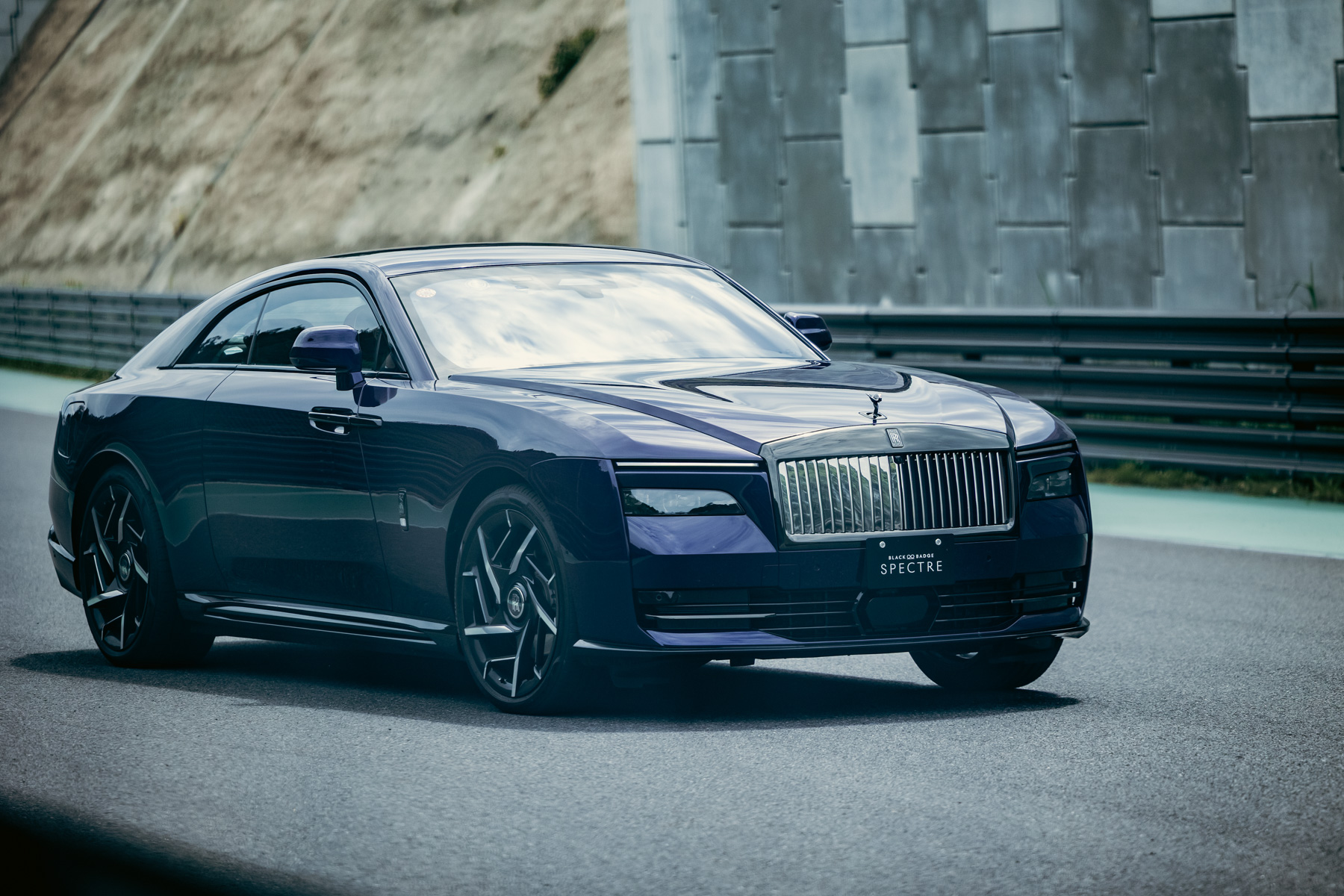
The Rolls-Royce team is the first to admit that a world-class Hermann Tilke track is not a place you’d typically find their cars. Alas, the car we’re here to drive is not your typical Rolls-Royce. It’s the new Black Badge Spectre, the bolder, more audacious and more dynamic sibling to the all-electric Spectre coupé. Rolls-Royce announced the Black Badge line in 2021, a sister line of cars for an emerging category of clientele requesting increased performance, added drama and an edgier way to express their individuality. They viewed the marque as a kind of grandfather/old man’s brand and were rebelling against this in their bespoke choices. Rolls-Royce describes Black Badge as the “alter ego”, a Rolls-Royce in a darker, sharper suit, so to speak. Since its arrival in 2023, Spectre has garnered a reputation as a driver’s car, something that came naturally to its long, sweeping fast-back roofline, two-door design and driver-focused cockpit. It attracted a younger customer to the Goodwood luxury marque – which now claims an average age of 35 for first-time buyers – and the demand has been constant since. On the glamorous and slightly menacing coupé, all the telltale signs of a Black Badge are there – the Infinity loop motif, shiny blacked-out chrome brightwork and a gothic reimagining of the Spirit of Ecstasy hood ornament. For the first time, the iconic Pantheon Grille has been backlit with a soft yet futuristic illumination effect, which is available in four bold colours: purple, yellow, chartreuse and blue. Inside the cabin, this illumination continues across the fascia, tread plates, iconic starlight headliner and doors, and new ’80s and ’90s club culture-inspired colours across the instrument dials. Black Badge Spectre also debuts an incredibly interesting material called Technical Fibre, a diamond-shaped weave made by hand-laying delicate metal threads between layers of carbon fibre. After the pieces are cured, each is sandblasted, sealed with six layers of lacquer and hand-polished, resulting in a mesmerisingly deep finish.

Black Badge is more than a Spectre with attitude – it’s also the most powerful Rolls-Royce ever made, and, as we found out on the heights of the circuit, it’s almost a Jekyll and Hyde of a car. Of course, it has every mark of the luxurious, smooth, cruisy, grand tourer we’ve come to love from Rolls-Royce – and Spectre is already a very quick machine – but switch it into the exclusive Infinity Mode and it comes alive with emotion and thrills, via a more direct and reactive throttle response, weightier and more focused steering and Spectre’s 485kW of power at your will. Then, there’s Spirited Mode, Rolls-Royce’s launch control, which, when pressed from a standstill – or out on our Magarigawa straight – sees the car slightly squat, its haptic touchpoints lightly vibrate and temporarily unleashes its full and meaty 1075Nm of torque to rocket from 0-100km/h in 4.1 seconds. In short, it’s a two-for-one. Black Badge Spectre behaves like a much lighter and sportier car than its near three-tonne self, with a planted and confident stance upon hard cornering and braking, offering plenty of dynamic feedback and a surprising amount of thrill. When I mention this shock and awe to Christopher Hardy, Rolls-Royce Motor Cars’ product manager for Spectre, he smiles and gives me a knowing nod. “It gives you a little more freedom to be braver,” he says. “No one’s expecting this from a Rolls-Royce.” Let alone an electric-powered one at that. “First and foremost, it’s a Rolls-Royce. But we’re pushing the boundaries a little bit for those clients who might be more used to driving what we’d usually see out here on track, who want something a bit bolder, with a bit more panache, but still with that Rolls-Royce DNA.”
In the world of this fabled British luxury marque, customers are referred to as clients, but may as well be collaborators. For almost 120 years, it’s reigned as the most personalisable automotive brand in the world, where every car is hand-built, made-to-order and therefore, enshrined in storytelling at every touchpoint. Similar to the practice found in some haute couture maisons, there are three levels of specialised bespoke programs it offers: Private Collection, a limited series of cars released to a few; Private Commission, where a designer will step in to work one-on-one with a client who requests features and details beyond what a dealer configurator can offer; and Coachbuild, the pinnacle and most revered bespoke level, where an original, one-off car is created with a client. To its bespoke clients, a Rolls-Royce is a deeply personal artistic object, a reflection of one’s identity and often, a statement of legacy. Over time, Rolls-Royce’s designers will get to know their clients’ tastes, passions, habits and desires; where they live, where they travel to and how; and sometimes even playing the role of psychologist, but always with a zero-judgment attitude and degree of trust. “Our clients love coming to our Goodwood home because when they’re there, they have the confidence to spec their car differently, because they’re speaking to an expert, not a salesperson,” explains Hardy. Like many other luxury categories favoured by the blank cheque-signing set, the bespoke side of the business has experienced a surge in demand in recent years, prompting Rolls-Royce to meet the demand where its clients are, by opening what it refers to as ‘Private Offices’. These invitation-only spaces are now found in Dubai, Shanghai, New York and most recently, serving Asia-Pacific, Seoul, acting as regional design centre outposts for those requesting Private Commission work. “We thought, ‘Why don’t we bring Goodwood to our regions so they can speak to someone who understands the cultural nuances in the region, and that kind of thing?’”
Alongside Magarigawa and Rolls-Royce’s hospitality offering, the Seoul Private Office has set up a mobile atelier inside one of the villas for the event, just in case those visiting suddenly feel inspired with a glimpse behind the fabled studio doors. Here, Rolls-Royce can showcase the full ability and breadth of the bespoke division through samples, sketches and conversational storytelling – from examples of new paint colours, textures or applications to creative marquetry, specialised motifs, hand-painted exterior details, artworks or embroidery works; and offer clients the opportunity to discuss new and innovative pursuits, or share some of their own ideas. Perhaps you’ve heard of the exterior paint made with 1,000 ethically sourced diamonds? Or the client who requested a sealed storage area for their rock collection? All real-life lore that began with a bespoke request and ended with a team of engineers, craftspeople and lab testers who made it happen. According to James Bazun, regional bespoke designer at the Seoul Private Office, Rolls-Royce has recently employed two fine artists who are working full-time to redefine and push the possibility, longevity, creativity and limitations of hand-painted leather work within a personal car setting, which is something future clients can look forward to.
The most-asked bespoke question – besides, ‘How much did that cost?’ (of which you’ll likely never get an answer) – is around limitations. How far can one’s imagination stretch on a Rolls-Royce? The short answer: to the very edge of reason. Even then, says Bazun, with the luxury marque’s ability to invent, engineer, test, homologate and Coachbuild a single client’s desire in-house, turning one’s automotive dream into a reality often just comes down to how long they’re willing to wait. “Often, our clients are established businesspeople, so they understand the nature of a business case for things,” he says. “Obviously, if they’re asking for certain aspects that are sacrilegious to the brand, they understand why they might receive a no. But for us, saying no is very rare.”