Limusina
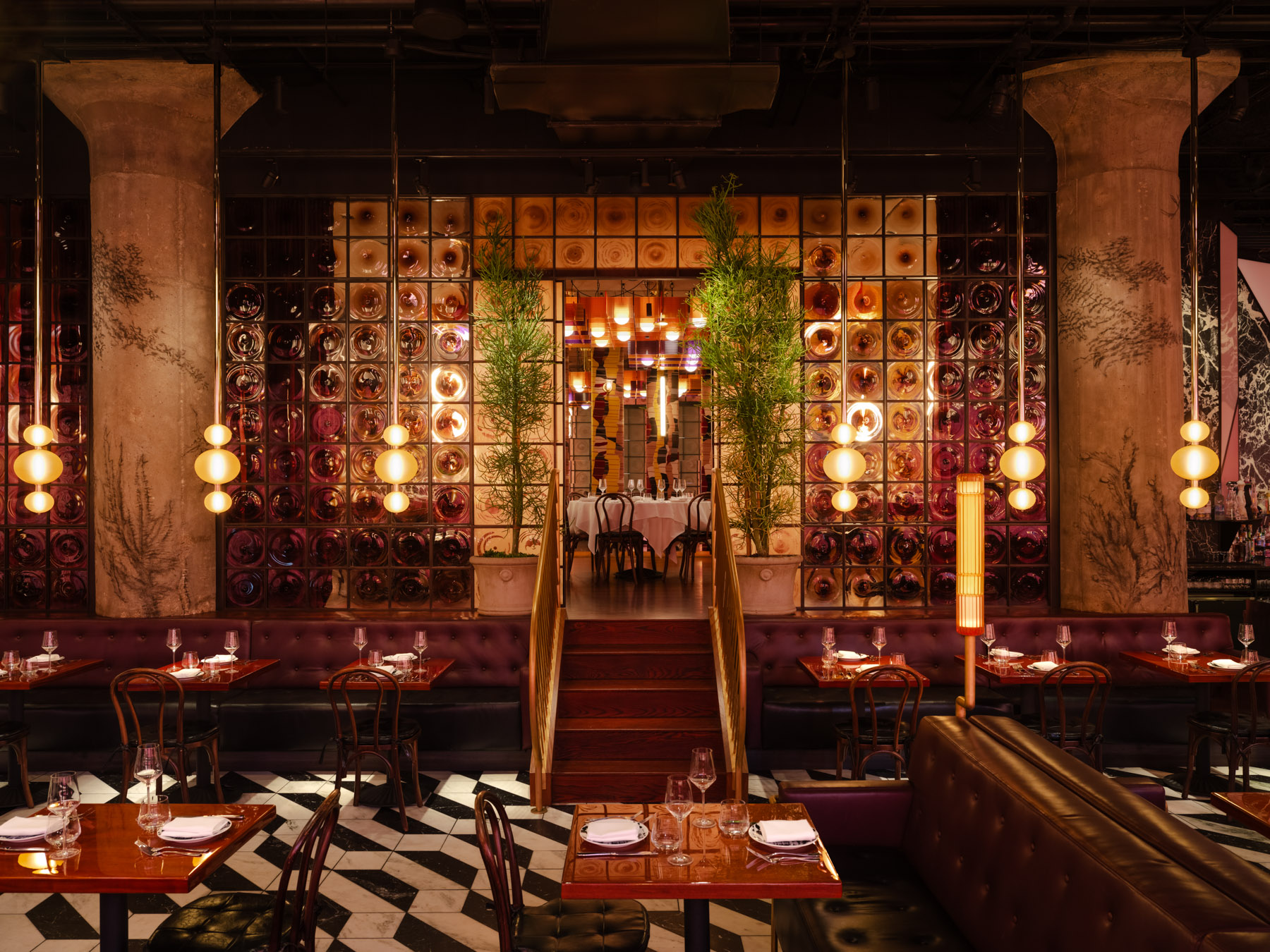
At Limusina in Manhattan, GRT Architects has sought to create a design vocabulary that sees maximalist tropes, a riot of colour and notes of retro-futurism collide in a space that’s charged at every turn.
The venue belongs to Quality Branded, the same group behind Bad Roman, a buzz-worthy Italian restaurant further uptown and one of the city’s cult favourites, Don Angie – both also designed by GRT Architects. Limusina, though, treads new ground. “Bad Roman was on the leading edge of a trend to maximalism which, over the years, has developed into a very eclectic and vintage-driven design language that is so popular now it’s almost safe,” says Rustam Mehta of GRT Architects. “With Limusina, we asked if a space could be maximalist without looking to the past and we wanted to take some risks.”



The team found inspiration in Blade Runner’s retro-futuristic version of Los Angeles, the louche glamour of 1980s Manhattan and maximalism across the eras. The building’s former life as a garage was also a fitting touchpoint. “In the ’70s and ’80s, nothing was more glamorous than a limo – boomerang antenna and all,” says Mehta. “So the limousine, as glamorous as it is gritty, became something of a spirit animal as we brought this new concept to life.”
Though there’s nothing shady about Limusina, it does exude a certain decadence thanks to a panoply of materials substantial in their varying colours and textures. Hand-dyed sheer curtains cast a sherbet glow across the space, slabs of honed marble cut geometric shapes on the walls and hand-painted vegetal motifs decorate existing columns. There are also handblown glass elements, custom-lit breezeblocks and desert plants. Even the unfilled travertine lining the walls was jazzed up with lilac epoxy resin.
It’s high octane but it works, and the dynamic layout – which has been deftly carved from the expansive space – helps to divide and temper these elements. Split over three partial levels and with capacity for 250 guests, there is a main dining room beneath bespoke oversized chandeliers, a private dining room that can be open, closed or split in two depending on the occasion (there’s also a covert dining room for 10 people hidden behind the bar), a lower-level dining area with a glossy green floor that emulates a pool, and a generous bar area that “flows down into the pool to meet you”. Each space features its own highly curated design response brimming with custom details and colour-driven narratives, achieved thanks to an open-ended design approach that resisted parameters and instead prioritised discovery. The outcome? Every seat feels like the best in the house.