
Love Shack
An adaptable Bondi home, Love Shack provides multifunctional spaces that embrace the outdoors. Extended by Second Edition, the coastal residence promotes a harmonious relationship between architecture and landscape.
Set on a compact triangular site, Love Shack is sheltered by the tree canopies above and the shrubs along its garden perimeter. The design brief centred the environment in its plan for an additional space, detailing a small-scale pavilion that serves as a guest room, office and personal retreat. At the core of the project are the three circular design principles: eliminating waste and pollution, circulating materials and regenerating nature. The resulting structure is intentionally elevated to maintain the garden’s flow of water and air – recycled materials enhance its gentle character and the existing trees are interpreted as welcome forms of shade.


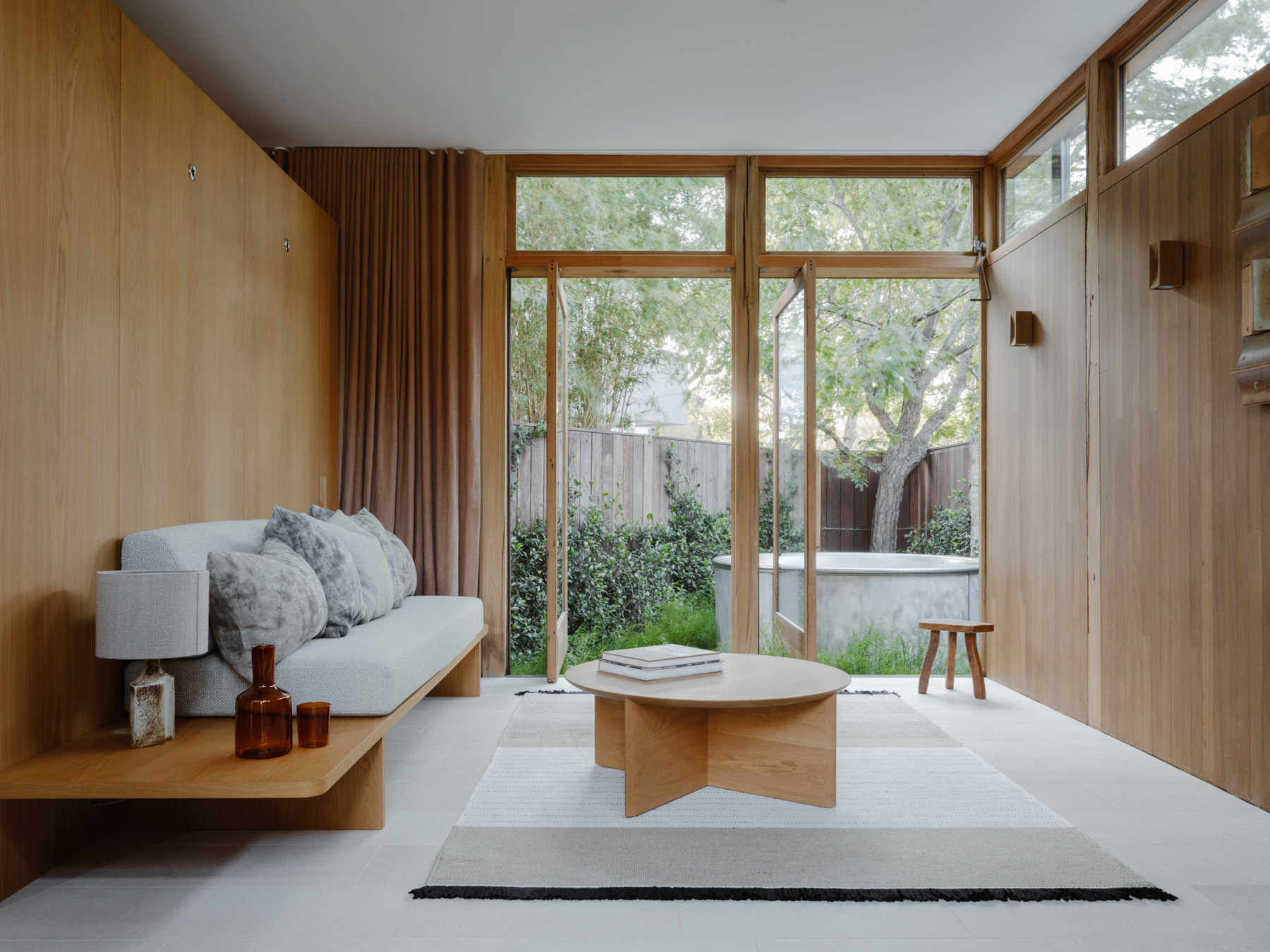
Accessed through the garden, the pavilion follows naturally from the landscape. Floor-to-ceiling glass doors create sightlines from within and without, presenting opportunities for spatial connection. While the rear doors open directly to the courtyard – complete with sandstone tiles and an outdoor bathtub – the front doors lead to the lawn between the pavilion and main building. These doors play a vital role in establishing a tranquil family environment, allowing spaces to be opened and closed depending on the need for privacy. High-level windows ensure that the interior is well-ventilated and filled with natural light.
The materiality of Love Shack emerges from a strict hierarchy. Existing site materials are chosen first as the best way of reducing waste, followed by construction materials salvaged from within 50 kilometres; these minimise transport pollution. Next are quintessential recycled materials, and finally virgin materials with low embodied carbon. The pavilion’s internal wall lining is crafted from reclaimed tallowwood flooring, while its outer structure, doors and windows champion recycled timber. Inside, the joinery utilises leftover veneer sheets and the light fittings incorporate offcuts. The hardware is sourced through local salvage networks.
In addition to its materiality, Love Shack responds to the environment through its passive design. The pavilion operates on a 10-kilowatt solar system shared with the main dwelling. Natural ventilation reduces the need for mechanical cooling and an electric heat-pump hot water system replaces gas. Second Edition’s collaboration with local trades results in alternative options for construction, including on-site material processing. Dry mechanical fixings ensure that the built structure can be effortlessly disassembled and its parts reused in the future.
A testament to circular design principles, Love Shack demonstrates how new constructions can account for their use of space and materials. Prioritising the environment, Second Edition creates a thoughtful, flexible extension that sits comfortably within its natural surroundings.
Architecture and interior design by Second Edition. Build by Robert Plumb Build. Landscape design by Dangar Barin Smith.


