
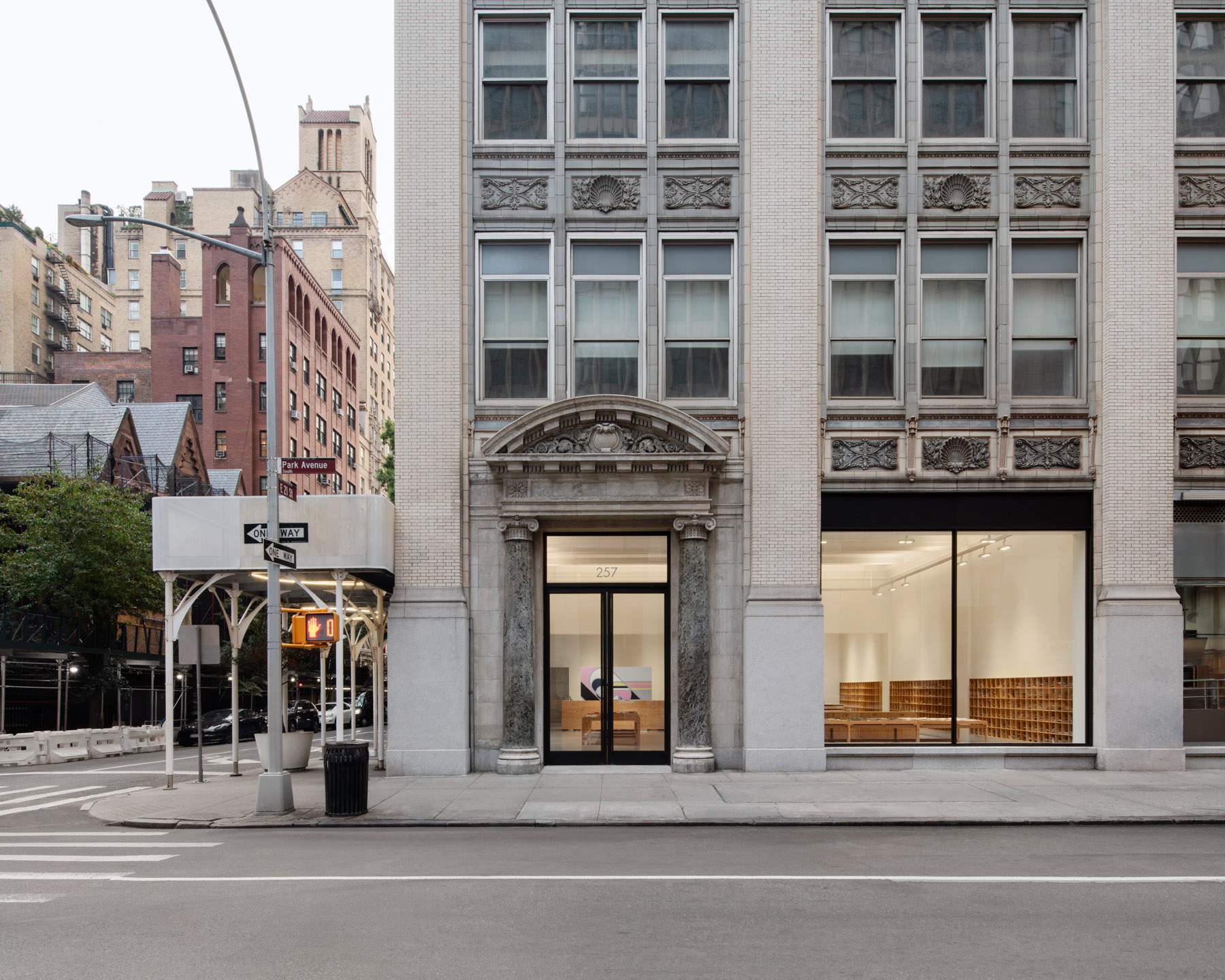
Maharam showroom
Historic buildings often carry a past that is as significant, if not more so, than their present. Maharam’s new Manhattan outpost at 257 Park Avenue South in Gramercy Park is a compelling example.
Home to its brands, Edelman, Knoll Textiles and Maharam, the 325-square-metre space occupies the ground floor of the former Eagle Building, a circa-1911 structure named after former silk company J. H. & C. K. Eagle Corporation, which commissioned the renowned architectural practice Warren & Wetmore to design the building and later occupied its street-facing side.


The multi-brand showroom is a contemporary reimagining of the historic space by local architect Neil Logan, who is celebrated for his ability to revitalise buildings while preserving their defining character. True to Maharam’s signature approach, the aesthetic is immediately apparent: a soaring gallery offers a vantage point over a large library of textiles and leather, while warm, earthy display units in Douglas fir and marine plywood counterbalance the materials’ softness. One wall is transformed into a vast canvas, showcasing a digitally printed work by Sarah Morris. Despite the space’s overarching sense of geometry, it is anything but rigid. Recessed wooden shelving doubles as wall-mounted sample libraries, while pigeonhole tabletops present objects in painterly grids of colour. Even the door handles are enveloped in soft leather, blurring the line between utility and ornament.
Bringing the space into the present was one challenge, but for Logan, it was equally important to honour its past. True to his vision, the showroom’s architectural details reflect Warren & Wetmore’s Beaux-Arts sensibilities, creating a dialogue between history and modernity. “We also wanted to pay homage to Maharam’s roots in New York,” explains Logan, recalling the brand’s humble beginnings in 1902, when Russian immigrant Louis Maharam sold bits of cloth from a barrow along the Lower East Side.

There are other features that nod to the site’s heritage. Expansive north- and west-facing windows flood the room with natural light, drawing attention to its exceptional height – a rare feature at the time of its construction. Cantilevered granite slabs beneath the windows extend inward, forming interior ledges that gently blur the line between inside and out. The restored plasterwork further emphasises the building’s historic character, with egg-and-dart cornices and acanthus leaf coffers carefully preserved. Beneath it all, herringbone parquet floors painted a luminous grey subtly echo the original design, grounding the space in its past. Outside, the company’s official registered name, Maharam Fabric Corp., is displayed in bronze lettering above the entrance, framed by stately columns and topped with a decorative pediment, quietly signalling the elegance within.
At every turn, a quiet insistence on material honesty elevates what could have been a mere showroom into a sensorial study in craftsmanship. Surfaces, hues and seams speak to Maharam’s devotion to design as a lived experience, where architecture becomes an extension of the fabric itself.


