Mardi Doherty
With old bones yet a new soul, a Federation-era house in Melbourne’s inner south-east has become interior designer Mardi Doherty’s expressive family haven.
Set on a corner block in heritage-sensitive Prahran, Melbourne, Gable House is an exploration of character, creativity and collaboration. Designed by Mardi Doherty, the founder and principal of Studio Doherty, alongside Tim Wilson of Folk Architects, the project is as much a professional milestone as it is a family abode.

Studio Doherty, an award-winning interior design practice based in Melbourne, is well-known for clever spatial planning and crafting stunning design concepts that include bespoke joinery, lighting design, finishes and fixtures, as well as furniture and textile pieces. Doherty’s own style sensibility is evident throughout the interiors of Gable House – completed in 2024 – yet this project posed a unique challenge. “It’s actually really hard to design for yourself,” she says. “So, I was really happy for Tim to take a brief from us about what we wanted for our home and then interpret it.”
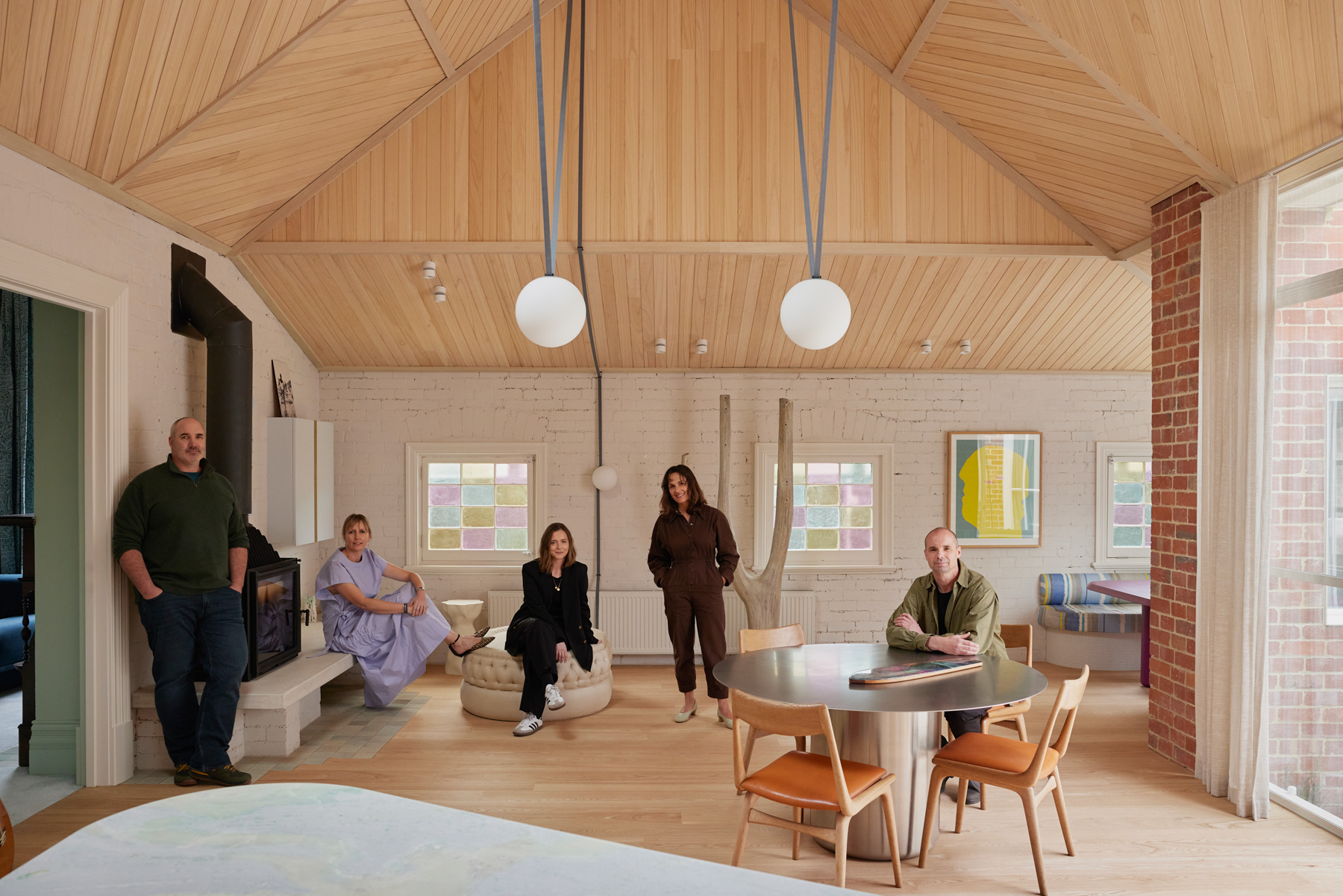
The original Queen Anne-Federation dwelling is a patchwork of history, adorned in red brick, white fretwork and a striking turret. When Doherty first entered its doors, she was captivated. “As soon as I walked in, it blew me away,” she says. “It had this amazing coloured glass in pale pinks, greens and blues. As a studio, we generally love using colour. The tones on the glass are probably not my go-to range, but there was something so charming and enticing about them.”
Far from the mid-century renovation she and her husband, builder Trent Schmidt, had imagined, Gable House posed a different opportunity. “I decided just to really lean into it,” says Doherty. “We just embraced it and leaned into the whole ‘Englishness’ of the architecture.” That decision laid the foundation for an immersive, colourful home that respects both its Federation roots and contemporary family life. The resulting design maintains the original facade and front rooms while introducing a sculptural rear extension clad in soft-green diamond zinc shingles– a hue that subtly echoes the pastel tones of the front windows.
A deep respect for heritage informed every decision. Rather than demolishing and rebuilding, Doherty and Wilson focused on reconfiguring the spaces. The central portion of the house, originally divided into several different rooms, was opened up into a single light-filled, timber-lined space with a soaring pitched ceiling, comprising the kitchen and dining room. The bricks within were carefully removed, cleaned by Doherty, Schmidt and their two teenage children and reused in the rebuild. “We really tried to use as much of the existing house as we could,” explains Doherty. “We kept all the existing cornices, skirtings and fireplaces.”
While the architecture is contextual and refined, the interiors are warm and openly expressive. A green living room offers a cocooning contrast to the lighter, more open spaces. “A lot of people are nervous about colour. We’ve actually had quite a number of clients come over, and they were pleasantly surprised by how relaxing it is to live in colour.” Various shades are used in unexpected ways – a bright-red fireplace, gradient bathroom tiles and wallpapered ceilings– yet the palette remains harmonious throughout. “It’s nice to have relief as well,” she adds, noting that her children opted for subdued white and grey schemes in their rooms.
Throughout the process, the interiors evolved naturally for Doherty, who describes design as an intuitive experience. “I will often just do a little physical shake and just go, ‘are all these bits and pieces feeling right?’” she explains. Rather than adhering to a set vision, the design unfolded in response to the materials, mood and light. “Having a project of your own … you can just pivot in and out. Sometimes I’ll say, ‘this isn’t quite working.’ And it’s funny how one small tweak can bring everything back into alignment.” This flexibility has ensured that every detail and surface is both refined and imbued with tactility and emotion.
The rear addition houses the new bedroom wing for the children, connected to the main home by a glazed walkway. At first, the separation was disconcerting for the designer. “For the first two weeks of us moving in, I’d wake in the night and just go and check that they were okay.” Now, since settling in, the layout offers privacy, independence and comfort for both parents and children. “It’s a great house for teenagers and young adults.”
Key to the project’s success was the working relationship between designer, builder and architect. With Studio Doherty leading the interiors and Folk Architects shaping the build, the collaboration bridged creativity and practicality. Wilson’s approach – humble, respectful, thoughtful– aligned with Doherty’s desire to embrace the home’s “kookiness”. And with her husband as the builder, they made decisions collaboratively and spontaneously, even in the middle of the night. “Sometimes he would sit up in bed and say, ‘Mards, I’m just not sure about this detail.’ And we’d sit there and resolve it, then go straight back to sleep,” says Doherty with a laugh.
In many ways, the home itself mirrors the rhythms of family life – fluid, responsive, evolving – and this is perhaps Gable House’s defining feature. The layout balances cosiness and openness, tradition and innovation. At the front, the rooms feel intimate and cocooning; at the back, sunlit volumes encourage gathering. “Itis both [sanctuary and outward facing], at different parts of the house.” From her daughter’s upstairs bedroom, elevated views of 120-year-old plane trees offer an almost hypnotic connection to the seasons. “You just feel like you’re so connected to the outside. It feels beautiful. It feels like you’re in a treehouse. The leaves have gone from being beautiful and green to turning red, then brown and yellow – and now they’ve dropped off. This house has lots of views, and I find that so invigorating.”
This appreciation for the outside world extends to passers-by. The dwelling’s front garden, unusually large for an inner-city home, has turned into a kind of communal hub. “So many people talk about activating their back gardens,” says Doherty. “For us, it was the front garden.” Outfitted with a fire pit, the outdoor space frequently hosts neighbours for drinks or marshmallows around the fire. “We’re not tucked in behind a high fence,” she adds. “People will walk past, they’ll come in, somebody will just chat at the fence – it’s quite a social house. We’re actually very community-minded, and we have the front garden really for the street.”
Gable House is a wonderful example of a family residence that reveals more of itself the longer you look at it. It is not about grand gestures but rather the beautiful layering of detail, history and personality. The home is, unmistakably, designed with intention and inhabited with joy, which is a true reflection of the woman who helped shape it – creative, considered, generous and bold.
Architecture by Folk Architects. Interior design by Studio Doherty. Build by Exceed Group. Landscape design by Mud Office.