
Michael Kirby Building
A few years ago, Macquarie University’s Wallumattagal Campus, situated on Dharug Country in Sydney, Australia, looked a little different. The tired circa-1985 structure that masqueraded as the administration centre is now where the Michael Kirby Building stands.
When architectural firm Hassell ultimately took up the gauntlet of reimagining the space into a contemporary learning destination, the intent was never to undo the past but to honour it in making room for the future.

Inaugurated in March 2024, the Michael Kirby Building – christened after the former Justice of the High Court of Australia and the university’s first Emeritus Chancellor – is an object lesson in adaptive reuse. The 8,500-square-metre upcycled building emerges from the shadows of its predecessor, serving as a modern home for Macquarie University Law School and the university’s Department of Philosophy. In remaining committed to its lifelong pursuit of educational excellence, the institution has also positioned the building as a support facility for the larger campus.
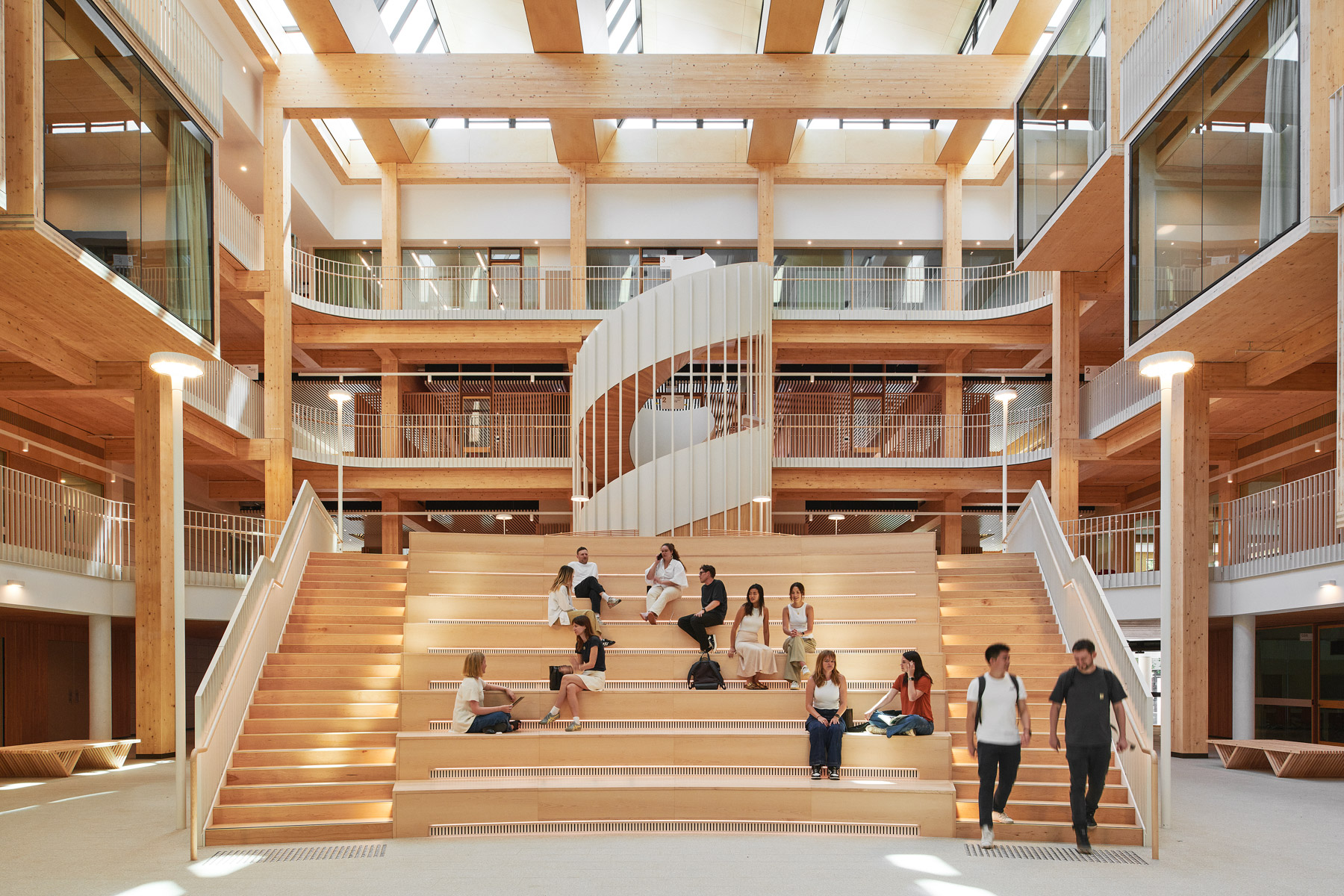
In a bid to transform the original two-level structure into a luminous four-storey exemplar, Hassell took cues from the existing architecture. The design team converted a neglected courtyard into a covered, naturally ventilated, top-lit atrium, allowing the elements to permeate a series of indoor gathering spaces that foster interaction and creative collaboration.





Alex Gurman, associate at Hassell’s Sydney studio, considers the glass-fronted cantilevered atrium the pièce de résistance of the building. “It really grew from a desire to preserve the character of the original courtyard, and it’s unlikely the building would have taken this form had it not been an adaptive reuse project,” she reflects. The intent to keep the structure light is reflected in its timber frame and glazed facade – a delicate departure from the robust masonry of the original architecture. This contrast not only enhances the building’s visual identity but also reinforces its openness and transparency, making it the crown jewel of Wally’s Walk, the tree-lined thoroughfare. “The building champions light, openness, accessibility and wellbeing,” adds Gurman.
“The desire to encourage connectivity and collaboration called for a transparent design that is adaptable and flexible while also retaining as much of the existing building structure as possible,” explains Kevin Lloyd, principal and one of the heads of design at Hassell in Sydney. “You can almost see what other people are doing from every vantage point of the building, which really gives that sense of interconnectedness and allows for the free exchange of ideas.”


The design is a flexible model capable of adapting to shifting needs. The building houses forward-thinking spaces for independent and crossdisciplinary learning, work and research, along with recording studios, an open-air zone, event space and moot court – suspended above the main entrance – for students to practise advocacy skills.
The result belies the challenges that arose during the design and construction process. Gurman cites building with timber as a particular hurdle, noting that it required careful coordination, precise detailing and a deep understanding of the material’s structural and environmental behaviour. “We had to consider everything from fire performance to moisture management and movement,” she says. “Still, we were fortunate that the site conditions necessitated a lightweight structure – and equally fortunate to collaborate with a forward-thinking client.”
In a bid to transform the original two-level structure into a luminous four-storey exemplar, Hassell took cues from the existing architecture.
To the casual observer, the building feels more crafted than constructed, with its beauty rooted in the clarity of its detailing. This is evident in the way multiple timber beams elegantly converge at a single column, and in the intricacy of the exposed structural system and services, where every junction has been resolved with precision and care – revealing the rigour behind the seemingly effortless design. Gurman adds, “I’m especially proud that its namesake called it ‘magnificent’.”


