Oden
At Oden by Rusell & George, the slow comfort of a centuries-old Japanese dish is given a Melbourne makeover in a space that is intimate, moody and simmering with atmosphere.
Oden by Russell & George is Melbourne’s first dedicated, elevated oden dining destination – a place where a humble Japanese dish is both the star and inspiration for the immersive interiors. Designed by Melbourne-based studio Russell & George, the venue translates the warmth and ritual of oden into a space that honours tradition while feeling utterly new.

Oden is a type of nabemono – a one-pot dish – traditionally made with ingredients such as daikon, eggs, tofu and fish cakes, gently simmered in a light soy-based dashi broth. At this new Bourke Street restaurant, the dish has been updated to include a rich, chicken broth and its slow, methodical nature shapes not just the menu, but the entire dining experience.
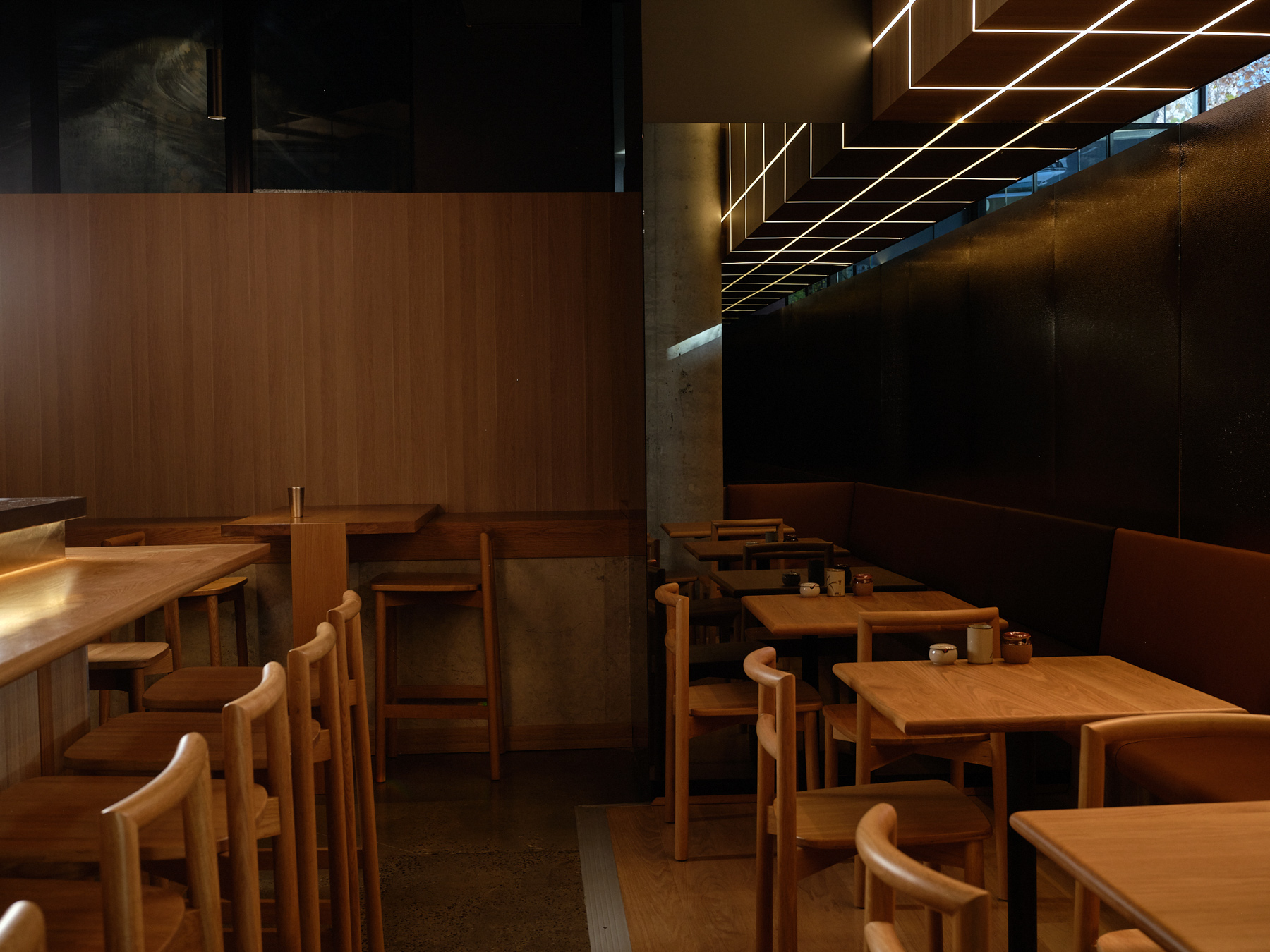
“The brief for Oden was centred on creating an intimate dining experience that felt nocturnal, industrial and deeply textured,” explains co-founder Ryan Russell. “Our key inspiration was the concept of the Japanese street stall (yatai), reimagined through a lens of contemporary dining.” The studio focused on “the contrast between the dark, shadowy alleys of Tokyo and the refined precision of traditional Japanese joinery” with the aim of capturing “the ‘heat’ and ‘steam’ of oden cooking in a physical environment”.
That sense of place is also shaped by Oden’s Melbourne context. Located within the CBD, the restaurant leans into the city’s laneway culture. “We didn’t want to ignore the city outside; rather, we wanted to create a dialogue with it,” notes co-founder Byron George. “The design responds to Melbourne’s laneway culture via the idea of finding something extraordinary behind a nondescript facade.” As he describes it, Oden is “a ‘Melbourne version’ of Japan – moody, weather-beaten yet incredibly sophisticated”.
Industrial materials are updated through refined detailing. “Concrete, timber and hammered copper are the main materials throughout the interior,” says Russell. The hammered copper, in particular, draws directly from traditional oden cooking pots. “Hammered copper pots with an internal grid to separate the different types of produce that float within a broth are the traditional way in which oden is served in Japan.” At Oden, that logic is scaled up architecturally: copper encloses the space, frames the open kitchen and informs custom lighting that references the grid of the pots themselves.
Copper encloses the space, frames the open kitchen and informs custom lighting that references the grid of the pots themselves.
Overall, the lighting is deliberately restrained and atmospheric. “As in all our work, lighting is never intended to be purely functional; it was designed to be theatrical,” explains George. A “low glow” strategy concentrates light on the food and the chefs’ hands, leaving the rest of the room in soft shadow and drawing diners toward the kitchen’s warmth.
Like great Japanese cuisine, the design balances tradition with innovation – which, as the designers note, is a hallmark of their practice. Drawing on ritual, spatial hierarchy and the diner-chef relationship, the studio oversized familiar forms and materials to give the interiors “a sense of modernity, tradition and conviviality”.