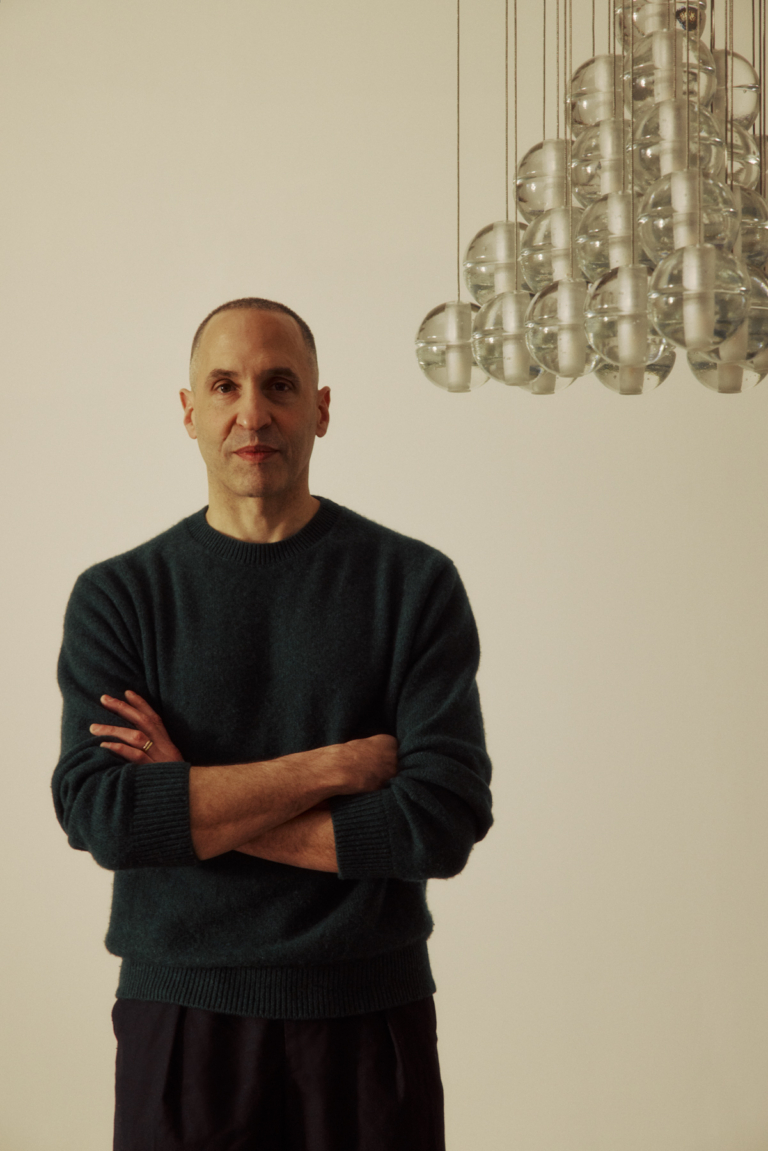
Omer Arbel
Though the co-founder of Bocci is perhaps best known for his exploration of light as a medium, his creative output – which is often unbound by traditional parameters – is far more extensive.
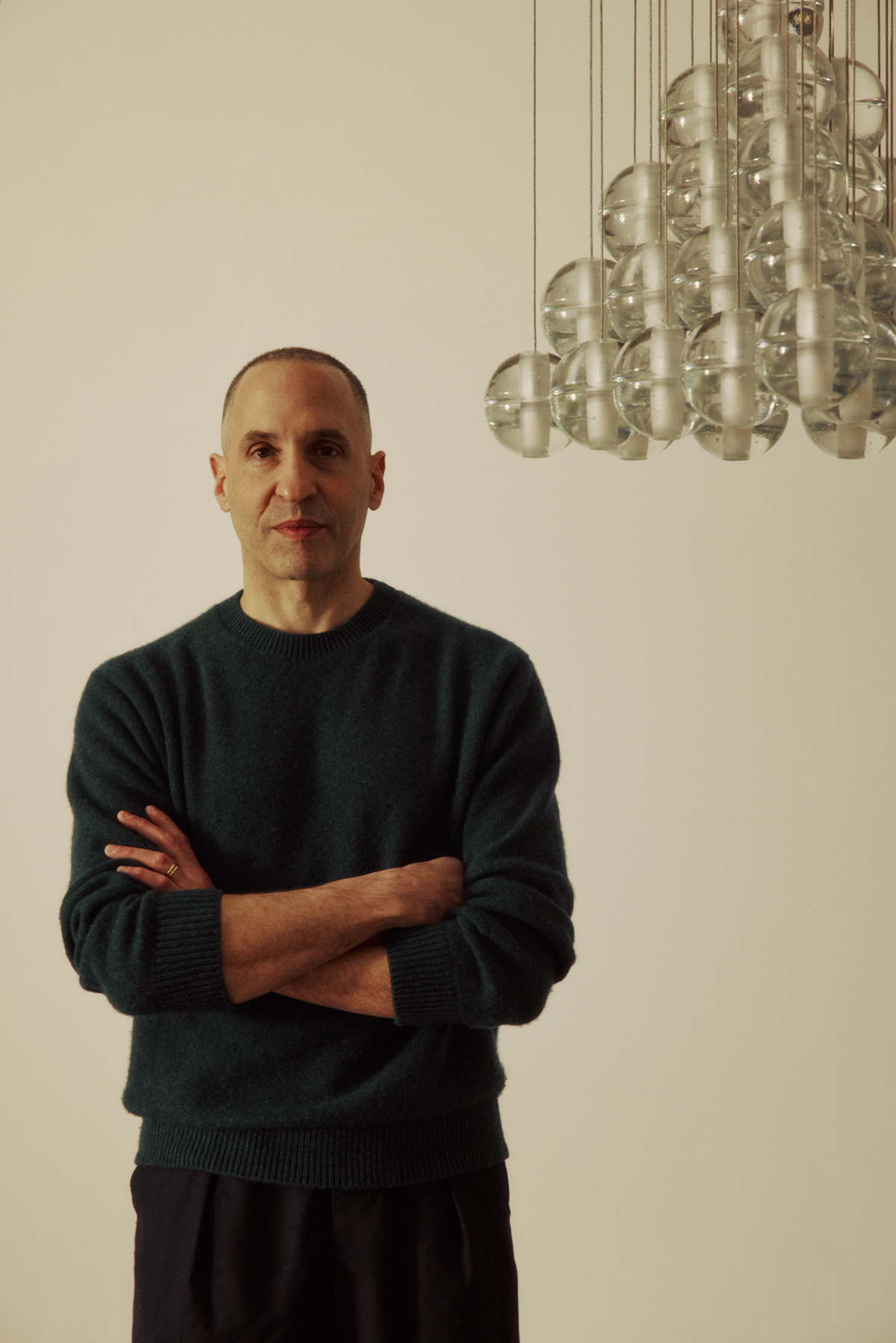
Omer Arbel turns a clear glass orb over in his hands, allowing it to roll between his palms before placing it on a table where it rests. It’s not just a beautiful object, although it could certainly pass for one; it’s the 14p, the portable version of Bocci’s renowned 14 Series light fixture, the company’s debut release more than 20 years ago and one of its most recognisable to this day.

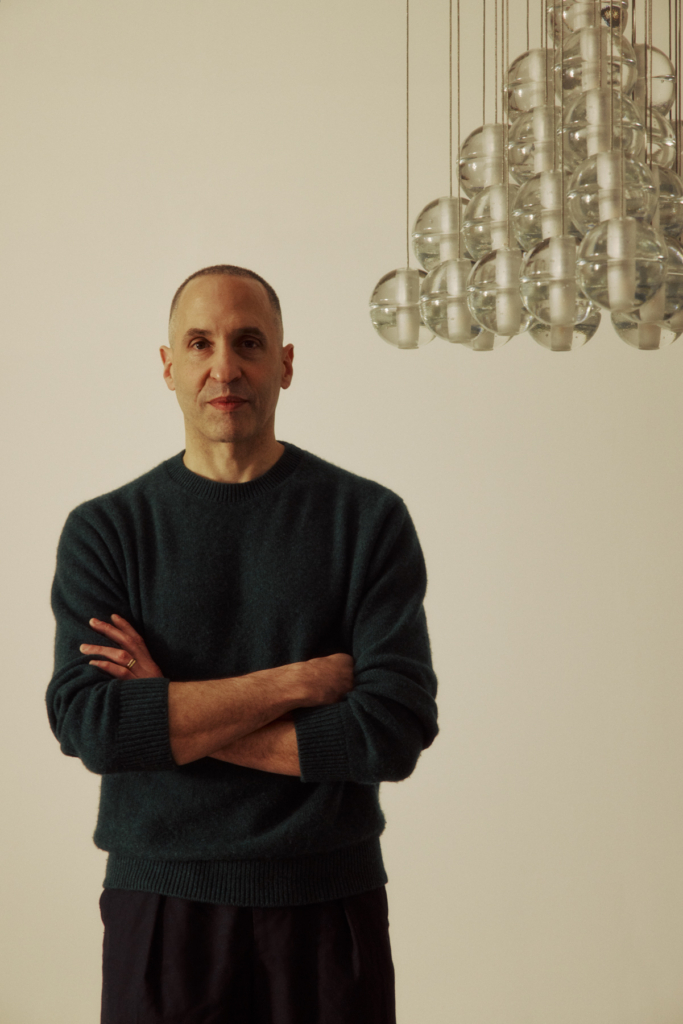
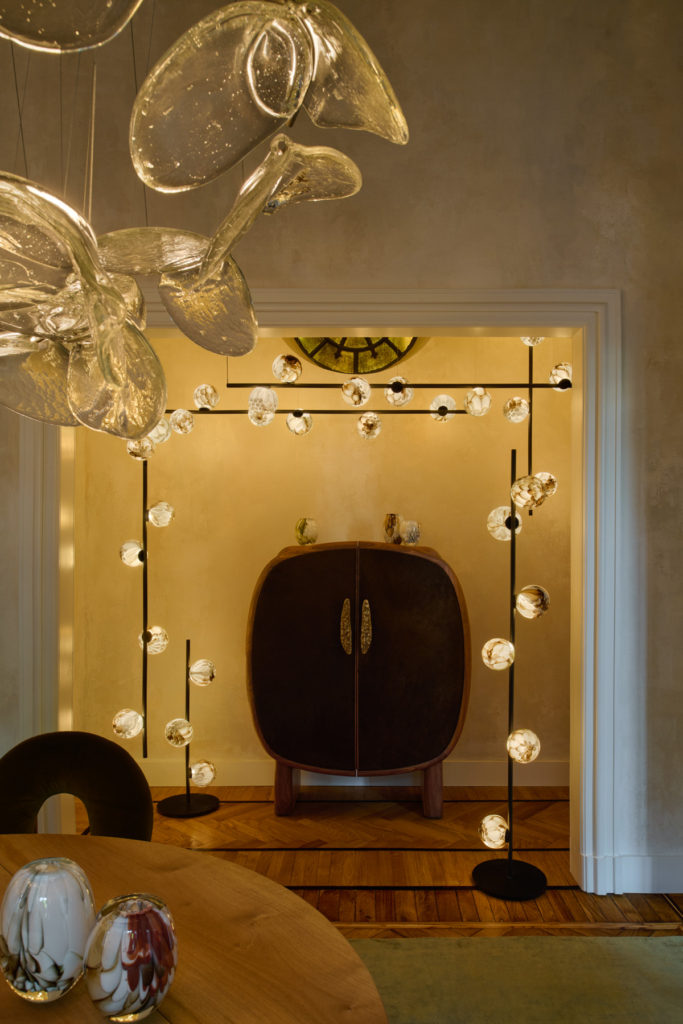
Research and experimentation are central to Arbel’s work and his process involves lengthy enquiries into form and materiality.
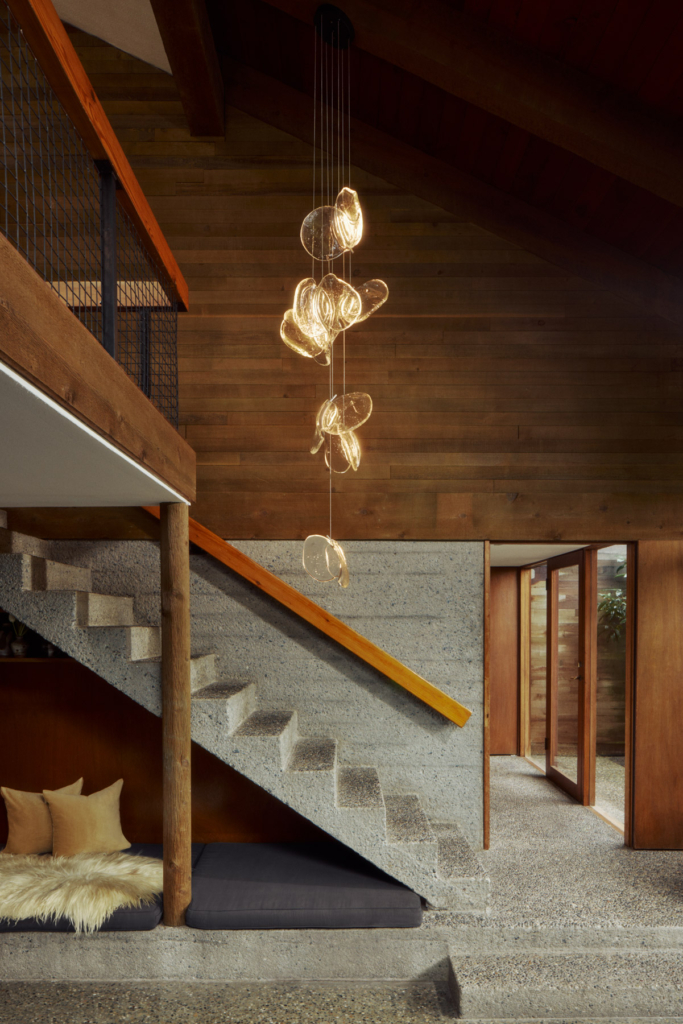
Despite the grey Pacific Northwest sky, Bocci’s sprawling Vancouver headquarters is bright and airy, thanks to large factory windows and high ceilings. In a small studio off the main office, sketches and objects abound and a cluster of 141 Series fixtures – made from two overlapping ladlefuls of hot glass that cool and harden to resemble butterfly wings mid-flutter – hangs from the ceiling.
Some pieces are immediately recognisable, like the 14 Series or rows of coloured 28 Series shells lining the shelves. Others, however, like the thick, weighty slab of swirled chocolate brown and cream glass, as well as a knotted piece of metal adorned with barnacle-like bulbs, are ideas currently in flux, yet to find context within his extensive practice.




“Basically, my entire job, along with a handful of my colleagues, is to experiment with materials,” he says. Arbel is minimising the breadth and complexities of his work, which encompasses lighting design and a staggering spectrum of research-based and architectural projects under Bocci and Omer Arbel Office.
Research and experimentation are central to Arbel’s work and his process involves lengthy enquiries into form and materiality, often with no context, project or brief in mind. For instance, discerning the chemical reactions of metals, freezing hot beeswax in blocks of ice or casting concrete around formwork made from hay. “In architecture school, you’re taught that criticism is the most important skill, and I don’t think that’s true. I think every idea is a good idea, sometimes they just need more time. That could be a week, a month or even a decade.”
A process somewhat free of budgetary and timing constraints is seldom enjoyed by creatives and Arbel admits it’s a luxury. “In the beginning, there was a lot of pressure and it’s taken a lot of work and effort to get here, but now there is enough momentum that I have the luxury of experimentation.”
Arbel splits his time across the Vancouver headquarters. A team of skilled glassblowers hold court in the hot shop, operating with a level of measure and care that contradicts the environment’s inherent intensity. Elsewhere, products are documented in the photography studio, light fixtures are tweaked and finished in the workshop, orders are packed and shipped and the day-to-day running of the business occurs. He also frequently retreats to a second studio space nearby – an offsite laboratory of sorts where he explores form and material interventions with few parameters.


Arbel’s business partner and co-founder of Bocci, Canadian entrepreneur Randy Bishop, fully supports this unique creative process. The pair, whose rapport is grounded in a sense of ease and mutual admiration of their respective aptitudes – Bishop in strategy and business, Arbel in ideation and design – meet twice yearly to discuss Arbel’s findings and lines of enquiry. They ascertain which concepts hold potential and place them where it makes the most sense, subsequently naming these projects in sequential numerical order. “We work without scale and program, so when Randy and I meet, we surround ourselves with all these prototypes and we ask, ‘Is it a light, a work of art, something we can commercialise, part of a building? Or is it a piece of research that leads to something else?’”
Bishop also comments on these workshops, describing them as “witnessing Omer’s change and evolution in real time”. He adds that Arbel has “had more great ideas in the last three to four years than the preceding decade” and that he thinks he “will undoubtedly go down in history as one of, dare I say, the best creatives of our time”.



A trained architect, Arbel has designed several buildings, including Bishop’s family home of 16 years. The most significant, however, is Governors Point. Located on a peninsula in Washington, just south of the Canadian border, the land was destined for a development that would have seen the old growth forests razed and natural ecologies destroyed. Instead, Bishop acquired the land, donating about 40 hectares for a dollar to the local Whatcom Land Trust as a protected nature reserve and retaining about 11 hectares upon which he and Arbel are designing 16 highly custom residences only visible from the water.
The first, a prototype of sorts and Bishop’s own, is nearing completion. Several innovative methods and materials developed by Arbel have found their place in this project, including a staggering roster of custom details and finishes and the use of tumbled cedar burl offcuts as cladding.

The latter represents a timely architectural response driven by context. “These massive 300-year-old cedars are dying because it’s too warm,” explains Arbel, adding that “in normal circumstances, the burl is very valuable, but because there’s such a glut of this material and its use in fine furniture is so niche, these amazing burls are being mulched.”
Arbel’s idea to take this waste material, tumble it into smaller forms and use them as architectural cladding is taking shape at Governors Point, where Bishop’s house will soon be veiled in a living, wooden envelope. “It’ll eventually become its own ecology with lichens and mosses,” adds Arbel. “I love it because it marks a time and a place.”
Arbel’s material-forward rationale can be traced back to the 14 Series, originally designed in 2005 as the fifth and final piece of a collection Arbel was presenting during the International Contemporary Furniture Fair in New York. “I had four beautiful things that I was going to show, but I have this weird thing with numbers, so the intent was to make a piece that complemented the other works and avoid the number four,” he says.
Using what he calls a “hemispherical mould” – originally it was a Boeing airplane part – found in a friend’s workshop, he designed and produced a light fixture in a matter of weeks. Though Arbel originally envisioned a seamless sphere, he made use of the two domes, and the 14 Series – with its distinguishing centre seam and meniscus-like edge – was born. It ultimately caught Bishop’s eye and was the foundation upon which Bocci was formed. “There was this kind of humbling moment where I realised that maybe the materials and the process have a lot more to teach me than I have to offer,” says Arbel. “My original vision paled in comparison to what was achieved by these two forced concessions to process and material properties.”
It’s a philosophy that has come to define Arbel’s extraordinarily unique lexicon and it underpins the astounding catalogue of concepts, products, buildings and research he has produced over the past two decades. Nevertheless, Arbel and Bishop never imagined a single glass orb would lead them here. As Bishop says, “In the early days, we tossed the term iconic around as a half-joke over wine. Now, with a few pieces quietly entering that territory, I believe Bocci will outlast us both.”