Brud Studia and Oigäll Projects
Andy Kelly and Mitchell Zurek seemingly followed a whim with their creative pursuits, but behind the scenes is a steely resolve, matched by a resonance with brutalist forms and bold gestures.
A gut feeling and trusting intuition has determined not only Andy Kelly and Mitchell Zurek’s creative paths but their life journeys, too. While Kelly has a fashion background and Zurek is a landscape architect by trade, the pair’s seemingly disparate skill sets have resulted in a distinctive yin and yang balance of sorts. And it has led to two different pursuits that have left more than a passing impression on the design scene: furniture and objects studio Brud Studia and design-focused gallery Oigåll Projects.

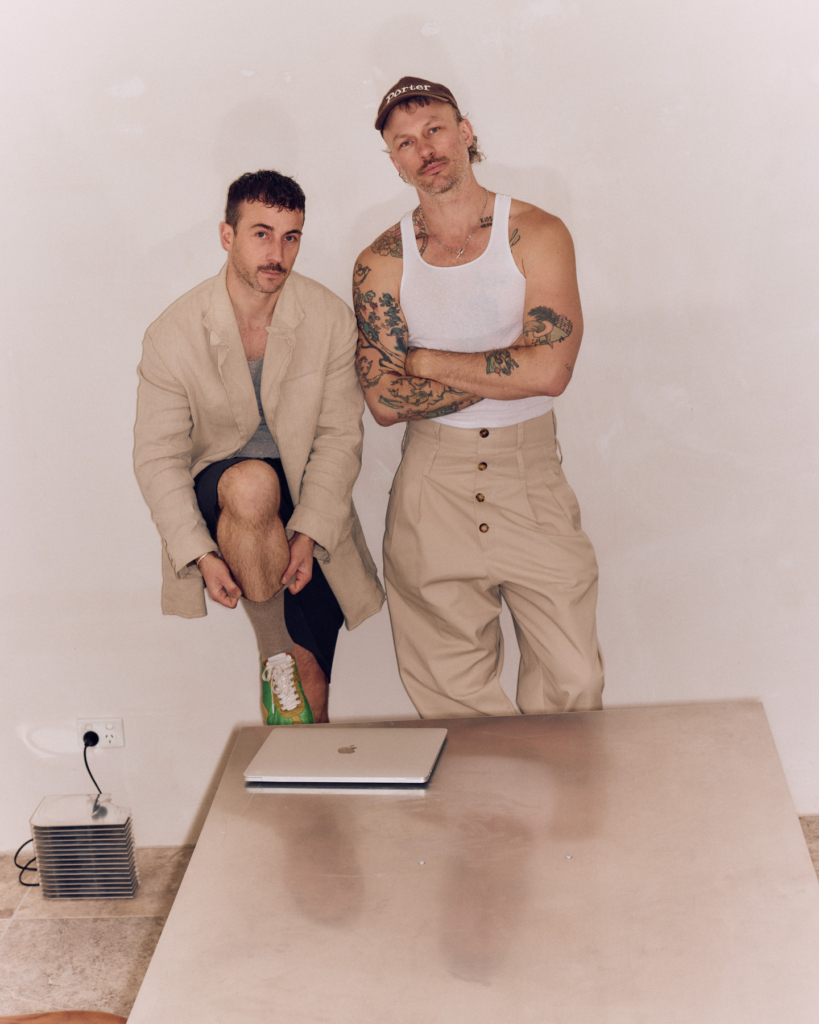
The Melbourne-based partners in life and work went with a hunch, and it has served them well, despite an unsteady start. “It has been an absolute comedy of errors with no – when I say no, zero – plan,” says Kelly. “We had no business plan. We had no idea why we wanted to buy something – we just wanted to. And then I convinced Mitchell’s dad that it would be a great investment opportunity. I woke up one day and I was like, ‘I’m going to buy a commercial building.’ And then I somehow lied, convinced and manipulated him into thinking it was a good idea.” Andy Kelly and Mitchell Zurek seemingly followed a whim with their creative pursuits, but behind the scenes is a steely resolve, matched by a resonance with brutalist forms and bold gestures.
Back in 2020, Kelly and Zurek were determined to purchase a dwelling as a home base that could also serve as a workplace. Brud Studia was a budding practice at this point, an avenue for the pair to create things for fun during lockdown while exploring brutalist forms in direct dialogue with materiality and more than a touch of the absurd and abstract. “We were making these chairs in our living room in our little townhouse in Collingwood over lockdown with a set of 200-year-old files that Mitchell’s grandfather had left him. And then the next logical step to me was a building purchase,” says Kelly. Brud’s first piece was a chair of precise proportions, made of pieces that slotted together with no need for screws or glue, realised in aluminium and travertine. The silhouette is unapologetically cutting and angular, inspiring other iterations that also, admittedly, “look like toilets” as the website states. The Brud repertoire now includes lamps, vases, stools and side tables, as well as a coffee table named after friend and fellow designer Henry Wilson.


Upon settling this two-storey corner property, the ground level was slated to be a studio, but to what extent was never a fully articulated plan. Timing did play a key role. Melbourne Design Week that year was held in March, and a close friend of the couple, designer and artist Ella Saddington of Cordon Salon, floated the idea of the trio curating a show in the space together. “It was a really great way to introduce us,” recalls Kelly. “We essentially set up the gallery, but at the time, we weren’t calling it a gallery.” Melbourne then went back into lockdown and Oigåll began in earnest as a live art catalogue. “All of the paintings were on the walls, so people would message us going, ‘I’m going for my five-kilometre walk. Can you swap out the painting that’s on the back wall and put it in the window, so I can have a closer look?’ We were moving things around so people could walk past the window and buy stuff.”
A dinner catered by Seasonal Simone within the gallery, lined with paintings by Billy Vanilli, set the tone for Oigåll doing things a little differently, intuitively marching to the beat of its own drum during the uncertainty of the time. And while the ‘non-plan’ was taking shape, former visual merchandiser Kelly credits early supporters and mentors for Oigåll’s subsequent iterations. “Fashion was a really early adopter. Kellie Hush was so supportive, buying big, huge paintings,” he says. “In that window, too, is when I met gallerist Sophie Gannon. She really took me under her wing, and when we were getting to the point where we were like, ‘Okay, well we’ll end this gallery,’ that’s when she was like, ‘No, what you are doing is so exciting and so needed for the landscape.’”
It’s hard to separate the progression of Brud Studia or Oigåll Projects without acknowledging that each business acutely informs the other. As Zurek puts it, “the gallery is now stemming more into the design world a bit because it’s always been our trade. As we think about fabrication, how we make things, the materials we’re using with Brud, then that’s also how we curate.” This is a sentiment Kelly echoes: “Whether it’s art, whether it’s design, whatever it is, we are always very material- and process-focused, and that’s just kind of naturally what’s started to be the thread … the only thing we care about is material and process.”
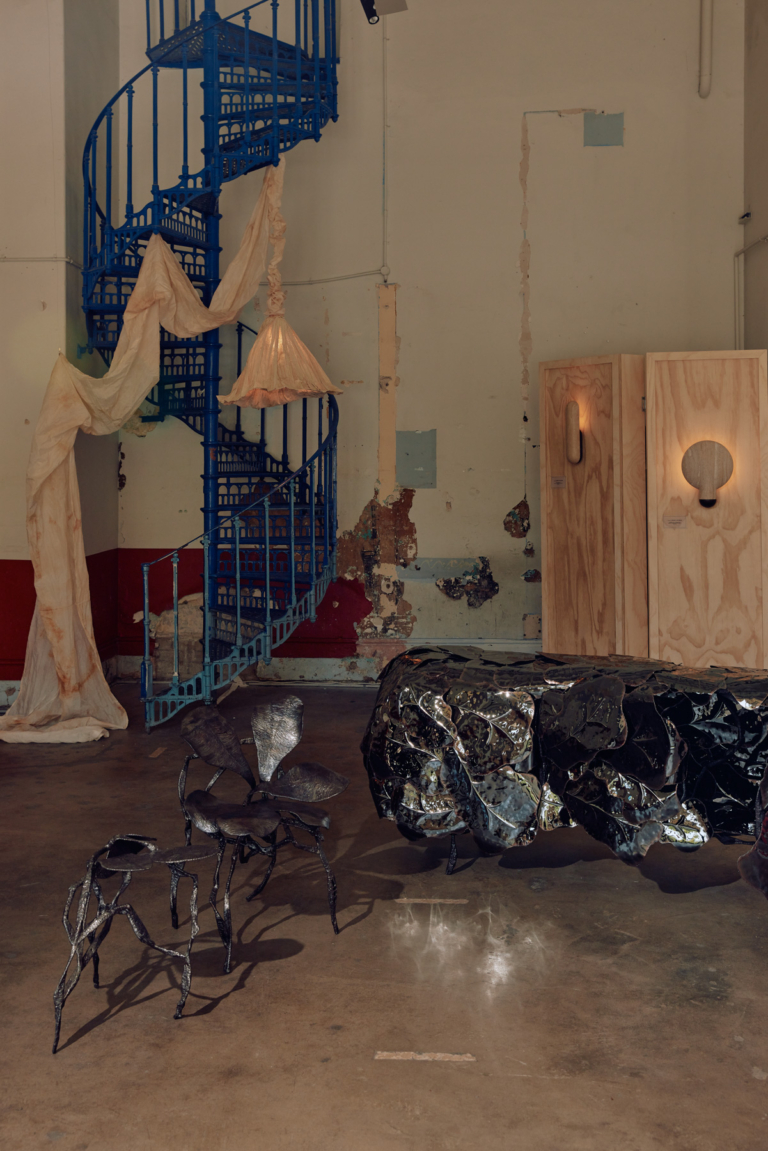
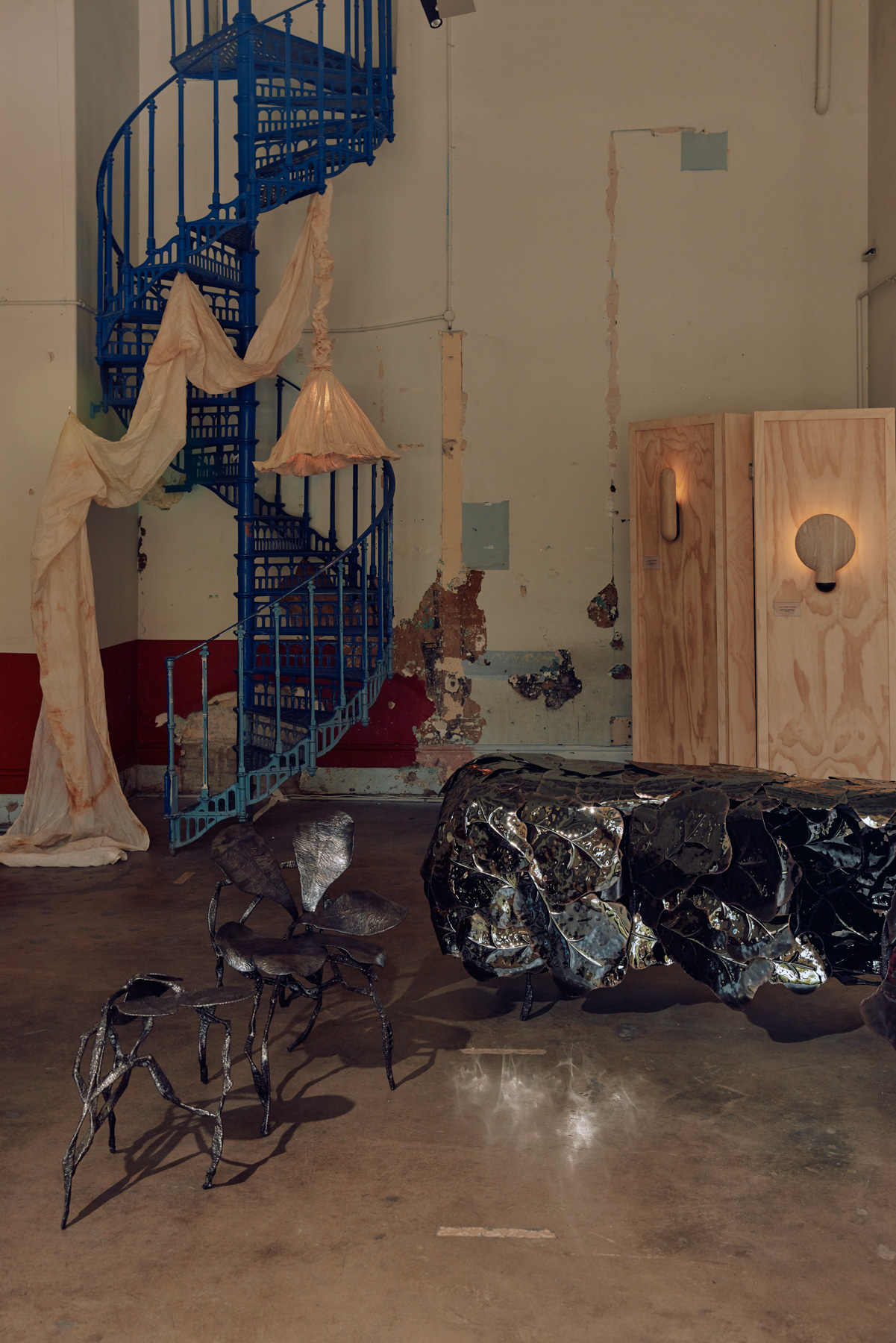
Aluminium is a material that marks both Brud and Oigåll via seats, tables, vases, lamps and installation backdrops. At first it was chosen for its accessibility, cost-effectiveness and the duo’s ability to send fabricators CAD drawings of their designs and have them produced in aluminium, as those trades were essential businesses during lockdown. It proved to be a crucial beginning point. “When we started Brud, I was like, ‘Well, let’s make sure that we lean into the aluminium. It does scratch, it does patina – let’s make that part of it,’” says Zurek. “It’s reductive in its palette, too,” adds Kelly. “It has a nice shine to it and also disappears. You can do lots to it: it can be cast, folded and offers endless possibilities.”


Feeling like they had reached a limit with aluminium, the pair turned back to the humble beginnings of Brud. “It was always meant to be a creative outlet, so we don’t put too much pressure on it, and we’re experimenting and learning,” says Zurek. Brud’s process has evolved from machines that cut in only one direction to CNC, which can cut 360 degrees, utilising an original slot construction. “The CNC opened up all these other capabilities of how our pieces could slot together,” explains Zurek. “We’ve created our own set of boundaries where we know that things have to slot together. Sometimes it’s frustrating because you’re like, ‘Oh my god, we could just screw it and call it a day.’ But we’re working with these tight little parameters, and I’m adamant we’re sticking to that.”
The first result of this method is the Stos lamp in a delicious butter yellow tone, a marked departure from Brud’s monochromatic offering. The “very brutalist, stoic point of view” remains, “but then neither of us are actually that brutalist or that stoic, so it started to feel a bit forced,” says Kelly. To emphasise this, Kelly reveals that he loves “shiny stuff mostly. I’m actually a huge maximalist. My favourite designer is Christian Lacroix. I love Versace. I love extremes, and something like that glossy yellow in the framework of Brud, that’s Palazzo Versace for us. The yellow lamp also became the opportunity to be a bit silly. And you’ll see our Instagram changed. Our website changed.”
This shift also marks a confidence that Kelly and Zurek have in both practices, which has come from the reality of making a living through creative pursuits. “We understand what it’s like to be on that side of the fence, and then we have the gallery, so we get both sides,” says Zurek. “We don’t really formally represent anyone, so we made our own rules.” Leaning into a trusted community of makers and kindred spirits has also honed the Oigåll focus further. “Being gay and not having huge families has meant making a chosen family and fostering really deep connections with people who share the same ideas on aesthetics and directional, curated living,” says Kelly.
Curation has become a maligned term, and Oigåll’s take on it is much more maker-focused with the likes of Cordon Salon, BMDO, James Lemon and Sozou Studio having held exhibitions. “There is a breed of curator that thinks their curation is a practice, and they almost elevate that to the same level as the work, whereas we don’t,” he says. “I’m very aware that this is a shop. What we do to sell the object is just not that important. I’m not going to give the same level of reverence to the admin of running this thing as the work itself. And just keep getting these kids paid – that’s the number one thing. Keep putting it in, keep selling it, keep pushing people. We’ve reached a place now where if we say this is good and it’s good for these reasons, people go, ‘They must be right.’ And I’m really grateful that we are in that place now. We are moving into a space where we have credibility, we have a point of view, people come to us for a certain kind of thing, and we can keep building that and working with these people.”


While the next frontier is doing something overseas, the hustle is still very real and keeps them nimble. “Andrew’s good at making sure that we don’t get stuck,” says Zurek. “We move quite fast, and that’s when you learn the most. I’ll get fixated on some of the details, and Andrew is just like, ‘No, it’s good enough. Print it. Next job.’” And while some things might change, others hold steadfast. “We do still fight a lot though when we design things,” says Kelly. “People never like feedback, and I don’t give feedback in a very kind way. There’s not a lot of blindness in my voice when I give feedback.” Kelly turns to Zurek and says, “you don’t love getting feedback anyway, so together it can be a little prickly. There was one time we were designing something and I said to Mitchell, ‘You’re killing me. You’re killing me to death.’”
One thing that seems certain is that the pair are involved in every facet of Brud and Oigåll, spending weekends dreaming up the next piece or exhibition. “Everyone always asks us, ‘Oh, who does all your graphic design? Who does all this? Who does all that for you? Who do you use?’ We do it all ourselves – everything,” says Zurek. “Anna Schwartz said that to us,” adds Kelly. “She gave us some great advice: do everything yourself for as long as you physically can, while we can do every single thing. Do it for as long as you possibly can.”