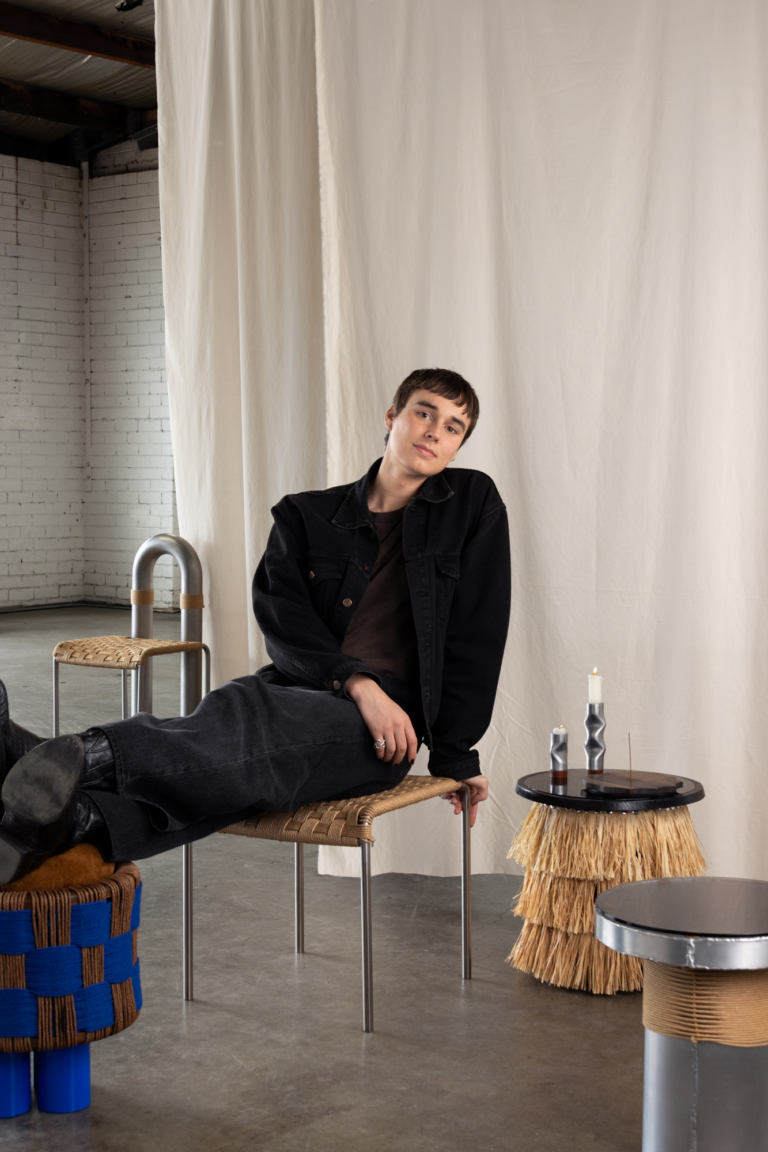
Locki Humphrey
Locki Humphrey’s innovative and playful furniture, lighting and objects continue to make a splash, landing them the top prize for Product Design in the 2025 (Emerging) Designer Awards.
What do you get when you cross bright-blue ethernet cables, PVC pipe and fabric from the seat of a Melbourne tram? Locki Humphrey’s Button stool, of course. This outside-the-box design won the 2023 IDEA Award (Rising) in Object, Furniture & Lighting and exemplifies the designer’s eye for the experimental and surprising. Constructed entirely from discarded materials, the Button stool transforms what might otherwise be overlooked into something desirable, unique and greater than the sum of its parts.

Fast forward two years, and Humphrey is taking home The (Emerging) Designer Award for Product Design, presented by Artedomus and The Local Project. “Locki’s work demonstrates a fresh exploration of unconventional and sustainable materials. This bold combination of creativity, craftsmanship and originality distinguishes Locki as a rising force in design,” notes juror Thomas Coward, who also serves as the creative director of New Volumes.
Unconventional is certainly an apt descriptor for Humphrey’s work – but it could also apply to their somewhat sideways entry into design. They began studying neuroscience and archaeology at university before deciding, in their final year, that it wasn’t the direction they wanted to pursue. Around 2017, they were running a live music venue in Sydney and picked up casual work in an upholstery studio. “I got to see this little peek behind the curtain before I even had been thinking too much about the idea of design,” Humphrey says.
This experience proved to be formative. Working on the deconstruction and prepping of furniture, as well as prototyping with designers like Tom Fereday and Koskela, Humphrey gained a practical, hands-on understanding of how objects are made. From there, they studied industrial design at TAFE before relocating to Melbourne at the beginning of 2020 – right as the Covid-19 lockdown struck. The timing, however, was “weirdly a blessing”. “I think I wanted a kick up the arse to get out of hospitality, and that was a good way to do that in having every single hospitality venue get shut down at once,” they say, laughing.
With this unexpected time to explore their creative side, Humphrey began teaching themself 3D rendering, creating designs and entering them into competitions and exhibitions. Unlike many designers trained in traditional sketching and model-making, this technique has remained a key part of their practice. “The way I ideate now and the way I concept furniture is still very much digitally… it helps me design a form without getting too hung up on the feasibility of it.” This drives the production of objects and furniture that feel unusual yet familiar, with playful proportions, material combinations or construction methods that deftly disrupt expectations.
“The way I ideate now and the way I concept furniture is still very much digitally… it helps me design a form without getting too hung up on the feasibility of it.”


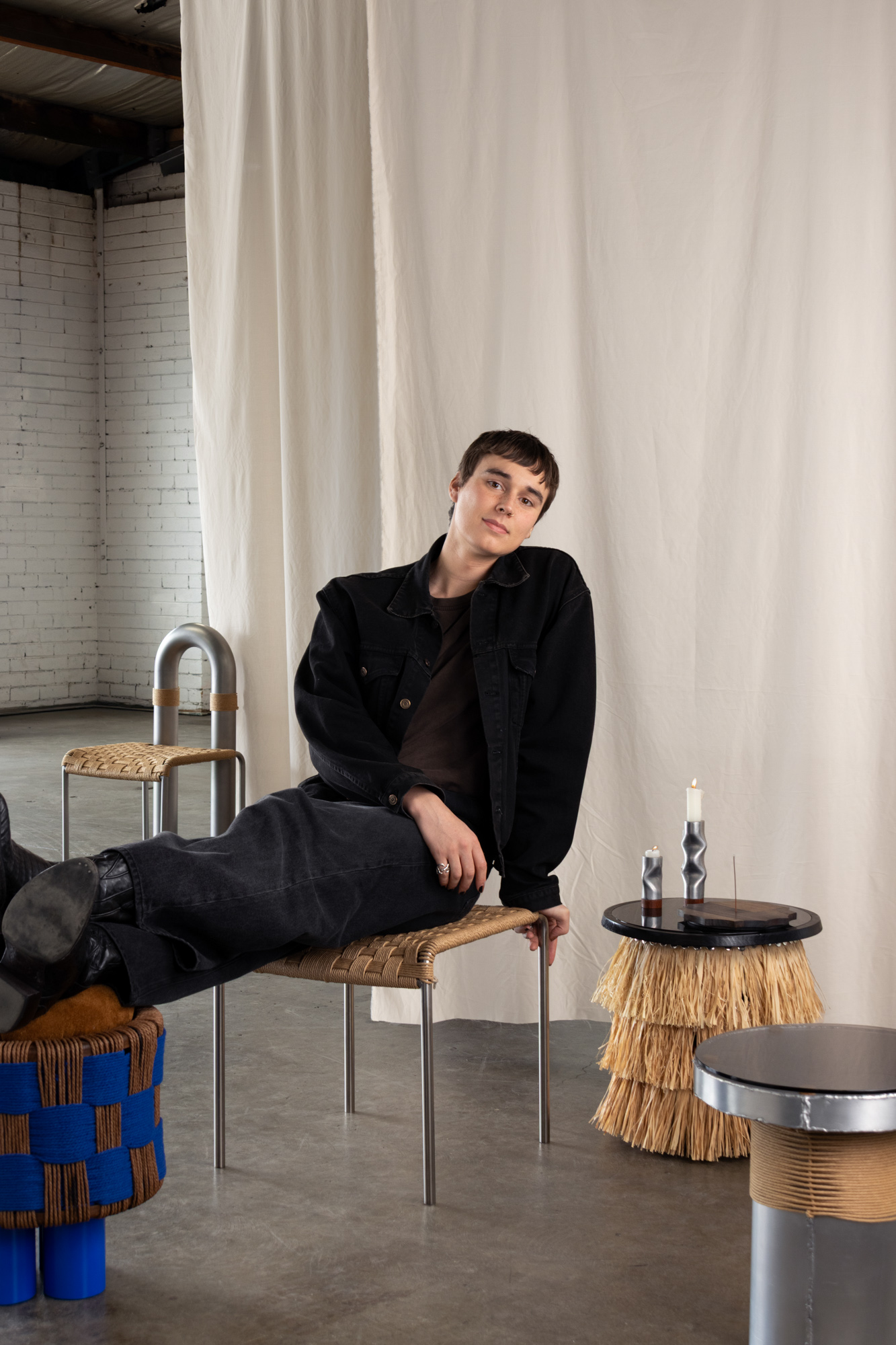
Materiality is always at the forefront of any project. “I usually start from materials… design within limitations produces the best results.” This often leads to unexpected pairings: industrial steel with organic fibres, glossy finishes against matte textures, rigid frames softened by tactile surfaces. Their Body & Soul table – topped with smoky glass and skirted in tiers of rustling dried raffia grass – is a great example of this. The tension between these elements is deliberate. “I really like that push and pull of the contrast, and having that element of tactile curiosity to it draws people in.”
Woven elements are another recurring motif in their work, emerging through a fascination with modernist Italian and Scandinavian design. Their first woven piece – the Bound chair, originally constructed from rebar and exhaust pipes bound with Danish cord – required them to learn the skill from scratch. This led to a material language that has since evolved across multiple projects, including a recent large-scale piece presented at Melbourne Art Fair’s inaugural design sector FUTUREOBJEKT. The decorative room screen crafted from over a kilometre of Danish cord reflects both a respect for historical craft traditions and a willingness to reinterpret them through new forms.
The decorative room screen crafted from over a kilometre of Danish cord reflects both a respect for historical craft traditions and a willingness to reinterpret them through new forms.
A commitment to sustainability and reuse is also at the core of Humphrey’s practice. They aim to build all of their designs around three pillars of sustainability: recyclable or biodegradable materials, local manufacturing and designing for disassembly. “If I design something and it doesn’t tick those three boxes, then I need to either rework it or abandon the design,” they explain. “It’s nice to have a guiding compass to keep me on track so that I don’t end up with an unwieldy, unsustainable beast.”
Nowhere was this more evident than in ‘Oxide’, a solo exhibition presented at Craft Victoria as part of Melbourne Design Week 2025. The show formed part of the By/Product series, which challenges designers to repurpose discarded materials. Humphrey developed a collection of furniture – including a lamp, occasional chair, coffee table and wall work – constructed from remnants such as industrial steel and textile waste. It also introduced a new material into their repertoire: a leather alternative derived from prickly pear cactus, an invasive species in Australia.
They aim to build all of their designs around three pillars of sustainability: recyclable or biodegradable materials, local manufacturing and designing for disassembly.
Humphrey had previously discovered cactus leather through meeting with a designer in Guadalajara, Mexico. “I really like leather in general, but I have been vegan for years now. I’ve always had my finger on the pulse of research into alternative leathers just out of interest.” The material carries both cultural and environment significance, produced from food waste and embedded in local economies, while retaining the tactile and aesthetic qualities that make leather so desirable. As always, Humphrey pushes the bounds of form, with the Orville coffee and side tables fringed like the distinctive mask of country singer Orville Peck, while the Vault stool’s black cushion takes a leaf from high fashion with its corset-like closure.
For inspiration, Humphrey often draws from design history while remaining deeply connected to the contemporary Australian design landscape. “I really like to consume a lot of design history. I’ll see a certain form that I’ve never seen before and be like, ‘Oh, that’s interesting. How could that fit into this new material that wasn’t around then?’” The Melbourne design scene has also had a big impact on them in terms of community and support. “There’s a lot more people who are purchasing work from designers they’ve never heard of, and there’s a lot of sharing of knowledge across the industry. I think that’s just created a really robust and connected scene here.”
For inspiration, Humphrey often draws from design history while remaining deeply connected to the contemporary Australian design landscape.


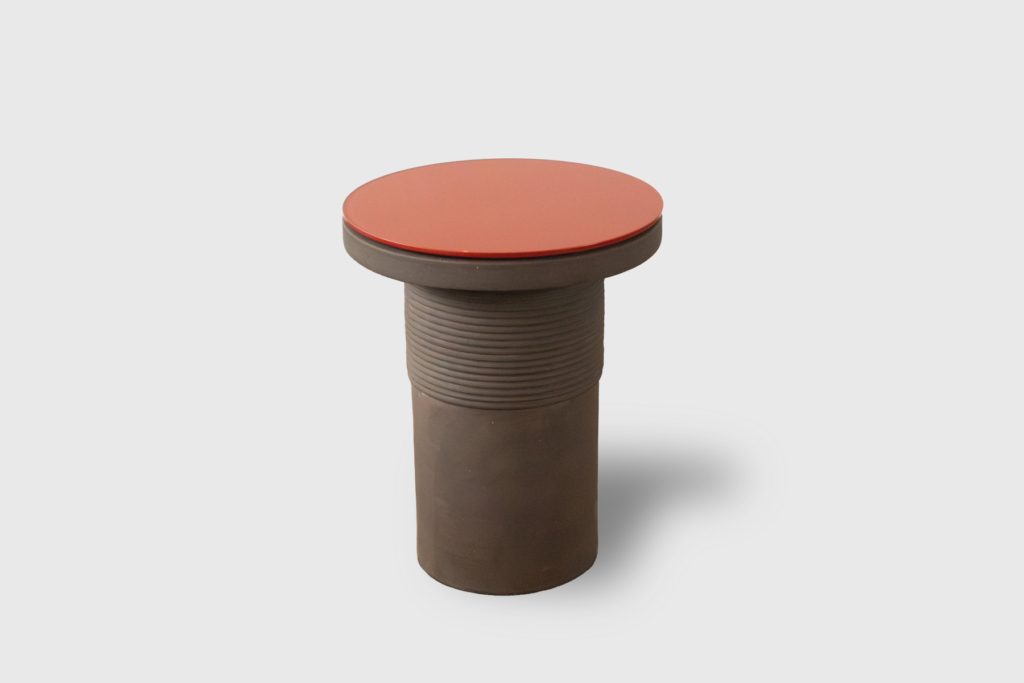
Looking ahead, Humphrey is interested in expanding both the scale and accessibility of their work. While collectible design remains central, there is a growing focus on producing pieces suited to broader commercial contexts. They are eager to continue collaborating with likeminded brands, building on the opportunity presented through The (Emerging) Designer Awards to develop work with New Volumes. “It feels like a big milestone… I want to spread the scope of what I’m producing.” The piece developed with New Volumes is an iteration of the Bound table, cast in Italian marrone terracotta with a hand-finished scalloped column and an optional glass top in hues of capsicum red, smoked or low iron.
Humphrey’s practice is ultimately driven by curiosity: about how things are made, how they might be remade and how objects can carry both history and possibility at once.