Te Whau
Starting with a lofty oceanfront site, Auckland studio Herbst Architects performed innovative architectural feats to maximise the water views in this stunning Waiheke weekender.
Perched high on a promontory, the location of Te Whau captures the feeling of being on the prow of a ship, high above the ocean. But while the site is a gift, the design of this home by Herbst Architects works hard to not only frame the vista but to deliver something delightfully unexpected.

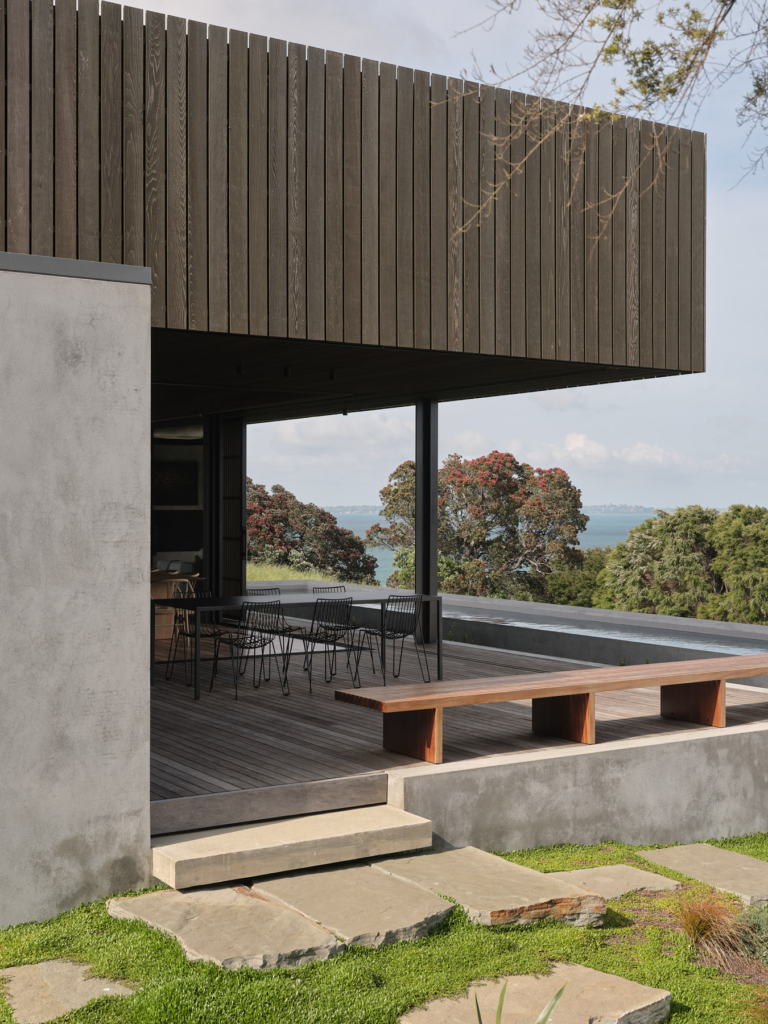
Perched high on a promontory, the location of Te Whau captures the feeling of being on the prow of a ship, high above the ocean.
Located on Waiheke Island, a short ferry ride from downtown Auckland, Te Whau was designed as a weekender – a holiday home with all the Kiwi bach-style simplicity that implies, but one that would be used more frequently and through all seasons of the year. “It’s very compact. As a practice, we believe in small buildings and we always try to size things to the smallest size – if possible – and with a weekender, you have the luxury of going small,” says architect Lance Herbst.
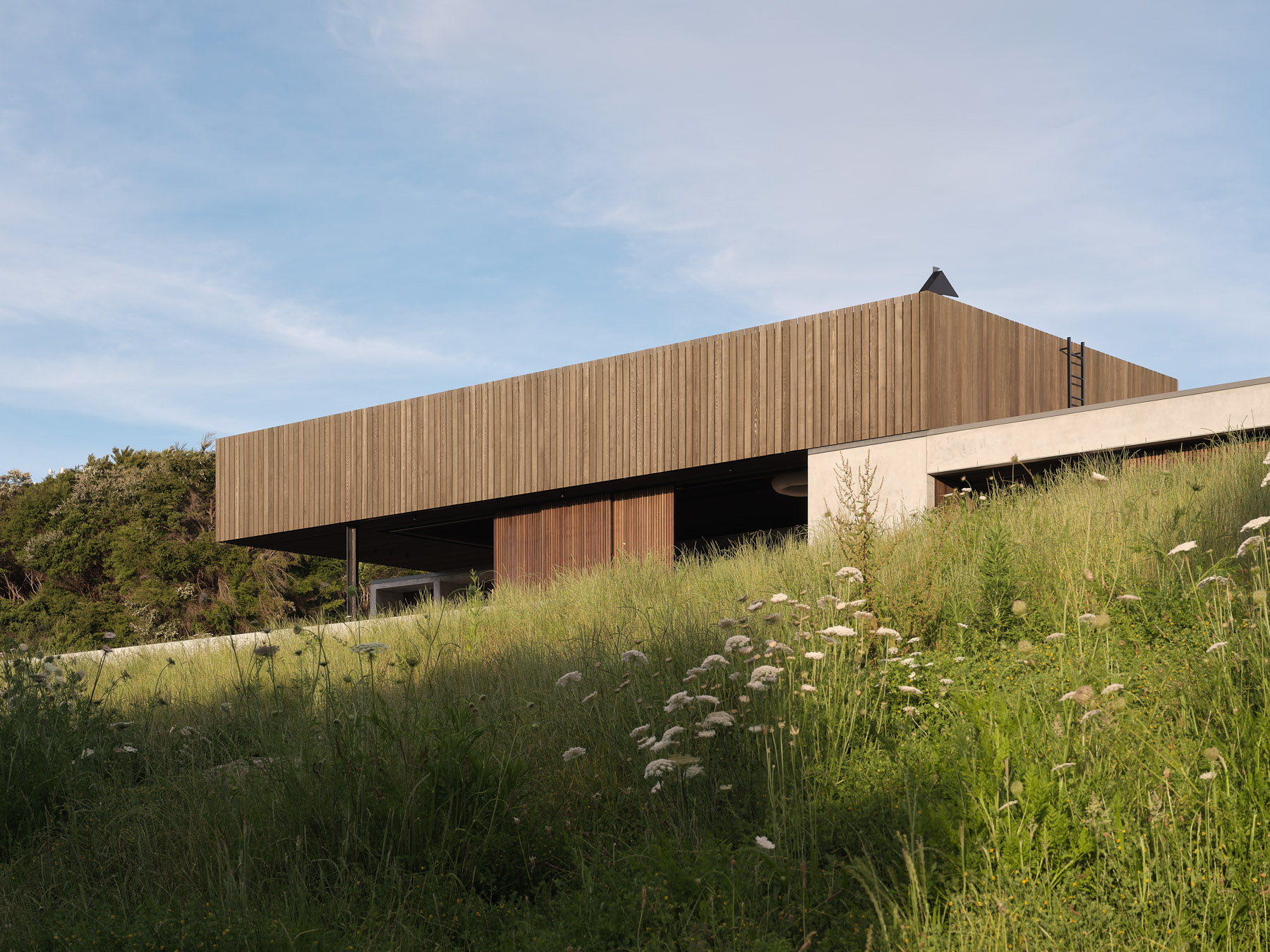
“The form of the building is quite elemental,” he explains. “You have two heavy, plastered masonry elements, which bed the building into the land. And then the roof element is like a light box, which floats over the top of them.” In a home that is all about light, views and embracing the wildness of the rugged location, these masonry boxes provide a solid backbone, anchoring the space in the hillside and providing a sturdy base to balance the negative spaces in the build – the barely there walls on the oceanside corner of the structure and the entrance point.
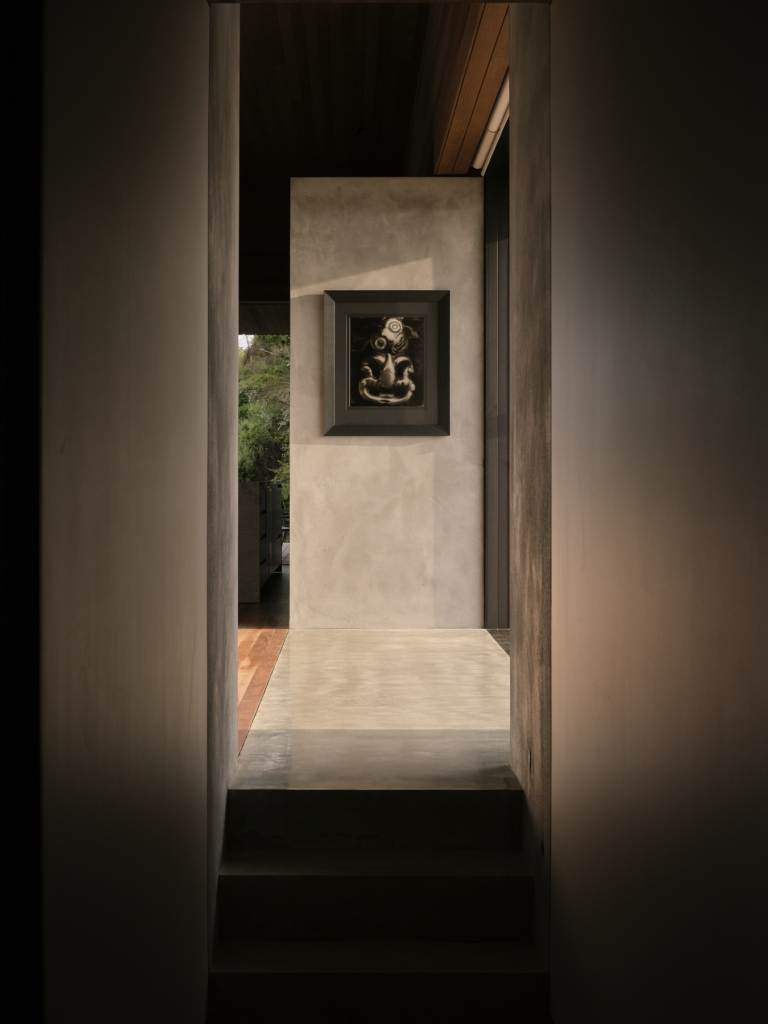
Te Whau’s entry is both modest and magical, a simple space between the two masonry blocks that reveals an iconic view. One arrives further back through a front gate and traverses around the solid block of the building, then with a magician’s flourish, the view is unveiled around the corner: a perfectly aligned picture of the volcanic cone of Rangitoto Island.
Making the most of the astonishing perspective was also, of course, the main motivation for the airy front corner of the build, which is walled by discreet sliding glass pocket doors. Also invisibly housed in pockets until needed are a series of timber batten sliders, primarily designed to temper the challenges of the west-facing site. “The idea of those is threefold. Primarily they’re there to deal with the sun for an hour or so when it gets quite low and starts bouncing off the water – you pull those across and it takes the sting out of the sun for that period of time when it is low,” says Lance. They also act as windbreaks and further create a sense of cocooning intimacy. “It’s such an open area, but you can pull the shutters across and it gives you a sense of enclosure.”
The living space flows smoothly to the pool – at least at first glance. Lance’s vision for the pool was for it to appear as a seamless extension of the space, over which one could enjoy an uninterrupted ocean view – “water over the water,” he says. But achieving this fence-free view while satisfying New Zealand’s strict compliance laws took some tricky manoeuvring. Though it appears joined to the house at first sight, the deep box of the pool is actually separated from the dwelling by a narrow sunken fence and then accessed by stepping off the main deck, through the gate and up onto a raised pool deck.
The views from Te Whau extend well beyond the obvious, with the site’s leafy surrounds providing several notable moments of tranquillity. Architect Nicola Herbst describes the site as a “ready-made Garden of Eden”, with its lush tapestry of natives including “a fringe of pohutukawas, with views through the filigree of trees to the water below”. Landscape designer Jared Lockhart – a regular collaborator with the Herbst team – was tasked with building on this landscaping with a light touch, concentrating on informal planting that would preserve the contrast of wild foliage and the heavier blockwork of the house.
Lockhart’s landscaping and the existing foundation of ancient pohutukawas are viewed from surprising spots such as the shower. From the ensuite, French doors open onto a completely private courtyard, open to the sky and fitted with an outdoor shower. One can simply appreciate the heavenly blue above or open a set of timber shutters for a view to a magnificently lush pohutukawa tree. “These kinds of beach houses, it’s a place where you go for delight,” says Lance. “So we try and make a space where people can get outside in complete privacy.”
This vision of a space of simple delights also drove the material selection and the furnishing of the house, which is dominated by barefoot comfort – the delightful scratch of jute rugs underfoot and plush sofas one can sink into. The exterior materials are chosen to age gracefully with cedar cladding and cement plaster. “It’s not a modern plaster, it’s an old-fashioned one that will hairline-crack a bit, which is what we wanted. It’s got a sense of wear and weather about it, it won’t look pristine all the time,” says Lance.
These materials run seamlessly from outside to inside – the cement on key interior walls and the stained cedar on the huge, coffered ceilings – with the darker palette a perfect foil for the blinding sunlight outside Te Whau. Two statement Santa & Cole Tekiò pendants from ECC also float against the pop-top roof. “They hold their own because they’re quite muscular in their shape, but they’re made out of paper, so they also have a very soft and kind of feminine feel,” says Nicola. With these strategic design selections, plus the ‘peekaboo’ views of trees and sea, the compact build packs a mighty punch.