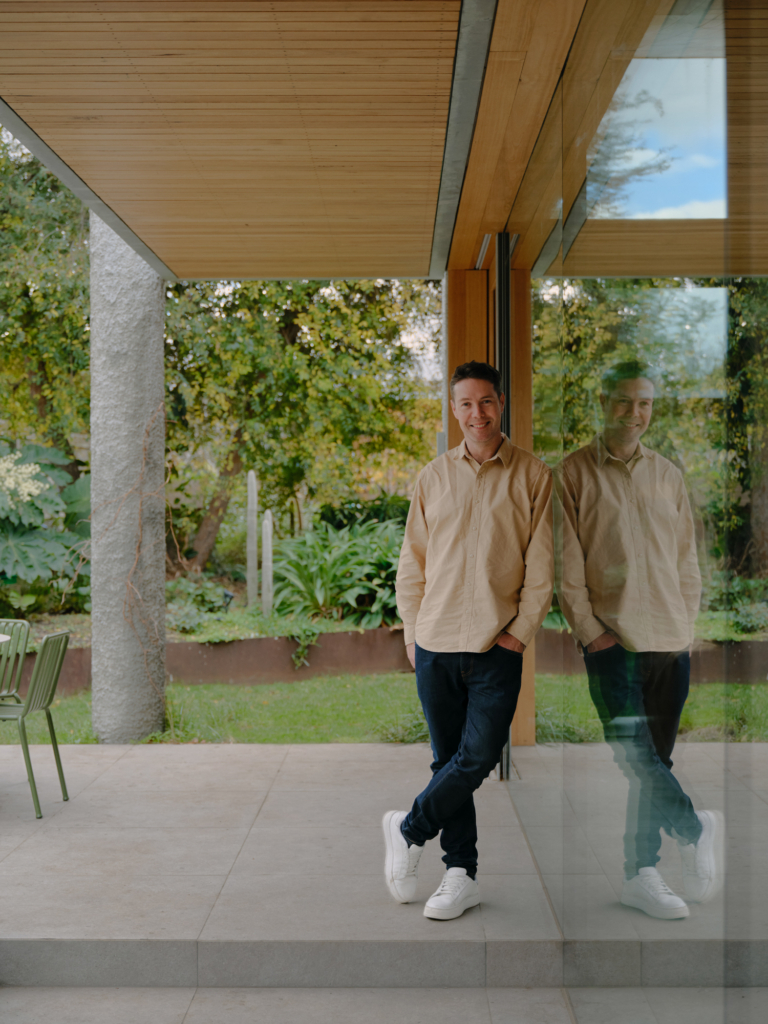
Chris Stribley
Devised as a permeable architecture, Harvest House is a testament to the romanticism of a natural landscape. Owner Chris Stribley, co-founder of Cera Stribley, has created a lush suburban shelter of dissolved edges, inviting nature to grow and take hold.
On the outskirts of bustling Melbourne lies a verdant pocket of respite and tranquillity, conceived by its owner-architect Chris Stribley as a place that transcends the norms of an everyday shelter by reaching deep into a plentiful landscape. This is a study of the personal relationship between protection and the natural surrounds – where the indoors evoke a calming retreat and thresholds surrender to a thriving garden. The architecture speaks to the finesse and imagination of an unconventional architect whose clarity of vision inspired curious iterations, backed by unwavering craft.

Embedded in an established streetscape of unassuming weatherboard worker’s cottages and deciduous plane trees, Harvest House presents an architect’s poignant love letter to the longstanding quarter-acre dream. “I grew up in the country, so I guess I’ve always appreciated that privileged connection to nature,” says Stribley. “I wanted to bring my own little slice of the country into the city – a place that I could go to reset and connect back to nature after a day’s work.”
Attracted to the potential of the sizeable plot, Stribley imagined a home that transcends the utility of mere shelter by heightening the experience of outdoor occupation. “Having lived in the house before its reinvention, I enjoyed watching the trees change and grow as the seasons turned, and the satisfaction I got from harvesting my own produce. This ultimately informed the direction for the project.” True to Stribley’s design sensibilities, the existing frontage is celebrated as an historical relic of the fabric of leafy Flemington, which is situated in Melbourne’s inner northwest. Neatly concealed behind this original cottage, a sweeping rear extension of warmth and permeability – the new construction is decisively bold and uplifting – becomes a functional viewfinder for outward vistas amid a sun-drenched living arena.
Devised as a compact home punctuated by pocket gardens and an outstretched central spine, the dwelling harks back to mid-century ideals in pursuit of a simple, refined authenticity. “I’ve always felt a particular affinity toward modernist Australian architecture. It prioritises simple forms, natural materials and site-responsive design – all things that I fundamentally value as an architect,” says Stribley. Approaching the design through the act of model-making, he sought a rear addition that would erode the feeling of physical boundaries. “Initial schemes weren’t feeling right. I kept trying different variations – trying to minimise the footprint, maximise natural light and all that – and then I rotated the addition by 90 degrees, and it all clicked,” he recalls. The outcome was a smarter-working, smaller footprint with connection at its core. “I didn’t want a big house. Instead, I wanted to maximise the garden and to blur the boundaries between inside and out.” Toying with the interplay of positive and negative space, solid stucco masses meet deep, shaded recesses in a dance between solidity and ethereal openness, elevated by a soaring concave canopy roof over the new backyard volume, reminiscent of Robin Boyd’s Walsh Street House.
Spatially, the dwelling is a fragmented collection of pods assembled around the cyclical rhythms of horticulture and lush vignettes. This transformative criterion bestows an enduring heartbeat of a deeply personable architecture where vibrance and sanctuary coexist. To the heritage volume, bedrooms and ablutions flank a central corridor axis for indirect daylight of an inward-facing agenda. An orderly study surveys the peripheral streetscape through an unkept front garden of low-lying succulents and rescued cacti. Approaching the rear, a singular step delineates old from new, flanked by a compact primary pavilion wrapped snuggly around a thriving central void. “One of my favourite views throughout the entire house is standing in the primary ensuite, looking through the atrium, across the hall and into our young daughter’s courtyard,” muses Stribley. “It feels like you’re in a jungle.”
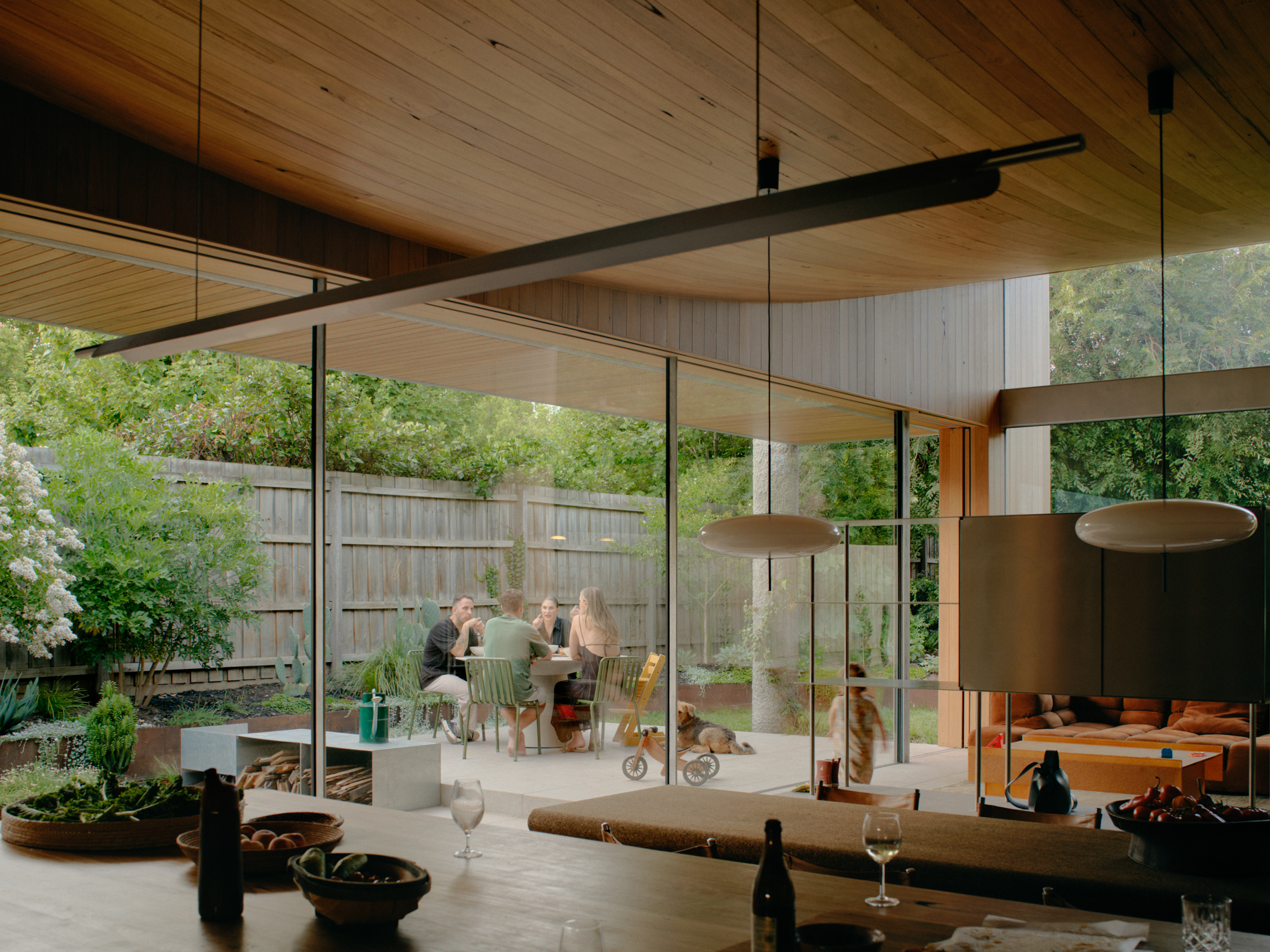
Arriving at the rear, a point of decision awaits: right, into the communal heart, or straight ahead, toward the garden. A reinvention of the sunken rooms of a mid-century vernacular, the timber-lined funnel extension signals the cooking and dining domain, instilling a sense of compression beneath a plunging roofline. “Tash [Stribley’s partner] and I love to cook. Collecting fresh produce from the veggie patch and cooking up a feast is part of our evening ritual,” says Stribley. “Having a kitchen that is open and feels connected to the rest of the living spaces was really important to us.”
Maintaining this visual link, a stainless-steel console becomes a multifunctional element, perched centrally atop a stepped floor plate as an informal demarcation to the lounge beyond. “During the build, I also joined a furniture-making course offered by the Victorian Woodworkers Association – something I’d been wanting to do for ages – which gave me a chance to pick the brains of the masters and to become more acquainted with the potential – and limitations – of the material,” adds Stribley. It was in this course that he constructed the island that now anchors the kitchen. Distinctly refined and brimming with character, such pieces throughout the interior serve to honour the art of the assemblage that imbues this humble shelter.

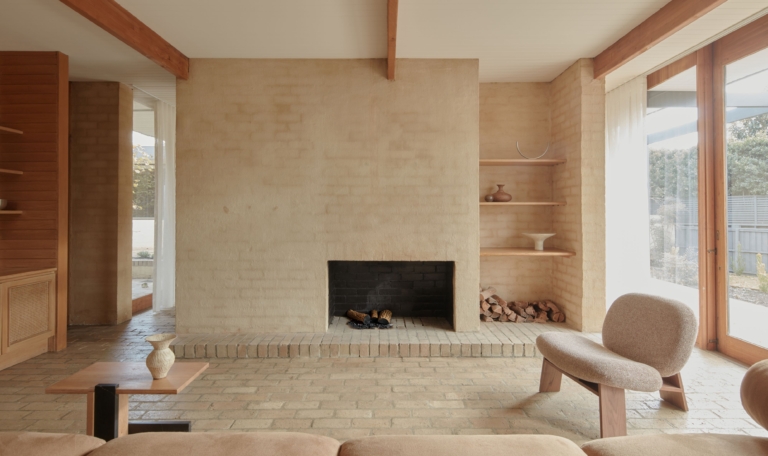
Materials are richly tactile and robustly authentic, evoking a natural quality that moves in harmony with the outdoors. “The transition between old and new is defiantly pronounced; engineered floorboards give way to decking timber, while plasterboard yields to textured stucco render. Suddenly it’s not clear whether you’re outside or in,” remarks Stribley of his unorthodox no-fuss selections. Acting as a palate cleanser, the heritage realm is markedly restrained to celebrate the ornate embellishments of the former century. Bold new insertions evoke a striking contradiction in courageous acts of play – like the rosso marble striations that engulf the main bathroom. A common palette of ochre, cork and burgundy adorns the rear addition, defined by a backdrop of Tasmanian ash and porcelain pavers underfoot. Slender metal frames soften thresholds, while doors retract into hidden pockets, ensuring constant outdoor engagement.
Anchored by a prominent Chinese elm, the expansive backyard is apportioned into a series of external spaces. Nearest the house, an alfresco terrace finds relative shelter within a private enclave, protected by borrowed vegetation along the neighbouring fence line. Beyond the enclosure, a generous lawn morphs into a garden abundant in fruit, vegetables and herbs, a defining household pastime. “It’s more functional than designed – focused on productivity over aesthetics – almost like a quiet back-of-house area for growing and tending, away from the more social parts,” says Stribley. Weathered sleepers, Corten steel edges and rugged concrete planes inject raw utility, in keeping with the language of the home. “I wanted to cultivate a space that feels a bit wild and natural – rather than perfectly manicured – giving the kids a place to climb, hide and imagine.” Community and solitude converge in this outdoor sphere, inviting leisure and repose amid the busy lives of the spirited family who reside here.


“I didn’t anticipate how much life would shift between planning the house and living in it,” reflects Stribley. “I was single when I first drew the plans. By the time Tash and I moved in, we had a baby – and now we have two.” Adaptable and permeable, Harvest House sits respectfully in the suburban fabric as an intriguing and ever-changing artefact shaped by both the world around it and the storied memories it holds.
Architecture and interior design by Cera Stribley. Build by Spire Projects. Landscape design by Chris Stribley and Eckersley Garden Architecture.