Active House
Designed to adapt to various modes of habitation and climate conditions, Active House by Panov—Scott embraces a simple architectural language that tethers its occupants to the landscape.
When one of the founders of Four Pillars Gin and his partner – also an early member of the founding team – approached Panov—Scott to design their family home in Sydney, it marked a deeply rewarding alignment. Having previously collaborated with Breathe on the Four Pillars Gin Distillery in Healesville and with YSG on its Laboratory in Sydney, the clients brought a deep understanding of the design and build process, coupled with a genuine excitement for conceptual thinking, engaging with the creative journey from the outset.

“They’re a high-achieving, intelligent couple who strive for excellence and know how to make a project happen,” says Panov—Scott director Andrew Scott of the qualities that mirror the practice’s cerebral, exacting approach to architecture. A highly engaged attitude enriched the project as a true collaboration between client, architect, builder, landscape designer and stylist – one that challenged all parties to push boundaries and deliver their best work.
Not far from Green Square and UNSW in Sydney’s inner south, the site sits adjacent to a regrowth bushland buffer at the northern edge of The Australian Golf Club, offering the benefit of space, vista and privacy. “We observed the context as strangely peri-urban,” says Panov—Scott director Anita Panov. “This wider contextual condition, a kind of inversion in which the natural landscape is newly remade adjacent to the 1909 subdivision with late Edwardian houses and stables from the early 1910s and ’20s, reinforced a continuing theme in our work: the entwinement of the natural and the artificial.”


Set in a heritage conservation area, the original four-room dwelling was largely intact, yet to a discerning eye, certain elements didn’t authentically reflect its original character. Panov—Scott respectfully renewed the home’s windows, doors, timberwork and slate front porch to strengthen its contribution to the streetscape. While the brickwork required restoration to enhance its condition and longevity, the design team eschewed traditional white mortar in favour of a red oxide tone that subtly echoes the brick’s historic patina.
A full-height door – likely added in the 1930s or ’40s when the house was divided into flats – was removed, replaced with a window where a sill forms a ledge for a desk in the study, with views across the garden. This careful stitching together of old and new is further expressed through the introduction of green glass accents, which draw the landscape into the facade and deepen Active House’s evolving story.


Inside, Panov—Scott refreshed the historic front rooms by polishing the original Baltic timber floors, meticulously restoring period details – such as decorative pressed-tin ceilings – and sensitively introducing new skylights and joinery insertions. The abode’s original layout remains largely preserved, despite the addition of a bathroom, which draws on a tonal palette of white wall tiles, biscuit-toned floor tiles and minimalist fittings to maintain cohesion throughout the interior. To the rear, substantial and poorly proportioned late 20th-century alterations and additions required a comprehensive reimagining – an opportunity for Panov—Scott to seize a new architectural language and facilitate a different way for the family to occupy space.
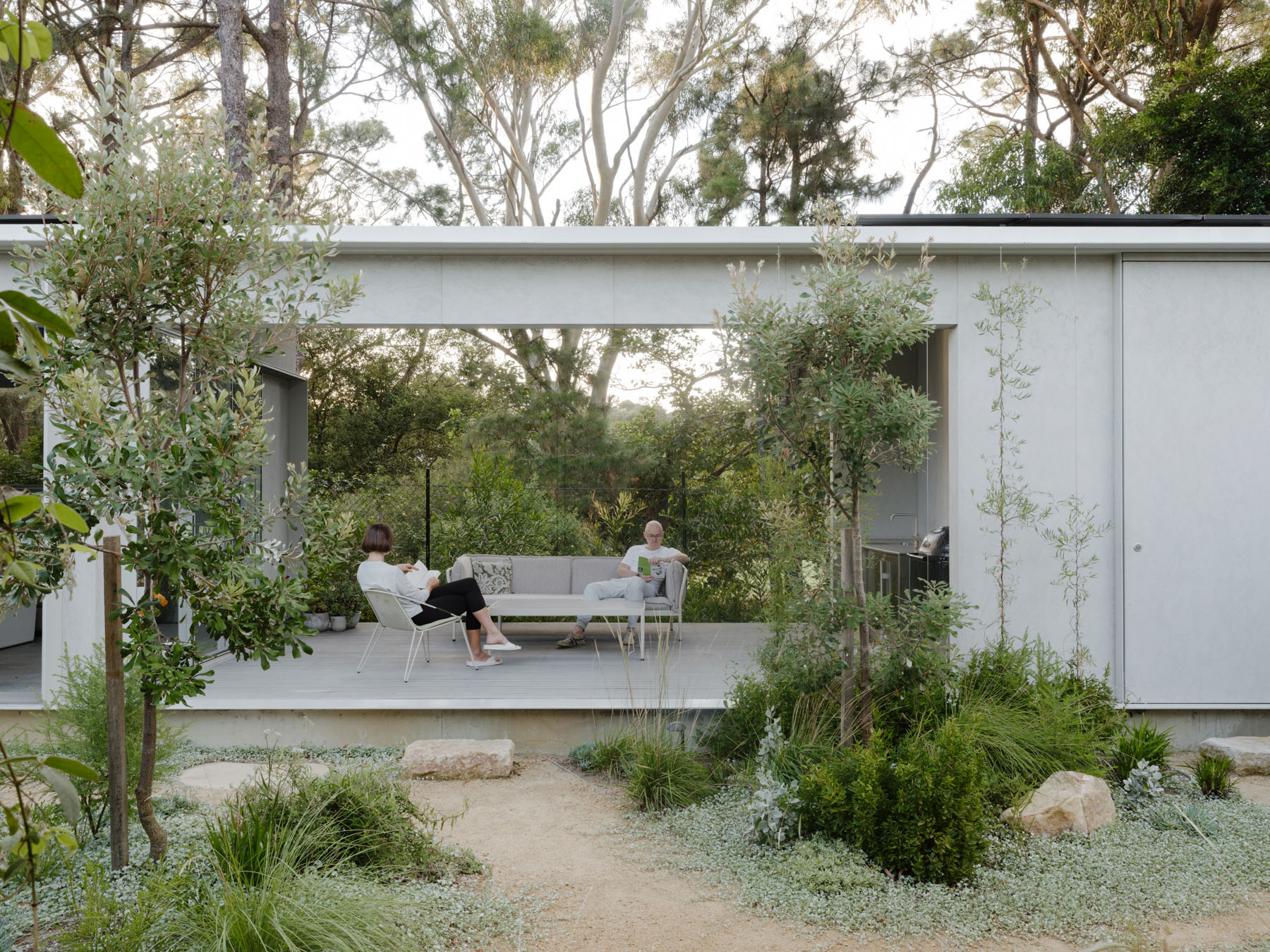
“If the tradition of the Federation dwelling is a series of rooms – ascribed a function and identity – for the family to inhabit, the intent of the addition is to make a simple, open space that embeds them in an ever-changing garden,” says Scott. The architecture adopts an archaic tectonic of floor, column and entablature. Columns hide window mechanisms and structure, while the entablature conceals upward-opening counterweighted windows and retractable blinds, allowing the building to transform into an open-air pavilion. “We are interested in an architecture that can be written – a simply scripted armature of repeating elements that anticipate adaptation on shifting timescales,” says Panov.
Active House responds to the site’s orientation, pushing the two-storey addition southwards to articulate an enclosed loggia that captures northern sun and, when the windows are raised, functions much like an extension of internal space.
The addition’s rear garden is equally connected to the interior and rear cabana – formerly an historic stables building – inviting a seamless occupation of the land. The upstairs main bedroom follows the same tectonic logic, drawing in natural light and breezes, with views across a roof garden to the surrounding rooftops and bushland.





This harmonious relationship is magnified by the beauty of the garden, designed by Emily Simpson Landscape Architecture, with planting by Garden Society. The garden’s unstructured quality evokes the sense of an architecture slowly yielding to nature, like a ruin receding into the landscape.
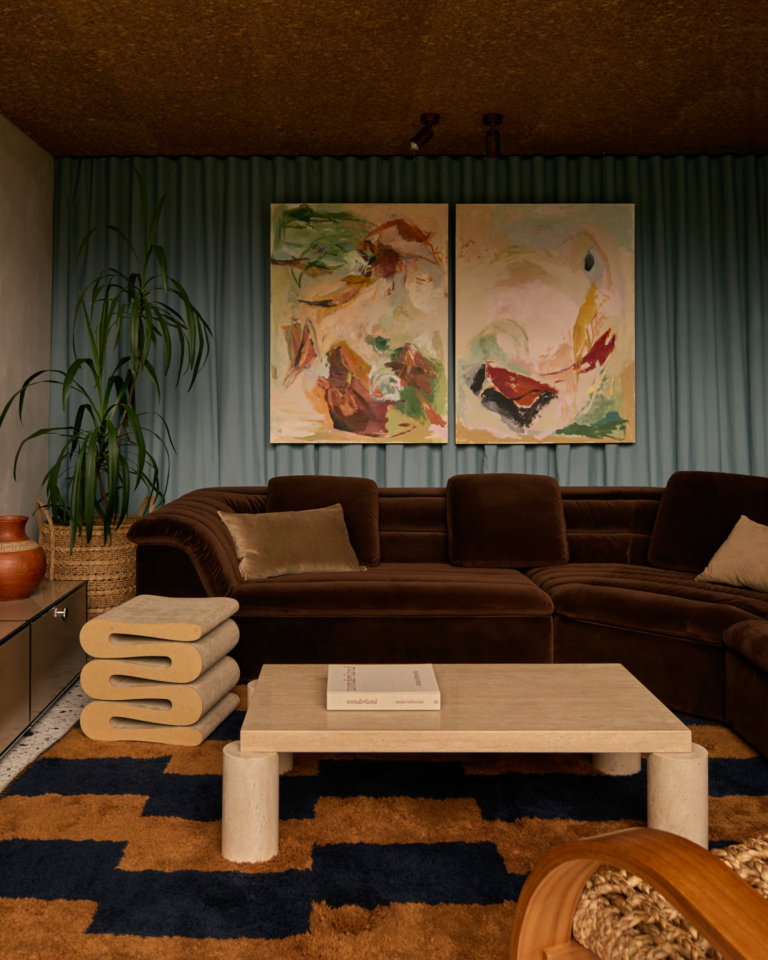
Likewise, the home’s furniture and decor, thoughtfully curated by Yasmine Ghoniem of YSG, bridges the architecture, landscape and patterns of daily life, layering Panov—Scott’s restrained interiors with warmth and eclecticism – a curious tension that speaks to the owners’ ease of living and passion for entertaining. “The house follows the notion of an architecture that can be made and remade by the people who live there,” says Scott. “We work so hard for buildings to look the way they look, but it’s always about how they function,” adds Panov.
With a focus on natural flow and easy connection to the outdoors, Panov—Scott has delivered a thoughtful response to site and brief, aligned with the aspects of daily life the clients value most. “If contemporary Australian domestic architecture is defined by the isolated pavilion within a dramatic landscape, this project stands apart,” says Scott.
Indeed, Active House offers a relevant model for our growing low-density suburbs, one that unites garden and built form through a courtyard typology, while helping to mitigate suburban heat, support habitat regeneration and enhance everyday wellbeing.
Architecture and interior design by Panov—Scott. Build by Promena Projects. Landscape design by Emily Simpson Landscape Architecture. Joinery by Jonathan West. Tiles by Artedomus. Appliances by Eurocave, Fisher & Paykel and Miele. Tapware by Astra Walker and Franke. Furniture by Cult, Grazia & Co, Hugh McCarthy, Jardan, Living Edge, MCM House, Remington Matters and Tait.