Homestead House
Nestled among pine and coastal scrub on the Mornington Peninsula, Homestead House by MRTN Architects is a warm homage to childhood memories of farm life in regional Victoria.
For the owner, the land has always held deep roots. She grew up here in a farmhouse built by her family in the 1970s, and decades later, that story entered its next chapter when her son became the builder who brought Homestead House to life.

Along the winding roads to the site, remnants of historic hearths and chimneys emerge from the landscape as markers of a bygone era. Antony Martin, studio director of MRTN Architects, recalls that these relics became “the visual touchstone and reference for the project”, inspiring a rammed-earth form that anchors the overall design. As construction unfolded, this element was the first to rise from the ground. During the time it stood alone on the property, it most clearly embodied the narrative from which it was drawn.
Once complete, this form becomes the entry point from which all other spaces unfold. Positioned at the intersection of two deliberately offset axes, it resists linear movement and encourages a more intentional passage through the house. Circulation is choreographed through moments of pause, compression and release, drawing people deeper into the interior while continually reconnecting them to the landscape beyond.


There is a clear sensibility toward landscape design across all MRTN projects, including Homestead House, underpinning the studio’s ability to adapt between rural, coastal and urban contexts. “The most successful projects have a landscape architect involved and work in partnership with us,” Martin notes. Rather than defining rigid boundaries between disciplines, he explains that MRTN is “quite happy to create a kind of blurred interface between those two parts”, often allowing the landscape architect to help shape the built elements closest to the house.
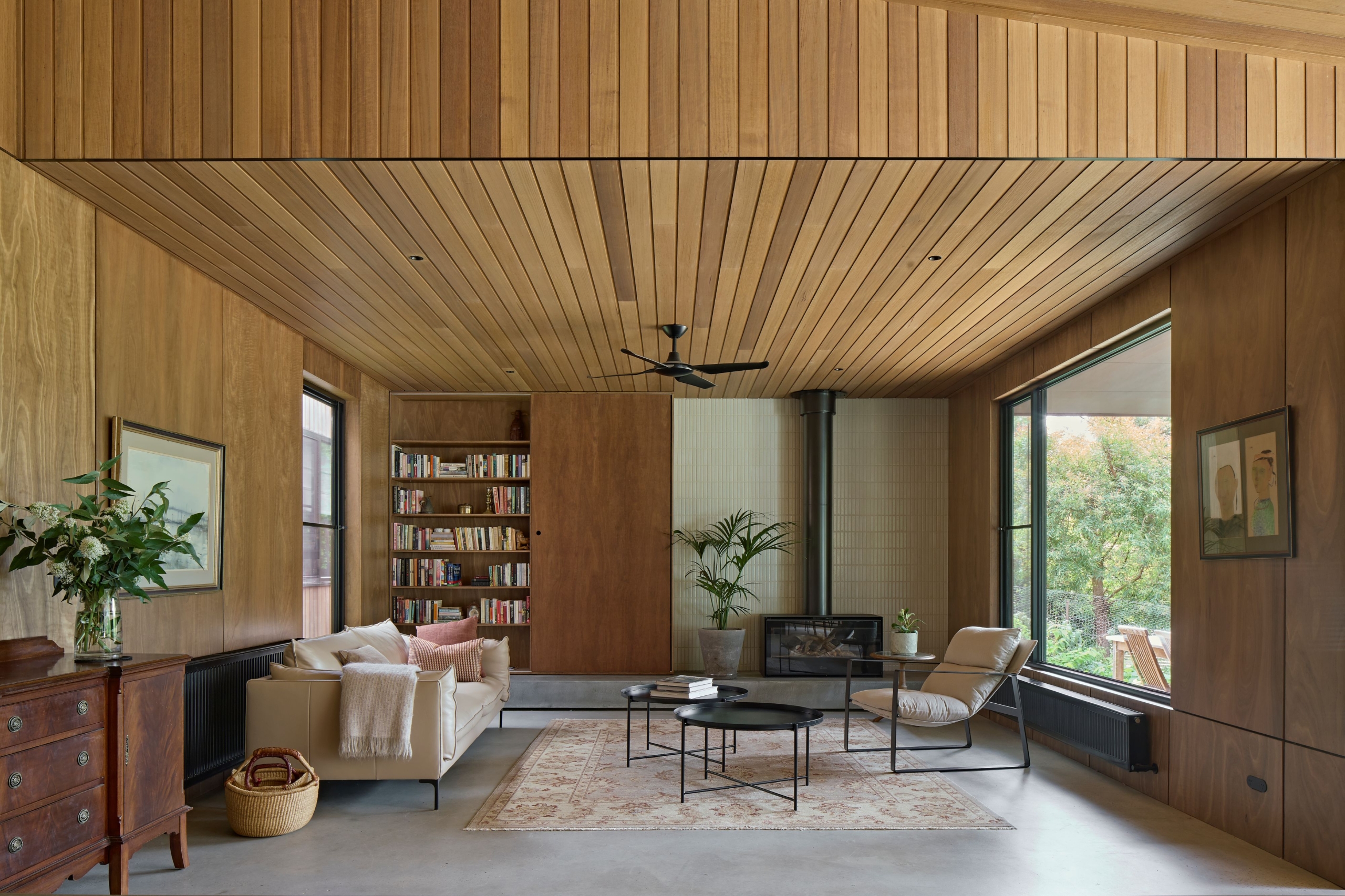
This blurred boundary extends into the material language of the project. Natural materials draw the landscape into the home, lending it a character reminiscent of Alistair Knox, a pioneer of site-responsive Australian architecture. Each space is saturated with an individual material, inviting occupants to slow down and appreciate subtle shifts in texture and colour. These materials heighten an awareness of light and shadow, introducing darker, more grounded moments that contrast with the abundance of natural light and create a sense of drama. More than a composition of materials, Homestead House is built from memory and a connection to place that will only deepen with time.