Leopold Banchini
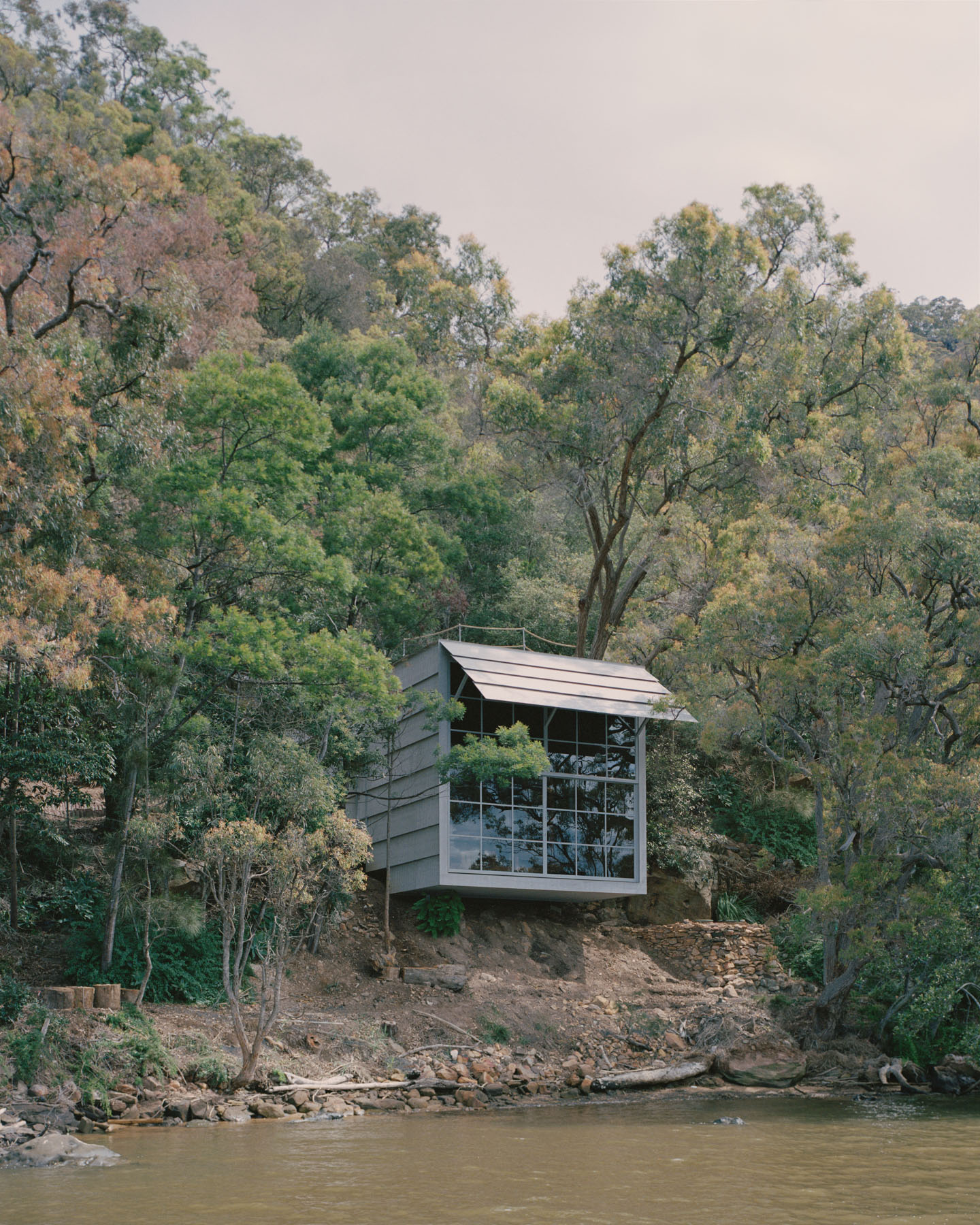
For Swiss architect Leopold Banchini, designing and building Marramarra Shack – a remote holiday home near the Hawkesbury River and his first project in Australia – was a study of provenance and place.
Building an off-grid shack in a remote part of the Australian bush wasn’t always on Leopold Banchini’s agenda. However, after following his wife to her hometown of Sydney, he felt compelled to design something informed by his new locale. “I had just finished a house for myself in Switzerland and, after meeting my wife, I decided to sell it and move to Australia,” he says. “So this project was a way for me to understand the local building culture, economics and permits, and create a place for us there.”

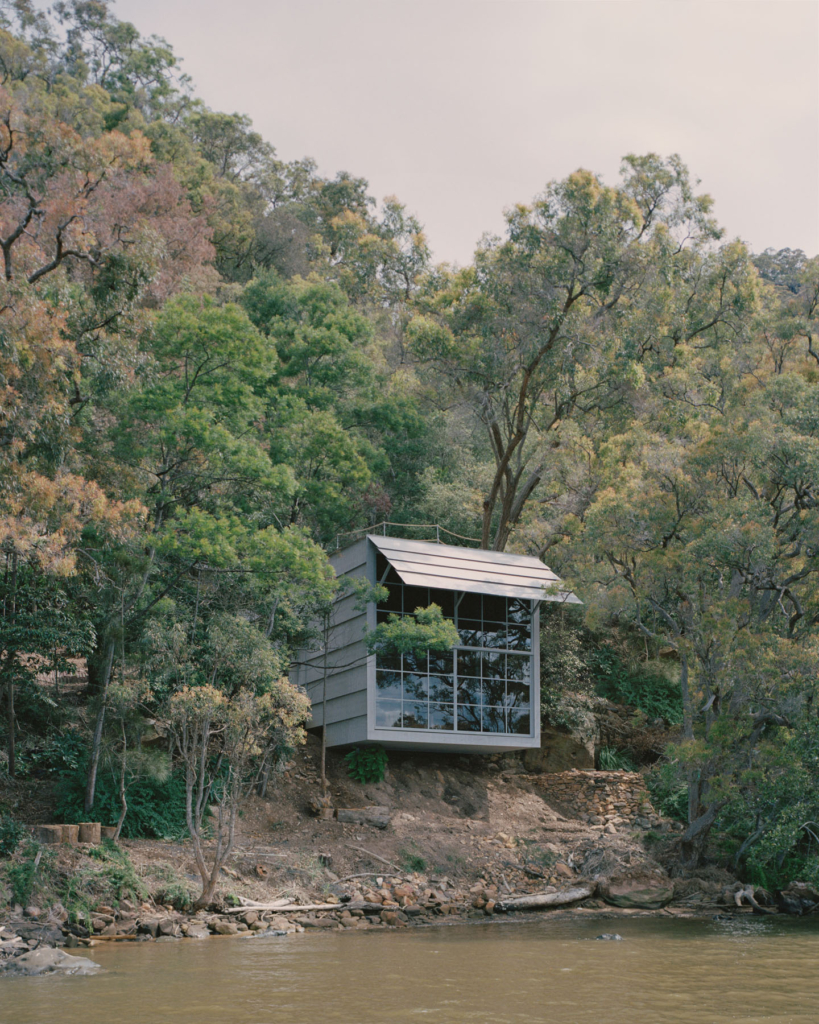
A competitive housing market and high land costs in the greater Sydney area led him further north to Marramarra Creek – a winding tendril off the majestic Hawkesbury River on the land of the Darug and Darkinjung people, about an hour’s drive north of Sydney’s CBD. The site he found – steeply sloping and only accessible by boat at high tide, with no electricity or water – had its challenges. However, Banchini was captivated by its secluded location, views and proximity to nature. “I really love the site because it’s close to Sydney but somehow extremely remote,” he says.
Banchini typically begins a project by educating himself on a site’s context, history and surrounding vernacular. “It’s important for me to start from a place of discovery – what exists there, and what is the local building culture?”
“I really love the site because it’s close to Sydney but somehow extremely remote.”
This involved research into the region’s Indigenous history as well an investigation into the evolution of local construction methods and materials. The other essential early consideration, he explains, is linked to regulations: this site had some of the most stringent, including bushfire, flood and conservation overlays.
Undeterred, Banchini pushed forward, enlisting the help of his brother-in-law and a friend, both carpenters, who subsequently lived on the river for six months while building the house. During this time, they immersed themselves in the small but vibrant Hawkesbury River community, dubbing themselves ‘river rats’ and joining the locals for beers after work on the banks of the region’s many waterways.
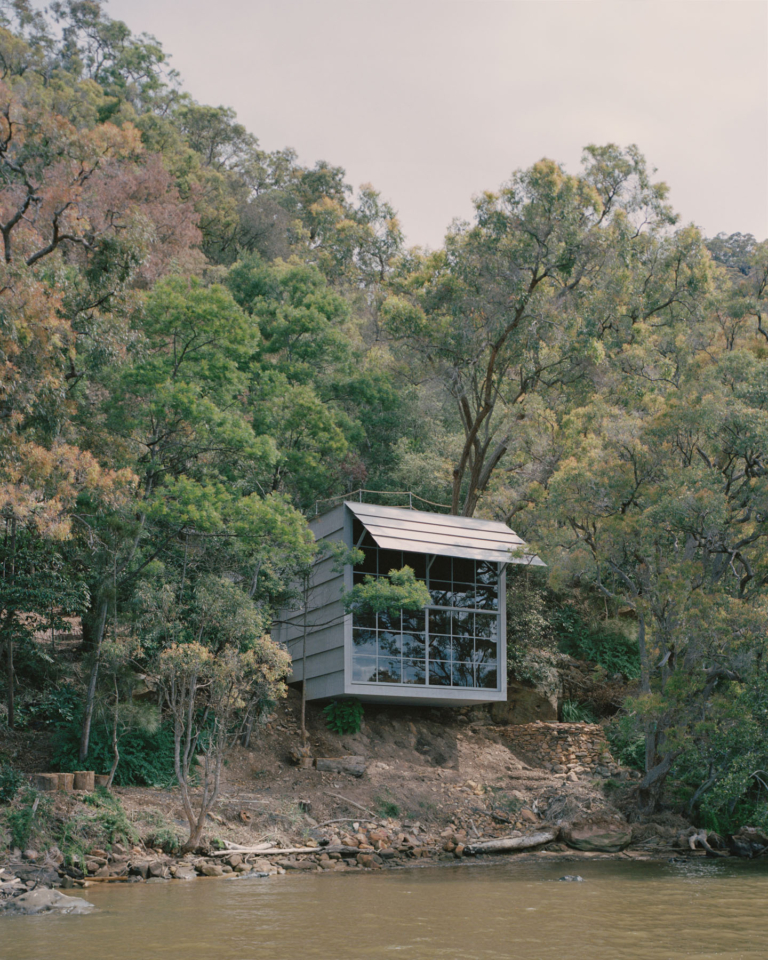
The project’s first phase involved constructing a rudimentary shed-like structure from which Banchini could work during daytrips from Sydney. Elemental and lightweight, the modest structure tucks into the hillside like a puzzle piece, its form following the surrounding topography and its tones reflecting those found in the landscape. As a prototype for the main house, it heavily informed Banchini’s approach. “It really allowed me to understand the site and its access better and also to test a few Australian materials and construction elements that I didn’t necessarily know.”
“It’s important for me to start from a place of discovery – what exists there, and what is the local building culture?”
The main house – similarly elemental in its appearance yet much larger and more complex – soon followed. Resolved in its reduced material palette of timber and fire-resistant fibre cement sheets and simple geometry, it is, in fact, a nuanced form that sits gently on the land. The footings are pinned to the underlying sandstone bedrock, eschewing the need for concrete pillars, and both solar energy and water are collected on the roof and stored on site, ensuring the house is completely self-sustainable.
The internal experience is guided by the form. The flat roof – there’s an open-air terrace within the tree canopy above – and tiered nature of the plan, which steps down with the site’s grade towards the creek bed, means the ceiling height increases as the home is traversed.
Each level responds to this, allowing the architectural framework to guide the location and dimensions of the rooms as well as that of fixed interior elements like cabinets and bench seats.
Elemental and lightweight, the modest structure tucks into the hillside like a puzzle piece, its form following the surrounding topography and its tones reflecting those found in the landscape.


At the rear, two small bedrooms, which face a planted courtyard, are tucked into the most condensed section of the home. A few levels below, the ceiling height increases. The shower sits beneath a dramatic void and, in the kitchen and living area at the front – where the home’s scale is fully realised – the ceiling height reaches six metres. Every space enjoys views to the water, made possible by the vast creekfacing wall-to-wall window, hand-built on site, which can be “split in half and hoisted upwards using counterweights”.
Banchini’s intent was two-pronged; although the home is designed to facilitate a deeper connection with nature – to be somewhere from which to escape the city and spend time on the water with his family and friends – it also needed to offer refuge and shelter.
“It was important to celebrate the view, but the environment is so wild that you want to be protected from it,” he says. Living among the wildlife has been humbling. “The birds and animals let you know it’s their place and that you should respect them, not the other way around.”
In this bush setting, where the natural environment plays the eternal leading role, Banchini’s thoughtful material palette feels entirely apt. Among these materials are various Australian hardwoods including ironbark and turpentine. Both have been repurposed – the former from 200-year-old electricity posts and the latter from an old jetty that previously stood on the site.
“The old jetty had probably been standing in muddy water for about 100 years, but when we scraped one to two millimetres off the surface of the wood, it was still absolutely perfect inside,” says Banchini. So impressed with its durability and drawn to both timber species, he used the ironbark pillars for some of the larger columns and the turpentine for various pieces of furniture and built-in elements. He also used spotted gum, which grows in the region, for the ceiling and floor beams, and plywood – an inexpensive material with high impact thanks to its deep, nutty stain – for the majority of the internal cladding.
Reflecting on his architectural response, Banchini says the design is the culmination of the site’s many constraints, from the limited access and harsh regulations to the steep topography.


Reflecting on his architectural response, Banchini says the design is the culmination of the site’s many constraints, from the limited access and harsh regulations to the steep topography. Executed with care, it is a place to engage with and retreat from the natural environment. He says it can take a few days to adjust to the extreme proximity to nature – the home is so close to the creek that, particularly at high tide, the experience of falling asleep to the sound of the waves lapping or glimpsing the glittering water from bed is akin to that of being on a boat.
Though he and his family have since returned to live in Europe, they frequent Marramarra Shack whenever they’re in Australia – spending afternoons with friends on the roof terrace or weekends exploring Marramarra National Park as a family. “We have two kids now, soon three, and it’s amazing for them to take a boat and go someplace where you have to be mindful of water and electricity. It’s quite sad in the sense that we never get to spend really long periods there – it’s always in holiday mode – but every time we do go, there’s something really magical about being instantly and completely remote and in another world. It’s an adventure.”
Architecture and interior design by Leopold Banchini Architects. Build by Urbon Constructions. Engineering by Cantilever.