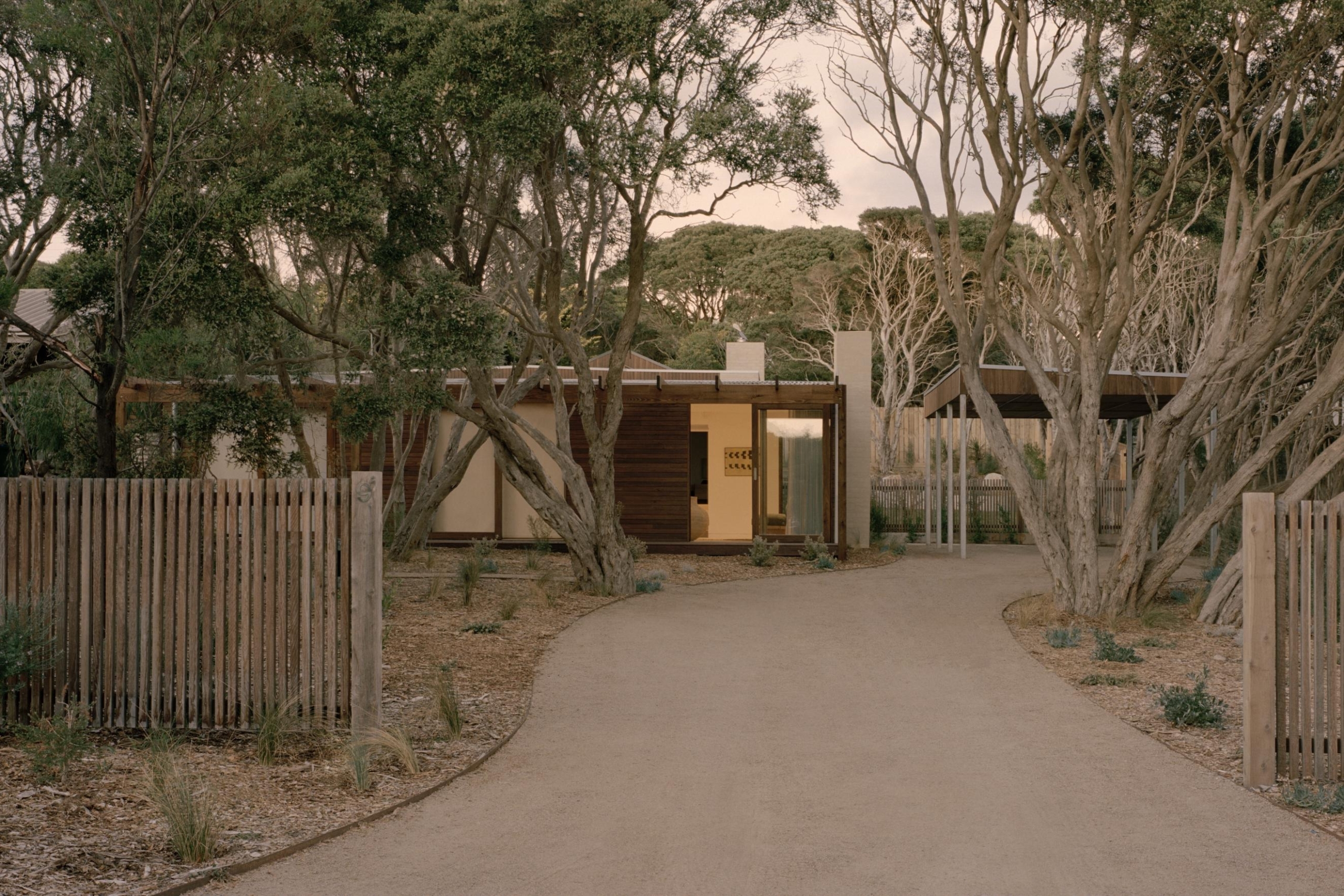
Marianne House
Through a careful extension, Victoria Merrett Architects has retained Marianne House’s mid-century coastal charm while updating and expanding it for modern living.
Preserving the 1960s structure was key to the design and formed the starting point for the home’s new addition – a necessary expansion to accommodate the client’s growing family. The new part of the home references the original wing’s vernacular – from its timber-lined walls and exposed rafters to its expansive brick fireplace – through a contemporary lens. These design cues are echoed in the extension’s solid blackbutt rafters and joinery, as well as the living area’s vaulted ceiling, stained in Cutek’s Walnut.

The original structure – which accommodates three bedrooms, a bathroom and a living space – remains largely untouched to preserve its mid-century character and the aesthetic typical of the Mornington Peninsula in the 1960s. While the core structure was retained, some interior walls were reconfigured to improve functionality and flow. Meanwhile, the new extension, positioned at the rear of the house, draws in natural light and opens direct views toward the garden and its Melaleuca trees. A light-glazed corridor connects the two wings, which, as Merrett explains, “acts as a gentle transitional link between old and new, maintaining separation while enabling connection”. The new wing houses the main bedroom, ensuite, kitchen, dining room, a second living zone, a powder room and laundry.
Fostering a sense of laidback coastal living was central to the expansion. Large windows invite the landscape in, while an outdoor bath and shower extends the home’s functionality beyond its walls. Sustainability was also a key consideration, with passive solar orientation, natural ventilation and energy-efficient glazing and insulation all incorporated into the design. “Retaining and adapting the original structure minimises waste, while the use of local, reclaimed and natural materials promotes environmental responsibility,” says Merrett.

The use of organic materials in neutral tones ensures the dwelling remains sympathetic to its coastal surroundings. The exterior is clad in Artisan Aurora bricks from Nubrik, paired with blackbutt shiplap stained in the same walnut hue as the vaulted ceiling inside. The same timber and finish are carried through to the doors and window frames, and a Colorbond Woodland Grey roof provides continuity with the light-toned brickwork.
Restraint underpins the design’s success. Light blackbutt joinery and Woodcut engineered floorboards in Perla add levity, offsetting the stained ceilings and rafters. Stainless-steel benchtops flow seamlessly from the kitchen to the living room, reinforcing the home’s calm atmosphere. Furniture boasting clean lines and soft tones further reduces visual noise – from the Mark Tuckey sofa, dining table and outdoor stools to the Hans Wegner Wishbone dining chairs – while artworks by Stefan Wirihana Mau offer gentle pops of colour.
By adding to rather than overhauling the original mid-century structure, Victoria Merrett Architects has preserved and enhanced the dwelling’s unique coastal character while adapting it for contemporary family life.
Architecture and interior design by Victoria Merrett Architects. Build by Momentum Building Group. Landscape design by Centred Landscapes. Artwork by Stefan Wirihana Mau.