Rosherville House
Embracing the project’s 1980s origins while reinterpreting it for contemporary living, Melbourne-based practice Kennedy Nolan achieves a thoughtful and grounded transformation of Rosherville House.
Set high on a sandstone outcrop on Sydney’s north shore, the project began with a solid 1980s brick-and-tile pavilion. Rather than pursuing demolition, the design team recognised the house’s inherent potential and adequate scale for a maturing family. So instead, their focus turned to improving function, atmosphere, spatial flow, privacy and thermal performance, while redefining the home’s textural and visual identity.

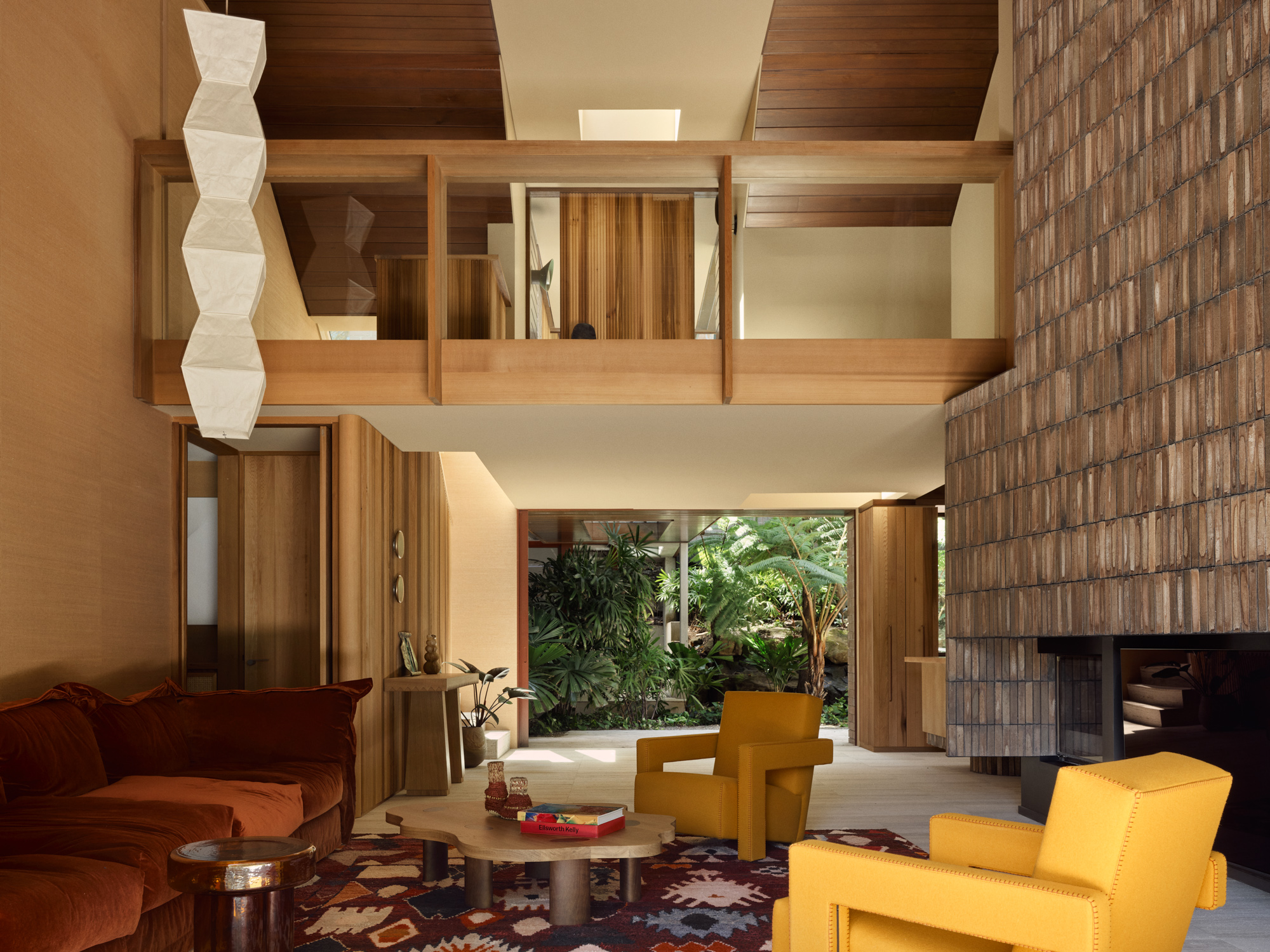
The existing house, though spatially awkward and materially bland, carried a distinct and promising architectural language. Kennedy Nolan’s response was to work with that identity rather than against it, cultivating a sense of resonance and celebrating the underlying strengths of the original design context. The defining materials – rich brown wire-cut brick, a dark glazed tile roof and raked cedar ceilings – form the basis for a renewed palette and a more coherent spatial order.
Key planning moves reinstate the clarity of the original pier-and-void structure, resolving circulation and introducing a deliberate sequence of thresholds that manage privacy and connection. The interiors now read as calm and unified, defined by natural texture and warmth. Travertine, raw clay tile, cedar panelling and tobacco grass cloth create depth and tactility, while muted tones of green, blue and umber add subtle vibrancy. A sculptural central form links the upper and middle levels, stitching together living, dining and kitchen spaces with a harmonious sense of continuity.
Previously generic elements have been reconsidered to add purpose and detail. Frameless glass balustrades, now set within cedar frames, offer both structure and tactility. Flat plasterboard surfaces were replaced or treated to introduce shadow and softness, while lighting is warm and diffused, balancing dimness with luminous moments that complement the materiality.
The connection to the exterior is equally resolved. Extensive landscape design by Dangar Barin Smith extends the architectural rhythm outward, establishing balance between interior and garden, and managing outlook, privacy and light with precision. For Kennedy Nolan, affirming this strong relationship to landscape is crucial to delivering architecture that embraces the complete context.
Through a series of considered interventions, Kennedy Nolan repositions Rosherville House as a layered, enduring family home. The home demonstrates the potential of working with an existing building fabric to create responsive architecture that is both sustainable and timeless – grounded in its place, uncompromising and deeply attuned to modern living.
Architecture and interior design by Kennedy Nolan. Build by Grange Building & Construction and Calibre Project Group. Landscape design by Dangar Barin Smith. Tiles by Artedomus.