South Coast Beach House
With picturesque views across a lagoon to the mountains beyond, South Coast Beach House transcends its immediate street context to offer an immersive experience of landscape within its meticulously crafted walls.
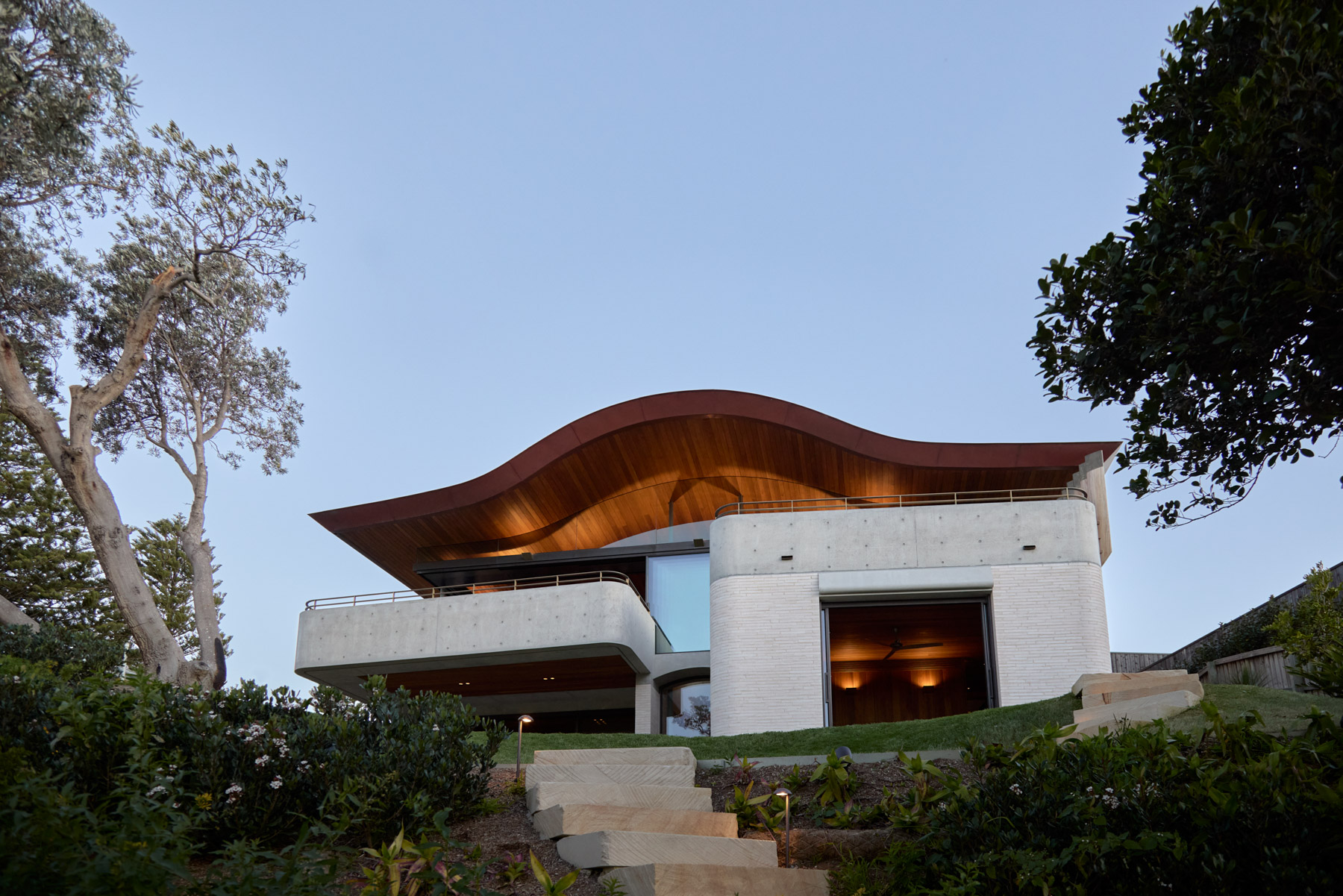
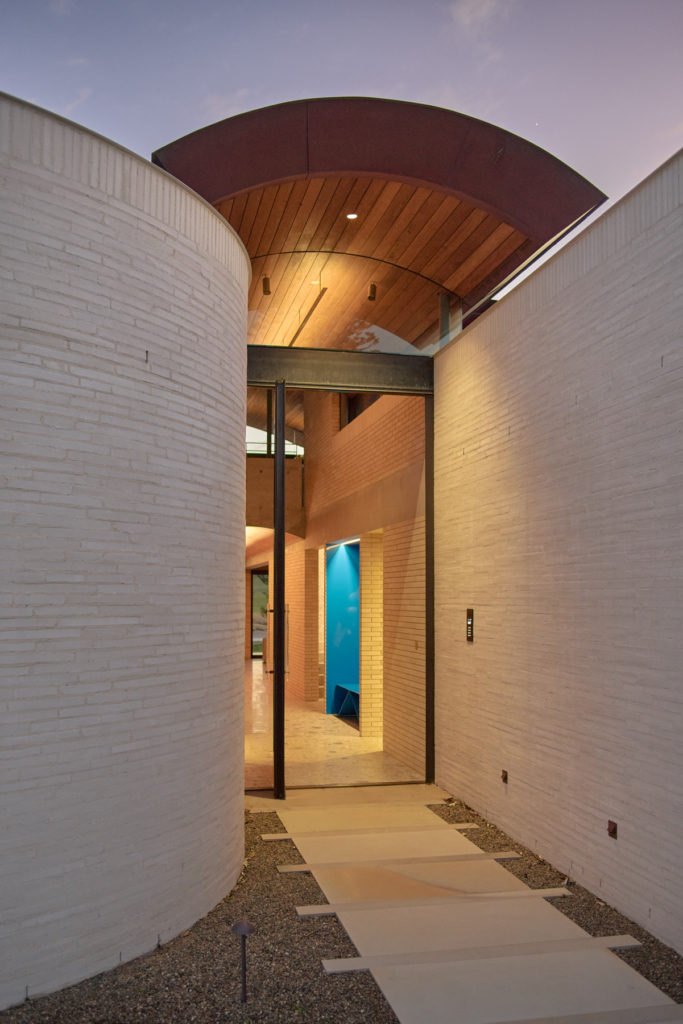
From the moment of arrival, South Coast Beach House begins to confound expectations. The gently winding streetscape could be that of any small Australian coastal town – a bitumen road flanked by wide grassy verges and rows of detached houses, from humble fibro shacks to much larger, more typical new builds. Into this familiar milieu, Casey Brown Architecture has inserted a building with a form that instantly marks it as ‘other’, its front mass broken down into two brick halves: one recognisably a garage, the other an intriguing round volume. Unusually, there are no openings to this frontage other than the main entrance. Stepped back from the facade, an undulating roof hovers above, indicating a second storey without imposing its presence. The result is a home that does not dominate the relaxed street context, despite its generous scale and robust materiality, and feels different from the neighbouring houses yet simultaneously at home on its site.

The cantilevered upper floor, meanwhile, rises up above earthly constraints to stretch itself out towards the lagoon and the Great Dividing Range beyond.
“It’s very much a building dictated by its constraints,” says project architect Daniel Weber. The brief was relatively open but detailed a home where the client couple could holiday with their extended family and also eventually move into permanently. As such, South Coast Beach House needed to accommodate many while also feeling comfortable for an occupation of just two. This necessitated both large spaces for groups and more intimate areas such as a generous main suite, as well as a number of smaller bedrooms and a bunk room. To fulfil this program, the design had to make the most of the available onsite space while negotiating setbacks and an easement. This resulted in an irregular building envelope and impressive feats of engineering to cantilever the second storey, so as not to place footings on the easement.
These challenges influenced the design for the better, reflects Weber. “It’s good to have some parameters to work with,” he says, and these constraints ultimately became opportunities. The side setbacks, for example, meant that, while only the main suite has a view over the lagoon, the relatively tight site didn’t push the other bedrooms right to the boundary. Rather, the side setbacks were used as landscaped passages that provide verdant views and northern light to each of these ground-floor bedrooms. The cantilevered upper floor, meanwhile, rises up above earthly constraints to stretch itself out towards the lagoon and the Great Dividing Range beyond.

For a house that has almost no apertures visible from the street, the views come as a surprise. Weber describes South Coast Beach House as an “interior building”, in that the architecture is perceived from within far more than it is experienced externally – the front elevation gives little away, and the rear elevation would be visible only from the lagoon. Yet it is also a building that seems to place its inhabitants in the landscape; a carefully orchestrated experience of the outdoors is key to its interiority. Stepping through the front door, one looks down the hallway straight out to the lagoon immediately over the rear boundary. Upstairs, the full panorama is experienced in a jaw-dropping moment of reveal.
Entering this elevated living pavilion, the neighbouring houses are hidden from sight and all that is experienced is an immersion in the landscape – sunlight sparkling on water, green rolling hills dotted with grazing cows, the outline of the ranges etched against the sky. Fully retractable glazed doors make this upper level feel like an extension of the adjoining outdoor terrace. Overhead, the roof seems to hover weightlessly thanks to a 360-degree band of glazing separating it from the walls, supported only by ultra-thin columns. “You get little glimpses out at the sky or the mountains from different angles through this glazing,” says Weber. “Then when the sun is low in the morning and evening, it comes right through the building and you get these beautiful bands of light.”


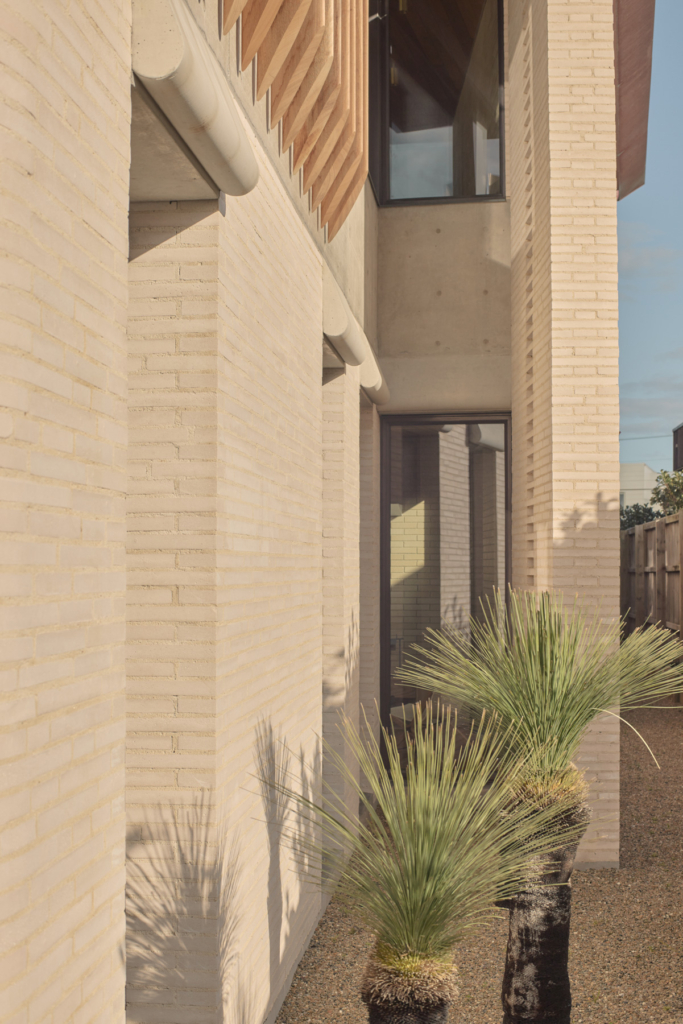
The team at Casey Brown Architecture oversaw both architecture and interior design, right down to designing much of the furniture and many of the key fixtures, such as the front door handle and built-in shower soap dishes. The unity of architectural and interior finishes, grounded in the practice’s emphasis on material honesty and connection to landscape, means that this interior building feels both experientially and conceptually cohesive. The interior hard surfaces – stone, concrete, brick and timber – either flow seamlessly between inside and out or feature the same material but with a subtle change. The bricks, for example, were selected after “a slightly deranged search of every brick supplier in Australia and not in Australia to find something that was not only beautiful and durable but spoke to the area,” says Weber. Externally, narrow cream bricks were horizontally laid, creating a soft, textural finish reminiscent of the nearby sand dunes, while internally, slightly darker face bricks with mortar joints half the usual width pick up the sand’s golden tones.
The interiors are not only made up of neutral hues and architectural materials, however. Empowered by the clients’ trust, Casey Brown Architecture injected moments of intense colour. The entry seat and alcove are coated with high-gloss blue automotive paint, also fulfilling the brief for a hard-wearing, robust building. The built-in bar is revealed to be a dark cherry red when the discreet timber door is opened, and red recurs in the light fitting and console in the main living space, this time in a tomato hue. Perhaps most unexpected of all is the lift, which is drenched in bright yellow – the client’s favourite colour. “It was quite hilarious. [During construction] I get a call from the site foreman saying, ‘There’s been a massive mistake; the lift’s turned up and it’s yellow!’” Weber recalls. “I had to reassure him that it was, in fact, correct.”
From these playful moments that enliven the interiors to the ambition of the engineering, the precision of the brickwork to the drama of the roofline, South Coast Beach House works across all scales to fulfil its purpose of becoming a building for the ages. Robust and enduring, it is a place of connection – to landscape and each other – for its inhabitants.