Conrad Johnston
For Conrad Johnston, founder and director of Sydney’s Studio Johnston, his family home in Balmain is the perfect encapsulation of his architectural ethos – robust, liveable and deeply connected to its surrounds.
Transforming an environmentally unsound, modestly sized two-bedroom 1970s semi on the waterfront into a sustainable home for a family of five and a set of in-laws, plus a cat and a dog, is a challenging enough prospect. But for Conrad Johnston, there were added layers of complexity when it came to creating what would ultimately become the award-winning SRG House.

To start, the property had heritage restrictions. Then, the land beyond the site was steep as it edged closer to the harbour. And the dwelling wavered between solidity and decrepitude – the timber cladding and windows were beyond repair, while the flat roof was completely uninsulated. Meanwhile, almost half of the bottom level was taken up by the mechanical plant of a commercial air-conditioning system, necessary because, with few opening windows, the property suffered immeasurable heat gain in summer and heat loss in winter. An unsympathetic double-brick garage had also been built in the early 1980s. Additionally, the house had once been the Sydney pied-à-terre of the esteemed Melbourne modernist architect Sir Roy Grounds – hence the SRG of its moniker – so architectural legacy was one more factor at play.
Johnston was undaunted. He and his wife, Katrina, had fallen in love with the house, drawn to its original bones and its enviable location on Sydney Harbour. Having something to work with, rather than starting from scratch, also held appeal. “On the one hand, you get a very strong initial direction because the house has a character that you want to work with,” he explains. “So we were able to develop what was there as opposed to walking onto a greenfield site and not having anything to work with or against. There were lots of things I liked about it, and then there were things I didn’t like about it – but that gave you something to change as well. In the end, I thought it was a good balance.”
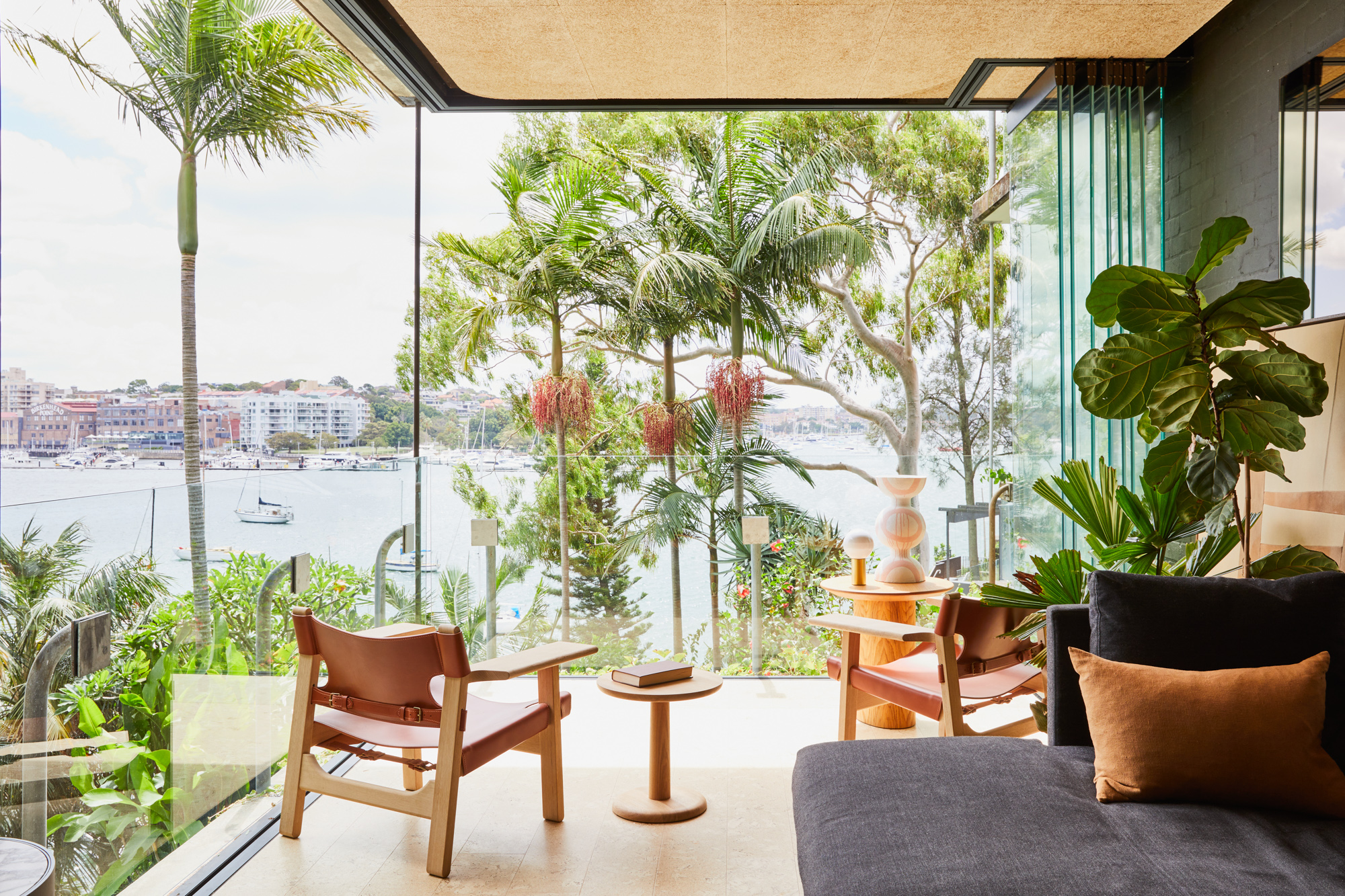
SRG House is a testament to his vision – and perseverance. The restoration began by stripping out dilapidated interior linings, revealing the concrete structure, and replacing windows with high-performance, timber-framed glass, including expansive sliding doors. The kitchen and dining room were opened up to a south-facing courtyard, resplendent with ferns, while a sitting room was raised up to be level with the courtyard to create a poolside rumpus room. The ground floor, without the air-conditioning plant, became two bedrooms for the Johnstons’ three teenage children. Finally, the garage was replaced with a new iteration, topped by a two-bedroom apartment for the in-laws.
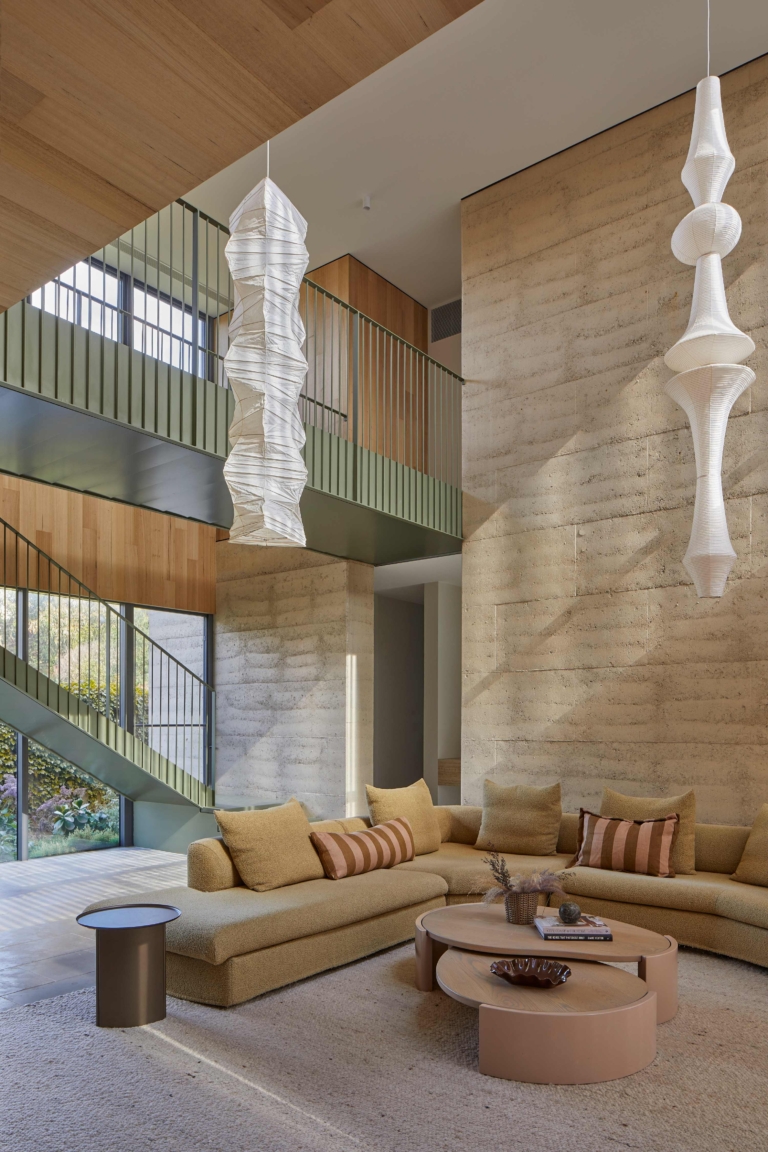
The result is a tall, lean three-storey home, strikingly contemporary yet with a material palette that harks back to its 1970s origins – think cork flooring, plywood joinery and red tiles that mirror those in an original bathroom. It’s been described as a ‘modern treehouse’: an accurate description of a residence where the line between indoors and outdoors blurs, with floors seemingly wholly comprised of floor-to-ceiling glass.
“The one thing about the house being very vertical and on a small footprint is that you end up with a lot of garden,” says Johnston. “The site is only about 500 square metres where we’ve put a two-bedroom apartment and the main house, but it still has a real sense of garden and wildness about the setting. I think that works with our ethos as a practice – bringing the landscape in. I grew up on Pittwater, which backs onto the national park, and I really like that sense of nature and water. I suppose everyone’s trying to re-create parts of their childhood in their life.”
The size of the abode is deceiving. “It looks big, but the interior is only about 180 square metres, which isn’t a lot for a four-bedroom house,” comments Johnston. “It’s actually quite small, which suits us, because we quite like small spaces.” It is not only relatively petite but also confusing at times, he admits. “The original subdivision [to create the two semis] has a zigzag in it, so it’s kind of odd, and you’re always changing direction as you walk through it.” He says he wanted to avoid the archetypal modern waterfront house “with two side walls and big glass facing the water. Here, it’s more like a journey that gives you little vignettes and different aspects of the view. The video The Local Project did on the house gets a lot of comments like, ‘I don’t understand this house,’ and people do get lost when they visit.”

Despite the complex floor plan, SRG House is very liveable, suited to life with three children, pets and extended family on site. For Johnston, liveability was a key element. “This was the second family house that I designed, and I think I made some mistakes with the first one – there was a marble bathroom, for example, that just didn’t work with kids. A lot of our clients are hyper-tidy people, but we’re a bit … well, let’s just say we have a big impact on a house. So, it’s a place you can live in with your kids without worrying about the marble – it’s a really robust, textural house.”
Being his own client makes for a very different design process, Johnston says. “You don’t have a brief as such. The brief is in your mind, and it kind of evolves; it’s never static. You’re always changing things on the basis of what’s available and you’re more able to suspend decisions. Whereas when you’re doing a house with a client, it’s very definitive. With your own house, it can be a bit more organic and dreamy, and you can let decisions hang until the right one crystallises.”



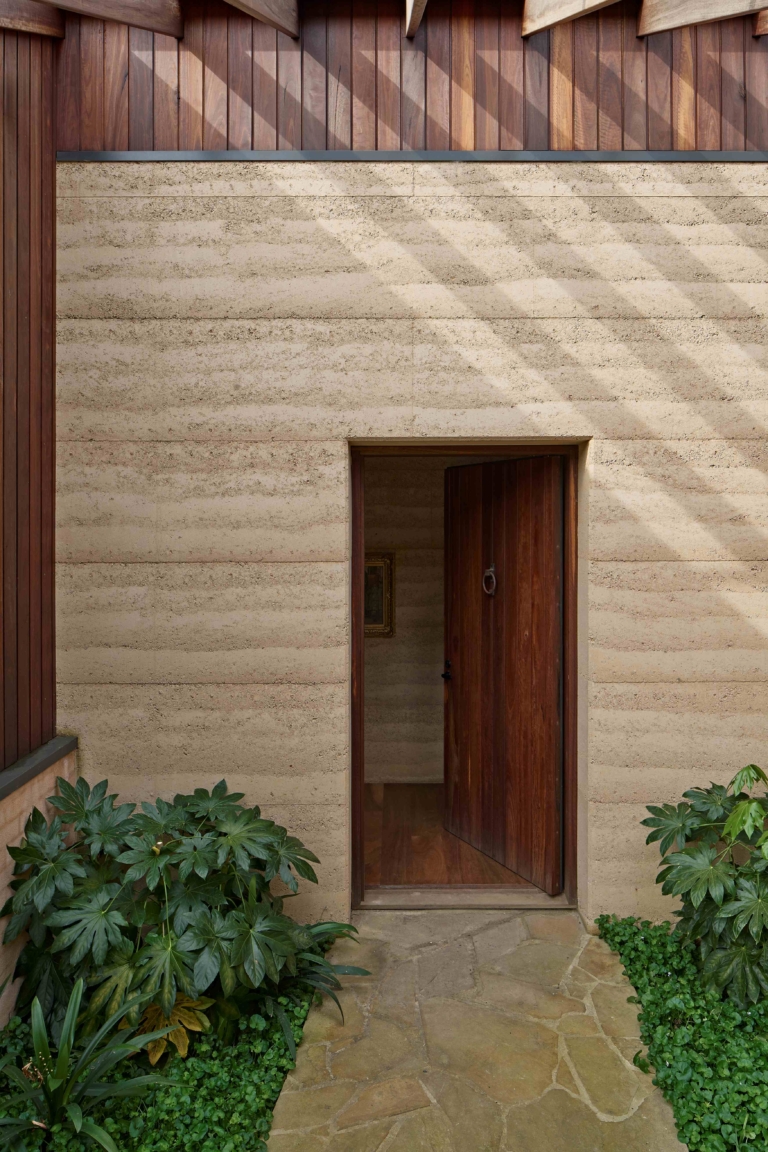
One example is the interior, he explains. “I had done lots of drawings, but everything changed because we kept finding things, and then we responded to that. When we pulled down the plasterboard, we discovered this raw, very textural concrete frame, and we decided to keep it. I don’t think many clients would like it because it has this quite rough texture.” The material palette kept changing, too. “A lot of the detailing was done onsite because I had that freedom. The builder was a friend and there wasn’t a formal contract, so it was a more intuitive process and that was the big difference. It’s actually the best way of doing it, but it’s hard to manage that on a client project because the costs are so sensitive.”
Working with family – ‘clients’ you know intimately – has its advantages as well. “You don’t have to ask, ‘Can we do this, or can we do that?’ You don’t have to do a factfinding mission on how people live because you know exactly how they live,” Johnston reflects. Bathrooms without doors are not an element he would consider for a client house, for example. But SRG House’s top-level ensuite is doorless, and the walls of his daughter’s bathroom on the ground level “don’t go to the ceiling, so when I walk past it on the stairs, I hear her singing in the shower. It’s very sweet.”
There was a distinct sense of freedom in creating his own home, although occasionally Johnston had to fight for his choices. “I have a very long-suffering wife who mostly lets me have my own say. But I remember having an argument with her when she wanted to get involved in choosing a tile. I said, ‘I just want to choose my own tile, just once!’”
Architecture and interior design by Studio Johnston. Build by SQ Projects. Landscape design by Dangar Barin Smith. Engineering by SDA Structures.