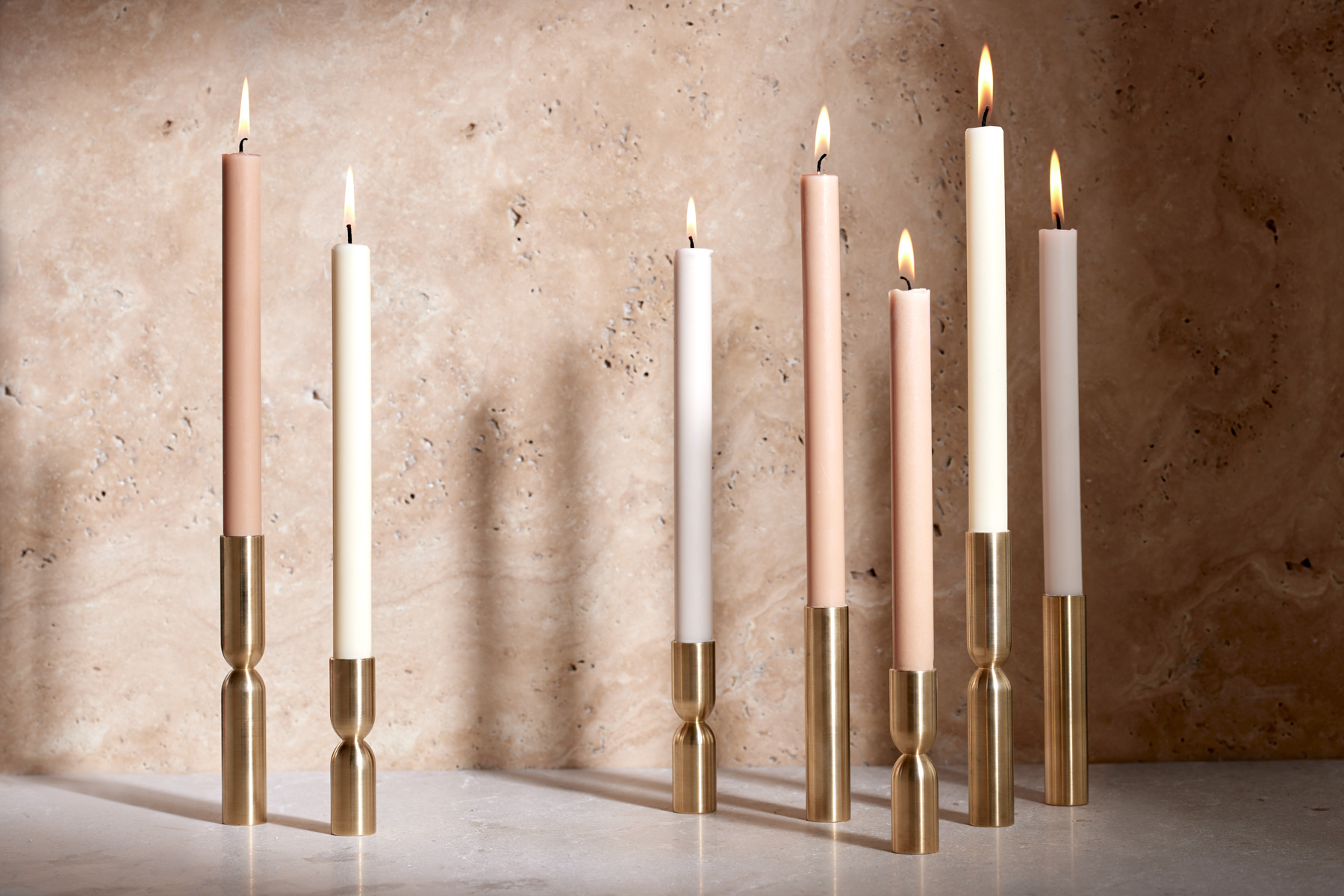
The Art of the Living Finish
AURUM Atelier designs candlesticks and incense holders in solid brass and silica bronze, built to patina, age and outlast trend cycles rather than follow them.
For Charlotte Guy, metal has always carried a particular kind of authority: strength, lustre and the promise of longevity. AURUM Atelier, the practice she founded, channels that instinct into candlesticks, incense holders and other metal objects, produced across workshops in Bendigo and Melbourne as a considered argument against disposability.
Guy’s path to metalwork began well before AURUM Atelier existed in its current form. Trained in architecture, she brings the same appetite for experimentation and process to smaller-scale objects, testing manufacturing methods as much as form. Her first AURUM collection was 3D printed in stainless steel, an early instance of a curiosity that continues to shape the studio’s direction as it moves into new techniques including sand casting and metal sheet folding. Production runs through a small team of metalworkers and casting specialists, with constant dialogue between them at every stage to refine detail and finish, whether a piece is turned on a hand lathe or cast directly in solid metal.
AURUM Atelier keeps no seasonal collections, a structure Guy treats as essential to the work rather than incidental to it. “I am not driven by trends, so there aren’t the external time pressures or deadlines that would ordinarily be imposed,” she says. “Our products are minimal in their design. However, achieving that sense of simplicity is actually very complex and time consuming. It demands patience; you cannot rush the process.”
“Achieving that sense of simplicity is actually very complex and time consuming. It demands patience; you cannot rush the process.”
Brass and silica bronze are left uncoated, so each object is free to develop a living finish rather than hold a fixed one. Surfaces darken, mark and soften with handling, evidence Guy reads with something close to attachment. “The more they have been handled and treasured, the richer the patina,” she says. “The use of the product leaves traces of the past, which can evoke memory and nostalgia. I love that a living finish can reflect the lives of those who interact with it.”
That approach sits deliberately apart from a market Guy sees as increasingly driven by immediacy, where mass-produced homewares move through households at pace. “I wanted to create something worth saving and waiting for, something with the strength and quality to transcend fashion, becoming an enduring part of the home.” Positioning AURUM Atelier outside that cycle – and outside the offshore manufacturing driving it – was a deliberate choice rather than a limitation.
“The more they have been handled and treasured, the richer the patina. The use of the product leaves traces of the past, which can evoke memory and nostalgia.”
Guy points to how people respond to the products on first contact as the clearest sign the philosophy holds. Handling a solid-metal object prompts an instinctive recognition of value, one that light, high-volume products rarely achieve. It’s proof that raw material, honestly used, still carries weight.


