Kailua House
Located on O‘ahu’s eastern coast, Kailua House by Mork-Ulnes Architects fuses the region’s traditional architectural vernacular with Californian and Scandinavian design principles.
From their offices in Oslo and San Francisco, Casper and Lexie Mork-Ulnes design to the tune of their respective Norwegian and Californian heritage with strong, site-specific references. Kailua House is the second residence they have completed for Anton and Bonnie Andryeyev and their family, who previously resided in San Francisco and have a lifelong affinity for Norway. This project presented a unique opportunity to bring together this legion of fortuitous, complementary touchpoints.

“Hawaii is wildly different to where we typically work,” reflects Casper. “It’s closer to the equator and it’s tropical, lush and green, with a consistent temperature all year-round, so it was interesting to use the same means and methods as other locations but in a very different environment.”
Designed to maximise the connection between the indoors and outdoors, while also capturing north-eastern views of the Pacific Ocean and the twin islets Nā Mokulua, Kailua House is defined by two pavilion-like volumes hugging a central pool. These two forms, which are painted green and enveloped by landscaping, are connected by a sweeping, crescent-shaped roof – the contour of which mimics the curve of the shoreline at nearby Kailua Beach.
Designed to maximise the connection between the indoors and outdoors, Kailua House is defined by two pavilion-like volumes hugging a central pool.
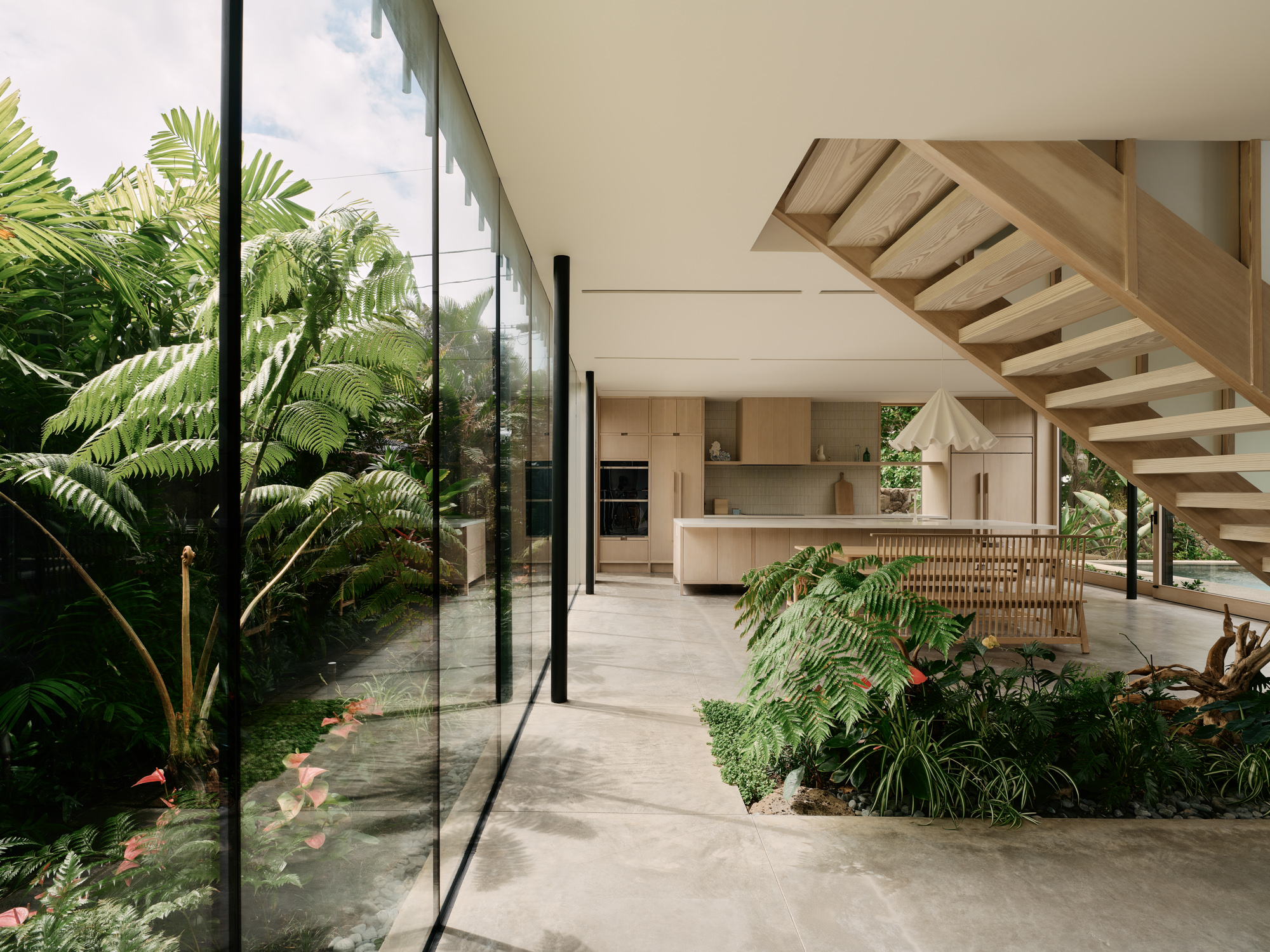
The primary pavilion is a two-storey linear form running the length of the rear boundary. On the ground floor, the open-plan kitchen and living areas are loosely defined, suggesting informal and fluid patterns of living guided by a love of the outdoors. Floor-to-ceiling glazing spans both elevations; to the rear, large windows frame “an incredibly dense, junglelike, verdant wall of plants that creates a buffer zone to the neighbours,” says Casper, and to the fore, glass sliding doors retract completely, dissolving the threshold and opening onto the swimming pool.
Though unexpected in a tropical context, the restrained palette of Douglas fir, concrete and light-toned materials speaks to the house’s strong Scandinavian influence. “With Bonnie’s love of Norway and appreciation for Norwegian architecture, we didn’t even have to discuss the palette,” says Casper.
Though unexpected in a tropical context, the restrained palette of Douglas fir, concrete and light-toned materials speaks to the house’s strong Scandinavian influence.
Notably, the timber has been finished with lye, a traditional Scandinavian treatment that “lightens and removes the yellow tones from pine and spruce, which are abundant in Scandinavian forests, giving the wood a warm, almost pink hue,” says Lexie. Nordic furniture and lighting appear alongside Isamu Noguchi’s Akari light sculptures, enhancing the home’s restrained and resolved design language.
The most compelling interpretation of indoor-outdoor living is in the single-storey pavilion on the other side of the pool. Inspired by the Hawaiian lanai – a covered, open-sided form – the main space includes a large outdoor living and dining area, plus a kitchen. There are three ancillary spaces (which are “more intimate and enclosed, as intended by their function,” says Casper), including an outdoor shower, a home office and a tearoom awash with natural sunlight.
The most compelling interpretation of indoor-outdoor living is in the single-storey pavilion on the other side of the pool.
Of the decision to include the lanai-like structure, Casper says, “we studied modernist and traditional lanais to try to understand what the space could be and developed our own Norwegian-Californian response.” He adds that “in Hawaii, you live as much outside as you do inside, so the use of this vernacular element to extend the program of the house itself into the garden, allowing the interior space to bleed into the lush exteriors, was the biggest driver for the design.”
This seamless blend between the internal and external defines Kailua House. Not only have thresholds been blurred and the presence of plants and light emphasised at every turn, the painted-green exterior is animated by batons that encourage the surrounding vines, a subtle design choice that will allow the home to recede into the natural environment.
“Throughout the hardscaping, there are pockets for plants to pop out, so it feels like the home is growing out of the garden.”

“It’s a combination of the vegetation, but also of the tectonics of the architecture to give this thorough, abundant experience,” says Casper. “Throughout the hardscaping, there are pockets for plants to pop out, so it feels like the home is growing out of the garden,” adds Lexie. The lanai-like structure also features a green roof, which helps to settle the volume into the landscape and also provides views to greenery from the bedrooms on the upper level of the main house.
Various elements enhance this effect within Kailua House, like the use of internal screens crafted from frosted glass and Douglas fir that allow light to travel across spaces, as well as circular skylights through which greenery snakes its way and a lush indoor garden that punctuates the polished-concrete floor in the shadow of the main building’s staircase. These details culminate in an inward-looking experience, where a sense of privacy and protection are prevalent, and the natural environment plays a deserving lead role.
Architecture and interior design by Mork-Ulnes Architects. Build by Concept 2 Completion. Landscape design by Terremoto. Structural engineering by Delta Engineering. Local design consulting by Fujita + Netski Architecture.